




Find the local maxima and local minima for the given function and also find the local maximum and local minimum \[f(x)={{x}^{3}}-6{{x}^{2}}+9x+15\].
Answer
 Verified
635.1k+ views
Hint: First we should find the differentiation of function f(x). Let us assume the differentiation of function f(x) is equal to \[{f}'(x)\]. Now we should find the value of x where the function \[{f}'(x)\] is equal to zero. We know that a function f(x) will have local maximum at x=a where \[{f}'(a)=0\] and \[{f}''(a)<0\]. We also know that a function f(x) will have a local minimum at x=a where \[{f}'(a)=0\] and \[{f}''(a)>0\]. So, to know the local maximum and local minima of function f(x) we have to find the\[{{f}^{||}}(x)\]. Now we have to substitute the value of x where the \[{{f}^{|}}(x)\] is equal to zero. This will give the local maxima and local minima of the function f(x). Now by substituting the respective values of x, we can get the respective local maximum and local minimum.
Complete step-by-step answer:
Before solving the question, we should have an idea on local maxima and local minima. By using this local minimum and local maximum we can find the values of local maximum and local minimum.
From the question, we were given that \[f(x)={{x}^{3}}-6{{x}^{2}}+9x+15\].
A function f(x) will have a local maxima and local minima at the value of x where \[{f}'(x)\]is equal to zero.
\[\begin{align}
& {f}'(x)=\dfrac{d}{dx}f(x) \\
& \Rightarrow {f}'(x)=\dfrac{d}{dx}\left( {{x}^{3}}-6{{x}^{2}}+9x+15 \right) \\
& \Rightarrow {f}'(x)=\dfrac{d}{dx}({{x}^{3}})-\dfrac{d}{dx}(6{{x}^{2}})+\dfrac{d}{dx}(9x)+\dfrac{d}{dx}(15) \\
& \Rightarrow {f}'(x)=3{{x}^{2}}-6(2x)+9+0 \\
& \Rightarrow {f}'(x)=3{{x}^{2}}-12x+9 \\
\end{align}\]
Now we have to find the value of x where \[{f}'(x)\] is equal to zero.
\[\begin{align}
& \Rightarrow {f}'(x)=0 \\
& \Rightarrow 3{{x}^{2}}-12x+9=0 \\
& \Rightarrow 3{{x}^{2}}-3x-9x+9=0 \\
& \Rightarrow 3x(x-1)-9(x-1)=0 \\
& \Rightarrow (3x-9)(x-1)=0 \\
& \Rightarrow x=3,x=1 \\
\end{align}\]
At \[x=3,1\] , we will have the value of \[{f}'(x)\] equal to zero.
So, we will have local maximum or local minimum at \[x=3,1\] for \[f(x)={{x}^{3}}-6{{x}^{2}}+9x+15\].
We know that a function f(x) will have local maximum at x=a where \[{f}'(a)=0\] and \[{f}''(a)<0\].
We also know that a function f(x) will have local minimum at x=a where \[{f}'(a)=0\] and \[{f}''(a)>0\].
\[\begin{align}
& {f}''(x)=\dfrac{{{d}^{2}}}{d{{x}^{2}}}f(x) \\
& \Rightarrow {f}''(x)=\dfrac{d}{dx}\left( \dfrac{d}{dx}f(x) \right) \\
& \Rightarrow {f}''(x)=\dfrac{d}{dx}\left( \dfrac{d}{dx}\left( {{x}^{3}}-6{{x}^{2}}+9x+15 \right) \right) \\
& \Rightarrow {f}''(x)=\dfrac{d}{dx}\left( 3{{x}^{2}}-12x+9 \right) \\
& \Rightarrow {f}''(x)=\dfrac{d}{dx}(3{{x}^{2}})-\dfrac{d}{dx}(12x)+\dfrac{d}{dx}(9) \\
& \Rightarrow {f}''(x)=6x-12.....(1) \\
\end{align}\]
To check whether \[x=1\] is a local maximum or local minimum, we should find the value of \[{f}''(1)\].
Now we will substitute x=1 in equation (1).
\[\begin{align}
& \Rightarrow {f}''(1)=6(1)-12 \\
& \Rightarrow {f}''(1)=6-12 \\
& \Rightarrow {f}''(1)=-6 \\
\end{align}\]
The value of \[{f}''(1)\] is equal to -6. It is clear that \[{f}''(1)<0.\] So, we can say that x=1 is a point of maxima.
So, at\[x=1\] we will have the local maximum value of f(x).
Now we will substitute x=1 in f(x).
\[\begin{align}
& f(1)={{(1)}^{3}}-6{{(1)}^{2}}+9(1)+15 \\
& \Rightarrow f(1)=1-6+9+15 \\
& \Rightarrow f(1)=19 \\
\end{align}\]
So, the maximum value of f(x) is equal to 19.
To check whether \[x=3\] is a local maximum or local minimum, we should find the value of \[{f}''(3)\].
Now we will substitute \[x=3\] in equation (1).
\[\begin{align}
& \Rightarrow {f}''(3)=6(3)-12 \\
& \Rightarrow {f}''(3)=18-12 \\
& \Rightarrow {f}''(3)=6 \\
\end{align}\]
The value of \[{f}''(3)\] is equal to 6. It is clear that \[{f}''(3)>0.\] So, we can say that \[x=3\] is a point of minima.
So, at \[x=3\] we will have the minimum value of f(x).
Now we will substitute x=3 in f(x).
\[\begin{align}
& f(3)={{(3)}^{3}}-6{{(3)}^{2}}+9(3)+15 \\
& \Rightarrow f(3)=27-54+27+15 \\
& \Rightarrow f(3)=15 \\
\end{align}\]
So, at \[x=3\] we will have the maximum value of f(x).
Note: We should remember that the local maximum value or local minimum value is not the same as relative maximum value or relative minimum value.
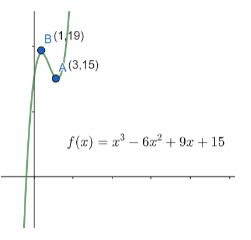
From the graph of \[f(x)={{x}^{3}}-6{{x}^{2}}+9x+15\], we can say that Local maximum is defined as the point where the graph of the function increases up to that point and decreases after that point. Local minimum is defined as the point where the graph of the function decreases up to the point and increases after that point.
By this we will have a clear difference between relative local minimum or maximum values and relative minimum or maximum values.
Complete step-by-step answer:
Before solving the question, we should have an idea on local maxima and local minima. By using this local minimum and local maximum we can find the values of local maximum and local minimum.
From the question, we were given that \[f(x)={{x}^{3}}-6{{x}^{2}}+9x+15\].
A function f(x) will have a local maxima and local minima at the value of x where \[{f}'(x)\]is equal to zero.
\[\begin{align}
& {f}'(x)=\dfrac{d}{dx}f(x) \\
& \Rightarrow {f}'(x)=\dfrac{d}{dx}\left( {{x}^{3}}-6{{x}^{2}}+9x+15 \right) \\
& \Rightarrow {f}'(x)=\dfrac{d}{dx}({{x}^{3}})-\dfrac{d}{dx}(6{{x}^{2}})+\dfrac{d}{dx}(9x)+\dfrac{d}{dx}(15) \\
& \Rightarrow {f}'(x)=3{{x}^{2}}-6(2x)+9+0 \\
& \Rightarrow {f}'(x)=3{{x}^{2}}-12x+9 \\
\end{align}\]
Now we have to find the value of x where \[{f}'(x)\] is equal to zero.
\[\begin{align}
& \Rightarrow {f}'(x)=0 \\
& \Rightarrow 3{{x}^{2}}-12x+9=0 \\
& \Rightarrow 3{{x}^{2}}-3x-9x+9=0 \\
& \Rightarrow 3x(x-1)-9(x-1)=0 \\
& \Rightarrow (3x-9)(x-1)=0 \\
& \Rightarrow x=3,x=1 \\
\end{align}\]
At \[x=3,1\] , we will have the value of \[{f}'(x)\] equal to zero.
So, we will have local maximum or local minimum at \[x=3,1\] for \[f(x)={{x}^{3}}-6{{x}^{2}}+9x+15\].
We know that a function f(x) will have local maximum at x=a where \[{f}'(a)=0\] and \[{f}''(a)<0\].
We also know that a function f(x) will have local minimum at x=a where \[{f}'(a)=0\] and \[{f}''(a)>0\].
\[\begin{align}
& {f}''(x)=\dfrac{{{d}^{2}}}{d{{x}^{2}}}f(x) \\
& \Rightarrow {f}''(x)=\dfrac{d}{dx}\left( \dfrac{d}{dx}f(x) \right) \\
& \Rightarrow {f}''(x)=\dfrac{d}{dx}\left( \dfrac{d}{dx}\left( {{x}^{3}}-6{{x}^{2}}+9x+15 \right) \right) \\
& \Rightarrow {f}''(x)=\dfrac{d}{dx}\left( 3{{x}^{2}}-12x+9 \right) \\
& \Rightarrow {f}''(x)=\dfrac{d}{dx}(3{{x}^{2}})-\dfrac{d}{dx}(12x)+\dfrac{d}{dx}(9) \\
& \Rightarrow {f}''(x)=6x-12.....(1) \\
\end{align}\]
To check whether \[x=1\] is a local maximum or local minimum, we should find the value of \[{f}''(1)\].
Now we will substitute x=1 in equation (1).
\[\begin{align}
& \Rightarrow {f}''(1)=6(1)-12 \\
& \Rightarrow {f}''(1)=6-12 \\
& \Rightarrow {f}''(1)=-6 \\
\end{align}\]
The value of \[{f}''(1)\] is equal to -6. It is clear that \[{f}''(1)<0.\] So, we can say that x=1 is a point of maxima.
So, at\[x=1\] we will have the local maximum value of f(x).
Now we will substitute x=1 in f(x).
\[\begin{align}
& f(1)={{(1)}^{3}}-6{{(1)}^{2}}+9(1)+15 \\
& \Rightarrow f(1)=1-6+9+15 \\
& \Rightarrow f(1)=19 \\
\end{align}\]
So, the maximum value of f(x) is equal to 19.
To check whether \[x=3\] is a local maximum or local minimum, we should find the value of \[{f}''(3)\].
Now we will substitute \[x=3\] in equation (1).
\[\begin{align}
& \Rightarrow {f}''(3)=6(3)-12 \\
& \Rightarrow {f}''(3)=18-12 \\
& \Rightarrow {f}''(3)=6 \\
\end{align}\]
The value of \[{f}''(3)\] is equal to 6. It is clear that \[{f}''(3)>0.\] So, we can say that \[x=3\] is a point of minima.
So, at \[x=3\] we will have the minimum value of f(x).
Now we will substitute x=3 in f(x).
\[\begin{align}
& f(3)={{(3)}^{3}}-6{{(3)}^{2}}+9(3)+15 \\
& \Rightarrow f(3)=27-54+27+15 \\
& \Rightarrow f(3)=15 \\
\end{align}\]
So, at \[x=3\] we will have the maximum value of f(x).
Note: We should remember that the local maximum value or local minimum value is not the same as relative maximum value or relative minimum value.
From the graph of \[f(x)={{x}^{3}}-6{{x}^{2}}+9x+15\], we can say that Local maximum is defined as the point where the graph of the function increases up to that point and decreases after that point. Local minimum is defined as the point where the graph of the function decreases up to the point and increases after that point.
By this we will have a clear difference between relative local minimum or maximum values and relative minimum or maximum values.
Recently Updated Pages
Master Class 12 Business Studies: Engaging Questions & Answers for Success

Master Class 12 Chemistry: Engaging Questions & Answers for Success
Master Class 12 Biology: Engaging Questions & Answers for Success
Class 12 Question and Answer - Your Ultimate Solutions Guide
Master Class 11 English: Engaging Questions & Answers for Success
Master Class 11 Social Science: Engaging Questions & Answers for Success
Trending doubts
Which are the Top 10 Largest Countries of the World?
Draw a labelled sketch of the human eye class 12 physics CBSE
Differentiate between homogeneous and heterogeneous class 12 chemistry CBSE
In order to find out the different types of gametes class 12 biology NEET_UG
Why is the cell called the structural and functional class 12 biology CBSE
Draw ray diagrams each showing i myopic eye and ii class 12 physics CBSE