




Find the least number which is divided by 5, 6, 8, 9, 12 leaves a remainder 1 but when divided by 13 leaves no remainder.
A.3601
B.1469
C.2091
D.4879
Answer
 Verified
646.8k+ views
Hint: Here, we will first find the LCM of 5, 6, 8, 9 and 12. We will assume that the required number is 1 greater than a multiple of the LCM. Then we will find the required number using Euclid’s Division Lemma.
Formulas used:
We will use the formula of Euclid’s Division lemma which is given by \[a = bq + r\].
Complete step-by-step answer:
Let the required number be \[x\]. We know that when \[x\] is divided by 13, it does not leave any remainder. This means that \[x\] is divisible by 13.
Any number that leaves a remainder of 1 on being divided by 5, 6, 8, 9 and 12 will also leave a remainder of 1 on being divided by the LCM of 5, 6, 8, 9 and 12. We will find the L.C.M. of 5, 6, 8, 9 and 12:
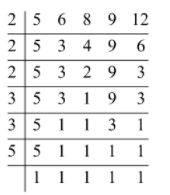
Now, the L.C.M. is given by:
\[\begin{array}{l}{\rm{LCM}} = 2 \times 2 \times 2 \times 3 \times 3 \times 5\\{\rm{LCM}} = 360\end{array}\]
As the number will leave a remainder 1 on being divided by 360, we will substitute 1 for \[r\], \[x\] for \[a\] and 360 for \[b\] in Euclid’s division lemma, \[a = bq + r\]. Therefore, we get
\[x = 360q + 1\]……………………\[\left( 1 \right)\]
We will substitute different values for \[q\] in the above equation and check whether the \[x\] we obtain is divisible by 13. We will do this till we find a number divisible by 13. This method is called the method of trial and error.
Substituting 1 for \[q\] in equation \[\left( 1 \right)\], we get
\[\begin{array}{l}x = 360 + 1\\ \Rightarrow x = 361\end{array}\]
361 is not divisible by 13.
Substituting 2 for \[q\] in equation \[\left( 1 \right)\], we get
\[\begin{array}{l}x = 360\left( 2 \right) + 1\\ \Rightarrow x = 721\end{array}\]
721 is not divisible by 13.
Substituting 3 for \[q\] in equation \[\left( 1 \right)\], we get
\[\begin{array}{l}x = 360\left( 3 \right) + 1\\ \Rightarrow x = 1081\end{array}\]
1081 is not divisible by 13.
Substituting 4 for \[q\] in equation \[\left( 1 \right)\], we get
\[\begin{array}{l}x = 360\left( 4 \right) + 1\\ \Rightarrow x = 1441\end{array}\]
1441 is not divisible by 13.
Substituting 5 for \[q\] in equation \[\left( 1 \right)\], we get
\[\begin{array}{l}x = 360\left( 5 \right) + 1\\ \Rightarrow x = 1801\end{array}\]
1801 is not divisible by 13.
Substituting 6 for \[q\] in equation \[\left( 1 \right)\], we get
\[\begin{array}{l}x = 360\left( 6 \right) + 1\\ \Rightarrow x = 2161\end{array}\]
2161 is not divisible by 13.
Substituting 7 for \[q\] in equation \[\left( 1 \right)\], we get
\[\begin{array}{l}x = 360\left( 7 \right) + 1\\ \Rightarrow x = 2521\end{array}\]
2521 is not divisible by 13.
Substituting 8 for \[q\] in equation \[\left( 1 \right)\], we get
\[\begin{array}{l}x = 360\left( 8 \right) + 1\\ \Rightarrow x = 2881\end{array}\]
2881 is not divisible by 13.
Substituting 9 for \[q\] in equation \[\left( 1 \right)\], we get
\[\begin{array}{l}x = 360\left( 9 \right) + 1\\ \Rightarrow x = 3241\end{array}\]
3241 is not divisible by 13.
Substituting 10 for \[q\] in equation \[\left( 1 \right)\], we get
\[\begin{array}{l}x = 360\left( {10} \right) + 1\\ \Rightarrow x = 3601\end{array}\]
3601 is divisible by 13.
$\therefore $ The least number which is divided by 5, 6, 8, 9, 12 leaves a remainder 1 but when divided by 13 leaves no remainder is 3601.
Option A is the correct option.
Note: The above method is a lengthy and tedious method. We can also find the answer by choosing the least number from the options and checking whether it is divisible by 13 and leaves a remainder of 1 on being divided by 360. Option B is divisible by 13 but doesn’t leave a remainder of 1 on being divided by 360. Option C is not divisible by 13. Option fulfils both the criteria, so it’s the correct option.
If a number (say \[a\]) on being divided by another number (say b) leaves a remainder \[r\] and has a divisor \[q\], then according to Euclid’s Division lemma: \[a = bq + r\]
where \[0 \le r < b\] and \[a\] and \[b\] are integers.
Formulas used:
We will use the formula of Euclid’s Division lemma which is given by \[a = bq + r\].
Complete step-by-step answer:
Let the required number be \[x\]. We know that when \[x\] is divided by 13, it does not leave any remainder. This means that \[x\] is divisible by 13.
Any number that leaves a remainder of 1 on being divided by 5, 6, 8, 9 and 12 will also leave a remainder of 1 on being divided by the LCM of 5, 6, 8, 9 and 12. We will find the L.C.M. of 5, 6, 8, 9 and 12:
Now, the L.C.M. is given by:
\[\begin{array}{l}{\rm{LCM}} = 2 \times 2 \times 2 \times 3 \times 3 \times 5\\{\rm{LCM}} = 360\end{array}\]
As the number will leave a remainder 1 on being divided by 360, we will substitute 1 for \[r\], \[x\] for \[a\] and 360 for \[b\] in Euclid’s division lemma, \[a = bq + r\]. Therefore, we get
\[x = 360q + 1\]……………………\[\left( 1 \right)\]
We will substitute different values for \[q\] in the above equation and check whether the \[x\] we obtain is divisible by 13. We will do this till we find a number divisible by 13. This method is called the method of trial and error.
Substituting 1 for \[q\] in equation \[\left( 1 \right)\], we get
\[\begin{array}{l}x = 360 + 1\\ \Rightarrow x = 361\end{array}\]
361 is not divisible by 13.
Substituting 2 for \[q\] in equation \[\left( 1 \right)\], we get
\[\begin{array}{l}x = 360\left( 2 \right) + 1\\ \Rightarrow x = 721\end{array}\]
721 is not divisible by 13.
Substituting 3 for \[q\] in equation \[\left( 1 \right)\], we get
\[\begin{array}{l}x = 360\left( 3 \right) + 1\\ \Rightarrow x = 1081\end{array}\]
1081 is not divisible by 13.
Substituting 4 for \[q\] in equation \[\left( 1 \right)\], we get
\[\begin{array}{l}x = 360\left( 4 \right) + 1\\ \Rightarrow x = 1441\end{array}\]
1441 is not divisible by 13.
Substituting 5 for \[q\] in equation \[\left( 1 \right)\], we get
\[\begin{array}{l}x = 360\left( 5 \right) + 1\\ \Rightarrow x = 1801\end{array}\]
1801 is not divisible by 13.
Substituting 6 for \[q\] in equation \[\left( 1 \right)\], we get
\[\begin{array}{l}x = 360\left( 6 \right) + 1\\ \Rightarrow x = 2161\end{array}\]
2161 is not divisible by 13.
Substituting 7 for \[q\] in equation \[\left( 1 \right)\], we get
\[\begin{array}{l}x = 360\left( 7 \right) + 1\\ \Rightarrow x = 2521\end{array}\]
2521 is not divisible by 13.
Substituting 8 for \[q\] in equation \[\left( 1 \right)\], we get
\[\begin{array}{l}x = 360\left( 8 \right) + 1\\ \Rightarrow x = 2881\end{array}\]
2881 is not divisible by 13.
Substituting 9 for \[q\] in equation \[\left( 1 \right)\], we get
\[\begin{array}{l}x = 360\left( 9 \right) + 1\\ \Rightarrow x = 3241\end{array}\]
3241 is not divisible by 13.
Substituting 10 for \[q\] in equation \[\left( 1 \right)\], we get
\[\begin{array}{l}x = 360\left( {10} \right) + 1\\ \Rightarrow x = 3601\end{array}\]
3601 is divisible by 13.
$\therefore $ The least number which is divided by 5, 6, 8, 9, 12 leaves a remainder 1 but when divided by 13 leaves no remainder is 3601.
Option A is the correct option.
Note: The above method is a lengthy and tedious method. We can also find the answer by choosing the least number from the options and checking whether it is divisible by 13 and leaves a remainder of 1 on being divided by 360. Option B is divisible by 13 but doesn’t leave a remainder of 1 on being divided by 360. Option C is not divisible by 13. Option fulfils both the criteria, so it’s the correct option.
If a number (say \[a\]) on being divided by another number (say b) leaves a remainder \[r\] and has a divisor \[q\], then according to Euclid’s Division lemma: \[a = bq + r\]
where \[0 \le r < b\] and \[a\] and \[b\] are integers.
Recently Updated Pages
Which will be the least stable resonating structure class 11 chemistry CBSE

How many 5 digit telephone numbers can be construc-class-11-maths-CBSE
How do you find the angle of the resultant vector class 11 physics CBSE
Draw labelled diagram of the following i Gram seed class 11 biology CBSE
1 Quintal is equal to a 110 kg b 10 kg c 100kg d 1000 class 11 physics CBSE
What is the need and importance of classification class 11 biology CBSE
Trending doubts
Find the value of the expression given below sin 30circ class 11 maths CBSE
One Metric ton is equal to kg A 10000 B 1000 C 100 class 11 physics CBSE
10 examples of friction in our daily life
Draw a diagram of a plant cell and label at least eight class 11 biology CBSE
Difference between physical and chemical change class 11 chemistry CBSE
Proton was discovered by A Thomson B Rutherford C Chadwick class 11 chemistry CBSE