




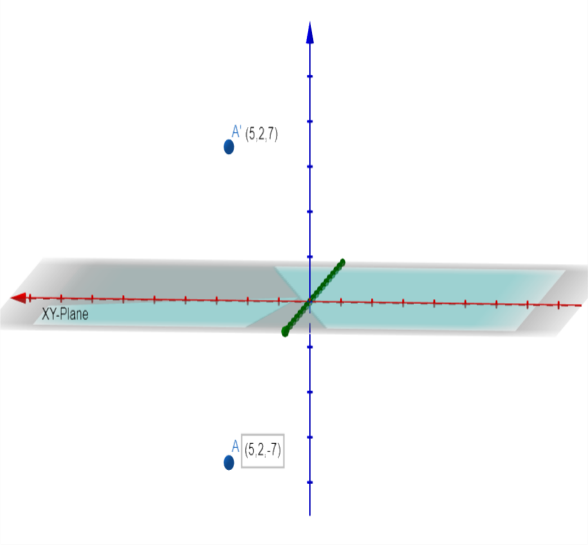
Find the image of point (5,2, -7) in XY-plane and image of point (-4,0,7) in XZ-plane.
Answer
 Verified
615k+ views
Hint: We should know that equation of XY-plane is z=0, equation of YZ-plane is x=0 and equation of XZ-plane is y=0. We should know that a point \[A(h,k,l)\] is image of \[B({{x}_{1}},{{y}_{1}},{{z}_{1}})\] with respect to the plane \[ax+by+cz=d\] if \[\dfrac{h-{{x}_{1}}}{a}=\dfrac{k-{{y}_{1}}}{b}=\dfrac{l-{{z}_{1}}}{c}=\dfrac{-2(a{{x}_{1}}+b{{y}_{1}}+c)}{{{a}^{2}}+{{b}^{2}}+{{c}^{2}}}\]. Now we should find the image of point (5,2, -7) in XY-plane and image of point (-4,0,7) in XZ-plane by using the above formula.
Complete step-by-step answer:
From the question, we were given to find the image of point (5,2, -7) in XY-plane.
Before solving the problem, we should know that the equation of XY-plane is z=0, equation of YZ-plane is y=0 and equation of XZ-plane is y=0.
We should know that a point \[A(h,k,l)\] is image of \[B({{x}_{1}},{{y}_{1}},{{z}_{1}})\] with respect to the plane \[ax+by+cz=d\] if \[\dfrac{h-{{x}_{1}}}{a}=\dfrac{k-{{y}_{1}}}{b}=\dfrac{l-{{z}_{1}}}{c}=\dfrac{-2(a{{x}_{1}}+b{{y}_{1}}+c)}{{{a}^{2}}+{{b}^{2}}+{{c}^{2}}}\].
Now we should find the image of point B (5,2, -7) with respect to line z=0.
Now we should compare z=0 with \[ax+by+cz=d\].
We get a=0, b=0, c=1 and d=0.
Let us compare \[B({{x}_{1}},{{y}_{1}},{{z}_{1}})\] with B (5,2, -7), then \[{{x}_{1}}=5,{{y}_{1}}=2,{{z}_{1}}=-7\].
We should know that a point \[A(h,k,l)\] is image of \[B({{x}_{1}},{{y}_{1}},{{z}_{1}})\] with respect to the plane \[ax+by+cz=d\] if \[\dfrac{h-{{x}_{1}}}{a}=\dfrac{k-{{y}_{1}}}{b}=\dfrac{l-{{z}_{1}}}{c}=\dfrac{-2(a{{x}_{1}}+b{{y}_{1}}+c)}{{{a}^{2}}+{{b}^{2}}+{{c}^{2}}}\].
Let us assume the image of B (5,2, -7) on the XY-plane is \[A(h,k,l)\].
\[\begin{align}
& \Rightarrow \dfrac{h-5}{0}=\dfrac{k-2}{0}=\dfrac{z+7}{1}=\dfrac{-2(-7)}{1} \\
& \Rightarrow \dfrac{h-5}{0}=\dfrac{k-2}{0}=\dfrac{z+7}{1}=14 \\
& \Rightarrow h=5,k=2,z=7 \\
\end{align}\]
So, it is clear that the image of point (5,2, -7) with respect to XY-plane is (5,2,7).
Now we should find the image of point (-4,0,7) with respect to line y=0.
Now we should compare y=0 with \[ax+by+cz=d\].
We get a=0, b=1, c=0 and d=0.
Let us compare \[B({{x}_{1}},{{y}_{1}},{{z}_{1}})\] with C (-4,0, 7), then \[{{x}_{1}}=-4,{{y}_{1}}=0,{{z}_{1}}=7\].
We should know that a point \[A(h,k,l)\] is image of \[B({{x}_{1}},{{y}_{1}},{{z}_{1}})\] with respect to the plane \[ax+by+cz=d\] if \[\dfrac{h-{{x}_{1}}}{a}=\dfrac{k-{{y}_{1}}}{b}=\dfrac{l-{{z}_{1}}}{c}=\dfrac{-2(a{{x}_{1}}+b{{y}_{1}}+c)}{{{a}^{2}}+{{b}^{2}}+{{c}^{2}}}\].
Let us assume the image of C (-4,0,7) with respect to line y=0.
\[\begin{align}
& \Rightarrow \dfrac{h+4}{0}=\dfrac{k-0}{1}=\dfrac{z-7}{0}=\dfrac{-2(0)}{1} \\
& \Rightarrow \dfrac{h+4}{0}=\dfrac{k-0}{1}=\dfrac{z-7}{0}=0 \\
& \Rightarrow h=-4,k=0,z=7 \\
\end{align}\]
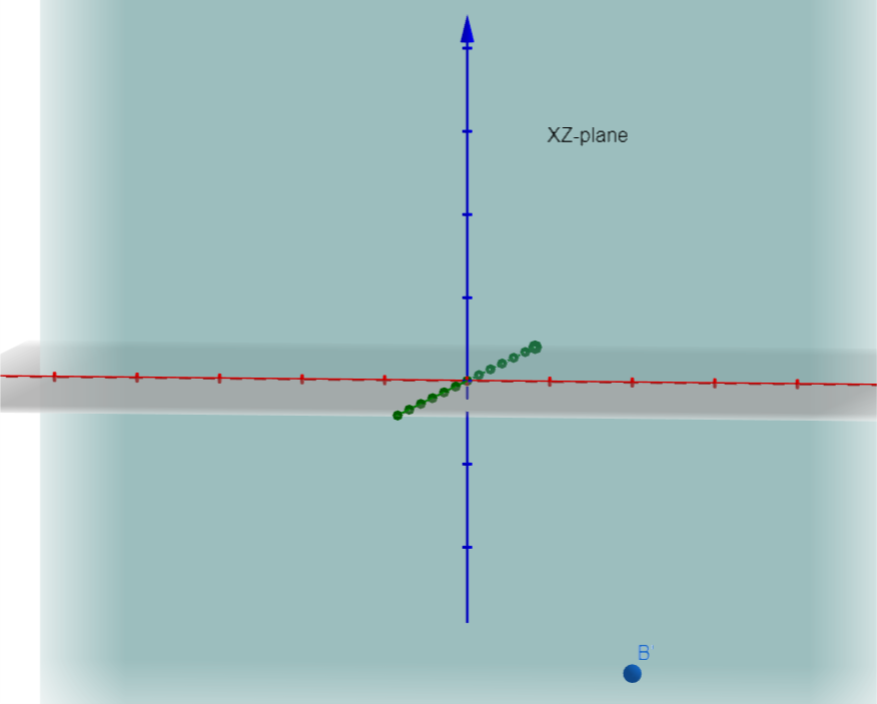
So, it is clear that the image of point (-4,0, 7) with respect to XZ-plane is (-4,0,7).
Note: This sum can be solved in an alternative method also.
We know that the image of a point \[B({{x}_{1}},{{y}_{1}},{{z}_{1}})\] with respect to XY-plane is \[({{x}_{1}},{{y}_{1}},-{{z}_{1}})\], the image of point \[B({{x}_{1}},{{y}_{1}},{{z}_{1}})\] with respect to YZ-plane is \[(-{{x}_{1}},{{y}_{1}},{{z}_{1}})\] and \[B({{x}_{1}},{{y}_{1}},{{z}_{1}})\] with respect to XZ-plane is \[({{x}_{1}},-{{y}_{1}},{{z}_{1}})\].
So, the image of point (5,2, -7) with respect to XY-plane is (5,2,7). The image of point C (4,0, -7) with respect to XZ-plane is (4,0, -7).
Complete step-by-step answer:
From the question, we were given to find the image of point (5,2, -7) in XY-plane.
Before solving the problem, we should know that the equation of XY-plane is z=0, equation of YZ-plane is y=0 and equation of XZ-plane is y=0.
We should know that a point \[A(h,k,l)\] is image of \[B({{x}_{1}},{{y}_{1}},{{z}_{1}})\] with respect to the plane \[ax+by+cz=d\] if \[\dfrac{h-{{x}_{1}}}{a}=\dfrac{k-{{y}_{1}}}{b}=\dfrac{l-{{z}_{1}}}{c}=\dfrac{-2(a{{x}_{1}}+b{{y}_{1}}+c)}{{{a}^{2}}+{{b}^{2}}+{{c}^{2}}}\].
Now we should find the image of point B (5,2, -7) with respect to line z=0.
Now we should compare z=0 with \[ax+by+cz=d\].
We get a=0, b=0, c=1 and d=0.
Let us compare \[B({{x}_{1}},{{y}_{1}},{{z}_{1}})\] with B (5,2, -7), then \[{{x}_{1}}=5,{{y}_{1}}=2,{{z}_{1}}=-7\].
We should know that a point \[A(h,k,l)\] is image of \[B({{x}_{1}},{{y}_{1}},{{z}_{1}})\] with respect to the plane \[ax+by+cz=d\] if \[\dfrac{h-{{x}_{1}}}{a}=\dfrac{k-{{y}_{1}}}{b}=\dfrac{l-{{z}_{1}}}{c}=\dfrac{-2(a{{x}_{1}}+b{{y}_{1}}+c)}{{{a}^{2}}+{{b}^{2}}+{{c}^{2}}}\].
Let us assume the image of B (5,2, -7) on the XY-plane is \[A(h,k,l)\].
\[\begin{align}
& \Rightarrow \dfrac{h-5}{0}=\dfrac{k-2}{0}=\dfrac{z+7}{1}=\dfrac{-2(-7)}{1} \\
& \Rightarrow \dfrac{h-5}{0}=\dfrac{k-2}{0}=\dfrac{z+7}{1}=14 \\
& \Rightarrow h=5,k=2,z=7 \\
\end{align}\]
So, it is clear that the image of point (5,2, -7) with respect to XY-plane is (5,2,7).
Now we should find the image of point (-4,0,7) with respect to line y=0.
Now we should compare y=0 with \[ax+by+cz=d\].
We get a=0, b=1, c=0 and d=0.
Let us compare \[B({{x}_{1}},{{y}_{1}},{{z}_{1}})\] with C (-4,0, 7), then \[{{x}_{1}}=-4,{{y}_{1}}=0,{{z}_{1}}=7\].
We should know that a point \[A(h,k,l)\] is image of \[B({{x}_{1}},{{y}_{1}},{{z}_{1}})\] with respect to the plane \[ax+by+cz=d\] if \[\dfrac{h-{{x}_{1}}}{a}=\dfrac{k-{{y}_{1}}}{b}=\dfrac{l-{{z}_{1}}}{c}=\dfrac{-2(a{{x}_{1}}+b{{y}_{1}}+c)}{{{a}^{2}}+{{b}^{2}}+{{c}^{2}}}\].
Let us assume the image of C (-4,0,7) with respect to line y=0.
\[\begin{align}
& \Rightarrow \dfrac{h+4}{0}=\dfrac{k-0}{1}=\dfrac{z-7}{0}=\dfrac{-2(0)}{1} \\
& \Rightarrow \dfrac{h+4}{0}=\dfrac{k-0}{1}=\dfrac{z-7}{0}=0 \\
& \Rightarrow h=-4,k=0,z=7 \\
\end{align}\]
So, it is clear that the image of point (-4,0, 7) with respect to XZ-plane is (-4,0,7).
Note: This sum can be solved in an alternative method also.
We know that the image of a point \[B({{x}_{1}},{{y}_{1}},{{z}_{1}})\] with respect to XY-plane is \[({{x}_{1}},{{y}_{1}},-{{z}_{1}})\], the image of point \[B({{x}_{1}},{{y}_{1}},{{z}_{1}})\] with respect to YZ-plane is \[(-{{x}_{1}},{{y}_{1}},{{z}_{1}})\] and \[B({{x}_{1}},{{y}_{1}},{{z}_{1}})\] with respect to XZ-plane is \[({{x}_{1}},-{{y}_{1}},{{z}_{1}})\].
So, the image of point (5,2, -7) with respect to XY-plane is (5,2,7). The image of point C (4,0, -7) with respect to XZ-plane is (4,0, -7).
Recently Updated Pages
Master Class 12 Social Science: Engaging Questions & Answers for Success

Master Class 12 Physics: Engaging Questions & Answers for Success
Master Class 12 Maths: Engaging Questions & Answers for Success
Master Class 12 Economics: Engaging Questions & Answers for Success
Master Class 12 Chemistry: Engaging Questions & Answers for Success
Master Class 12 Business Studies: Engaging Questions & Answers for Success
Trending doubts
Which are the Top 10 Largest Countries of the World?
Draw a labelled sketch of the human eye class 12 physics CBSE
Explain the structure of megasporangium class 12 biology CBSE
What are the major means of transport Explain each class 12 social science CBSE
How many chromosomes are found in human ovum a 46 b class 12 biology CBSE
The diagram of the section of a maize grain is given class 12 biology CBSE