




Find the foot of the perpendicular and the image of the point (1,2,1) along the line
$\dfrac{x-1}{1}=\dfrac{y+1}{2}=\dfrac{z-1}{3}=\lambda $
Answer
 Verified
620.1k+ views
Hint: In this question, we are given the equation of the line and the coordinates of the point. As the foot of the perpendicular must lie on the line, we should use the relation direction ratios of the perpendicular and that of the line to obtain the point of intersection. Then, as the point of intersection should be the midpoint of the original point and its image, we can use the equation for midpoint to find the coordinates of the image of the point.
Complete step by step solution:
We know that the direction ratios of a line represented by
$\dfrac{x-a}{d}=\dfrac{x-b}{e}=\dfrac{x-c}{f}=k$
Is given by (d,e,f). In this case, the given equation of the line is
$\dfrac{x-1}{1}=\dfrac{y+1}{2}=\dfrac{z-1}{3}=\lambda .................(1.1)$
Therefore, the direction ratios of the line are (1,2,3) ………………………… (1.2)
Now, we can rewrite the three equations in (1.1) as
$\begin{align}
& x-1=\lambda \\
& y+1=2\lambda \\
& z-1=3\lambda .............................(1.3) \\
\end{align}$
Let the coordinates of the foot of the perpendicular be $Q=\left( \alpha ,\beta ,\gamma \right)$ as shown in the figure.
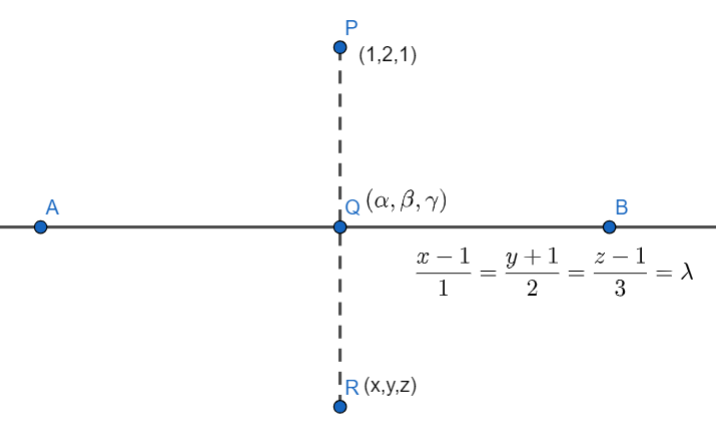
As the foot of the perpendicular should lie on the given line, $\left( \alpha ,\beta ,\gamma \right)$ should satisfy equation (1.3), therefore, we should have
$\begin{align}
& \alpha -1=\lambda \Rightarrow \alpha =1+\lambda \\
& \beta +1=2\lambda \Rightarrow \beta =2\lambda -1 \\
& \gamma -1=3\lambda \Rightarrow \gamma =3\lambda +1.............................(1.4) \\
\end{align}$
The direction ratios of a line passing through two points (p,q,r) and (s,t,u) is given by (s-p, t-q,u-r). Now, the perpendicular line starts from $P=(1,2,1)$ and passes through $Q=\left( \alpha ,\beta ,\gamma \right)$, therefore the direction ratios of the perpendicular line PQ should be $\left( \alpha -1,\beta -2,\gamma -1 \right)$……..(1.5)
We know that if two lines having direction ratios $\left( a,b,c \right)$ and $\left( d,e,f \right)$ are perpendicular then
$ad+be+cf=0..............(1.6)$
Thus, as PQ should be perpendicular to the given line, using equations (1.6), (1.5) and (1.2), we get
$\left( \alpha -1 \right)\times 1+\left( \beta -2 \right)\times 2+\left( \gamma -1 \right)\times 3=0...........(1.7a)$
Now, using the values from equation (1.4), we get
$\begin{align}
& \lambda \times 1+\left( 2\lambda -3 \right)\times 2+3\lambda \times 3=0 \\
& \Rightarrow 14\lambda =6\Rightarrow \lambda =\dfrac{6}{14}=\dfrac{3}{7}................(1.7) \\
\end{align}$
So, using this values of $\lambda $ in equation (1.4), we get
\[\begin{align}
& \alpha =1+\lambda =1+\dfrac{3}{7}=\dfrac{10}{7} \\
& \beta =2\lambda -1=2\times \dfrac{3}{7}-1=\dfrac{-1}{7} \\
& \gamma =3\lambda +1=3\times \dfrac{3}{7}+1=\dfrac{16}{7}.............................(1.8) \\
\end{align}\]
Thus, from equation (1.8), we obtain the coordinates of the foot of the perpendicular to be $\left( \dfrac{10}{7},\dfrac{-1}{7},\dfrac{16}{7} \right)..................(1.9)$
Now, if the coordinates of the image R is $\left( x,y,z \right)$, then we know that the foot of the perpendicular should be the midpoint of the line PR. Therefore, as the coordinates of the midpoint Q should be average of the coordinates of the end points P and R, from equations (1.9) and the coordinates of the given point (1,2,1), we obtain
$\begin{align}
& \dfrac{10}{7}=\dfrac{1+x}{2}\Rightarrow x=\dfrac{20}{7}-1=\dfrac{13}{7} \\
& \dfrac{-1}{7}=\dfrac{2+y}{2}\Rightarrow y=\dfrac{-2}{7}-2=\dfrac{-16}{7} \\
& \dfrac{16}{7}=\dfrac{1+z}{2}\Rightarrow z=\dfrac{16}{7}-1=\dfrac{9}{7} \\
\end{align}$
Thus, the coordinates of the image should be $\left( \dfrac{13}{7},\dfrac{-16}{7},\dfrac{9}{7} \right).................(1.10)$
Therefore, equations (1.9) and (1.10) are the required answer to the given question.
Note: We should note that in equation (1.5), we could also have written the direction ratios of PQ as $\left( 1-\alpha ,2-\beta ,1-\gamma \right)$ by interchanging the order in which P and Q are taken while finding the direction ratios, however the answer would still remain the same as in this case only an overall minus sign will be introduce in (1.7a) which will get cancelled out as the RHS is zero.
Complete step by step solution:
We know that the direction ratios of a line represented by
$\dfrac{x-a}{d}=\dfrac{x-b}{e}=\dfrac{x-c}{f}=k$
Is given by (d,e,f). In this case, the given equation of the line is
$\dfrac{x-1}{1}=\dfrac{y+1}{2}=\dfrac{z-1}{3}=\lambda .................(1.1)$
Therefore, the direction ratios of the line are (1,2,3) ………………………… (1.2)
Now, we can rewrite the three equations in (1.1) as
$\begin{align}
& x-1=\lambda \\
& y+1=2\lambda \\
& z-1=3\lambda .............................(1.3) \\
\end{align}$
Let the coordinates of the foot of the perpendicular be $Q=\left( \alpha ,\beta ,\gamma \right)$ as shown in the figure.
As the foot of the perpendicular should lie on the given line, $\left( \alpha ,\beta ,\gamma \right)$ should satisfy equation (1.3), therefore, we should have
$\begin{align}
& \alpha -1=\lambda \Rightarrow \alpha =1+\lambda \\
& \beta +1=2\lambda \Rightarrow \beta =2\lambda -1 \\
& \gamma -1=3\lambda \Rightarrow \gamma =3\lambda +1.............................(1.4) \\
\end{align}$
The direction ratios of a line passing through two points (p,q,r) and (s,t,u) is given by (s-p, t-q,u-r). Now, the perpendicular line starts from $P=(1,2,1)$ and passes through $Q=\left( \alpha ,\beta ,\gamma \right)$, therefore the direction ratios of the perpendicular line PQ should be $\left( \alpha -1,\beta -2,\gamma -1 \right)$……..(1.5)
We know that if two lines having direction ratios $\left( a,b,c \right)$ and $\left( d,e,f \right)$ are perpendicular then
$ad+be+cf=0..............(1.6)$
Thus, as PQ should be perpendicular to the given line, using equations (1.6), (1.5) and (1.2), we get
$\left( \alpha -1 \right)\times 1+\left( \beta -2 \right)\times 2+\left( \gamma -1 \right)\times 3=0...........(1.7a)$
Now, using the values from equation (1.4), we get
$\begin{align}
& \lambda \times 1+\left( 2\lambda -3 \right)\times 2+3\lambda \times 3=0 \\
& \Rightarrow 14\lambda =6\Rightarrow \lambda =\dfrac{6}{14}=\dfrac{3}{7}................(1.7) \\
\end{align}$
So, using this values of $\lambda $ in equation (1.4), we get
\[\begin{align}
& \alpha =1+\lambda =1+\dfrac{3}{7}=\dfrac{10}{7} \\
& \beta =2\lambda -1=2\times \dfrac{3}{7}-1=\dfrac{-1}{7} \\
& \gamma =3\lambda +1=3\times \dfrac{3}{7}+1=\dfrac{16}{7}.............................(1.8) \\
\end{align}\]
Thus, from equation (1.8), we obtain the coordinates of the foot of the perpendicular to be $\left( \dfrac{10}{7},\dfrac{-1}{7},\dfrac{16}{7} \right)..................(1.9)$
Now, if the coordinates of the image R is $\left( x,y,z \right)$, then we know that the foot of the perpendicular should be the midpoint of the line PR. Therefore, as the coordinates of the midpoint Q should be average of the coordinates of the end points P and R, from equations (1.9) and the coordinates of the given point (1,2,1), we obtain
$\begin{align}
& \dfrac{10}{7}=\dfrac{1+x}{2}\Rightarrow x=\dfrac{20}{7}-1=\dfrac{13}{7} \\
& \dfrac{-1}{7}=\dfrac{2+y}{2}\Rightarrow y=\dfrac{-2}{7}-2=\dfrac{-16}{7} \\
& \dfrac{16}{7}=\dfrac{1+z}{2}\Rightarrow z=\dfrac{16}{7}-1=\dfrac{9}{7} \\
\end{align}$
Thus, the coordinates of the image should be $\left( \dfrac{13}{7},\dfrac{-16}{7},\dfrac{9}{7} \right).................(1.10)$
Therefore, equations (1.9) and (1.10) are the required answer to the given question.
Note: We should note that in equation (1.5), we could also have written the direction ratios of PQ as $\left( 1-\alpha ,2-\beta ,1-\gamma \right)$ by interchanging the order in which P and Q are taken while finding the direction ratios, however the answer would still remain the same as in this case only an overall minus sign will be introduce in (1.7a) which will get cancelled out as the RHS is zero.
Recently Updated Pages
Master Class 12 Business Studies: Engaging Questions & Answers for Success

Master Class 12 Chemistry: Engaging Questions & Answers for Success
Master Class 12 Biology: Engaging Questions & Answers for Success
Class 12 Question and Answer - Your Ultimate Solutions Guide
Master Class 11 English: Engaging Questions & Answers for Success
Master Class 11 Maths: Engaging Questions & Answers for Success
Trending doubts
Which is more stable and why class 12 chemistry CBSE
Which are the Top 10 Largest Countries of the World?
Draw a labelled sketch of the human eye class 12 physics CBSE
Differentiate between homogeneous and heterogeneous class 12 chemistry CBSE
What are the major means of transport Explain each class 12 social science CBSE
Sulphuric acid is known as the king of acids State class 12 chemistry CBSE