




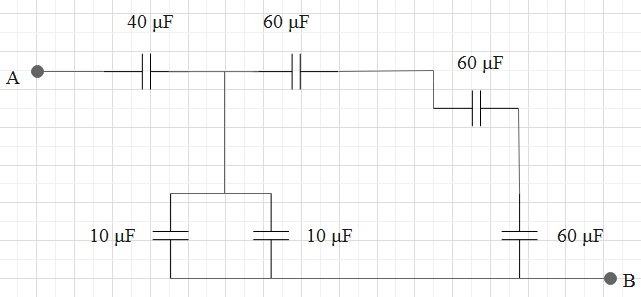
Find the equivalent capacitance of the combination of capacitors between the points A and B. Also, find a total charge that flows in the circuit when 100 V battery is connected between points A and B.
Answer
 Verified
567.7k+ views
Hint: The problem is based on using the formulae of the capacitance of the capacitor. The series and the parallel capacitance of the capacitor should be calculated first. Then, the net capacitance should be multiplied with the given value of the voltage to obtain the value of the charge that flows through the circuit.
Formula used:
\[Q=CV\]
Complete step-by-step answer:
Consider the diagram representing component connections in a circuit.
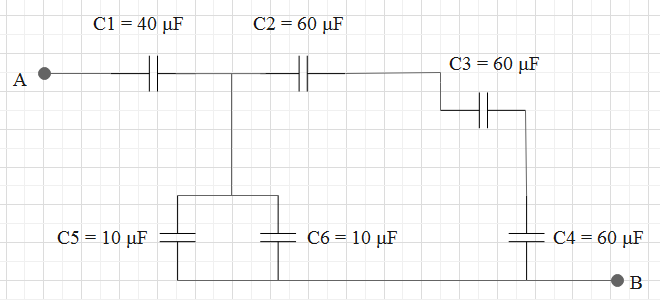
Considering the figure let us compute the capacitance of the circuit considering two capacitors at a time.
Let us begin the calculation.
Now consider the capacitors marked 5 and 6. So, these capacitors are in parallel. So, the equivalent capacitance is calculated as follows.
\[\begin{align}
& {{C}_{56}}={{C}_{5}}+C{}_{6} \\
& \Rightarrow {{C}_{56}}=10+10 \\
& \Rightarrow {{C}_{56}}=20\mu F \\
\end{align}\]
Now consider the capacitors marked 2, 3 and 4. So, these capacitors are in series. So, the equivalent capacitance is calculated as follows.
\[\begin{align}
& \dfrac{1}{{{C}_{234}}}=\dfrac{1}{{{C}_{2}}}+\dfrac{1}{{{C}_{3}}}+\dfrac{1}{{{C}_{4}}} \\
& \Rightarrow \dfrac{1}{{{C}_{234}}}=\dfrac{1}{60}+\dfrac{1}{60}+\dfrac{1}{60} \\
& \Rightarrow {{C}_{234}}=20\,\mu F \\
\end{align}\]
Now consider the capacitors marked 56 and 234. So, these capacitors are in parallel. So, the equivalent capacitance is calculated as follows.
\[\begin{align}
& {{C}_{23456}}={{C}_{234}}+C{}_{56} \\
& \Rightarrow {{C}_{23456}}=20+20 \\
& \Rightarrow {{C}_{23456}}=40\mu F \\
\end{align}\]
Now consider the capacitors marked 23456 and 1. So, these capacitors are in series. So, the equivalent capacitance is calculated as follows.
\[\begin{align}
& \dfrac{1}{{{C}_{123456}}}=\dfrac{1}{{{C}_{23456}}}+\dfrac{1}{{{C}_{1}}} \\
& \Rightarrow \dfrac{1}{{{C}_{123456}}}=\dfrac{1}{40}+\dfrac{1}{40} \\
& \Rightarrow {{C}_{123456}}=20\,\mu F \\
\end{align}\]
The equivalent capacitance of the combination of capacitors between the points A and B is \[20\,\mu F\].
Let us now compute the total charge that flows in the circuit when the 100 V battery is connected between points A and B.
The diagram representing the equivalent capacitance and the voltage between the points A and B is as follows.
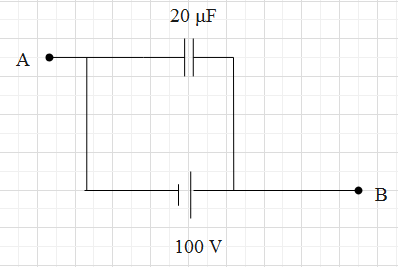
The charge is given as follows.
\[\begin{align}
& Q=CV \\
& \Rightarrow Q=20\,\mu F\times 100\,V \\
& \Rightarrow Q=2\,mC \\
\end{align}\]
Therefore, the equivalent capacitance of the combination of capacitors between the points A and B is \[20\,\mu F\]and the total charge that flows in the circuit when 100 V battery is connected between points A and B is 2 mC.
Note: The things to be on your finger-tips for further information on solving these types of problems are: The formula used to calculate the equivalent capacitance of the capacitors connected in parallel is different from that of the formula used to calculate the equivalent capacitance of the capacitors connected in series. The units of the parameters should be taken care of.
Formula used:
\[Q=CV\]
Complete step-by-step answer:
Consider the diagram representing component connections in a circuit.
Considering the figure let us compute the capacitance of the circuit considering two capacitors at a time.
Let us begin the calculation.
Now consider the capacitors marked 5 and 6. So, these capacitors are in parallel. So, the equivalent capacitance is calculated as follows.
\[\begin{align}
& {{C}_{56}}={{C}_{5}}+C{}_{6} \\
& \Rightarrow {{C}_{56}}=10+10 \\
& \Rightarrow {{C}_{56}}=20\mu F \\
\end{align}\]
Now consider the capacitors marked 2, 3 and 4. So, these capacitors are in series. So, the equivalent capacitance is calculated as follows.
\[\begin{align}
& \dfrac{1}{{{C}_{234}}}=\dfrac{1}{{{C}_{2}}}+\dfrac{1}{{{C}_{3}}}+\dfrac{1}{{{C}_{4}}} \\
& \Rightarrow \dfrac{1}{{{C}_{234}}}=\dfrac{1}{60}+\dfrac{1}{60}+\dfrac{1}{60} \\
& \Rightarrow {{C}_{234}}=20\,\mu F \\
\end{align}\]
Now consider the capacitors marked 56 and 234. So, these capacitors are in parallel. So, the equivalent capacitance is calculated as follows.
\[\begin{align}
& {{C}_{23456}}={{C}_{234}}+C{}_{56} \\
& \Rightarrow {{C}_{23456}}=20+20 \\
& \Rightarrow {{C}_{23456}}=40\mu F \\
\end{align}\]
Now consider the capacitors marked 23456 and 1. So, these capacitors are in series. So, the equivalent capacitance is calculated as follows.
\[\begin{align}
& \dfrac{1}{{{C}_{123456}}}=\dfrac{1}{{{C}_{23456}}}+\dfrac{1}{{{C}_{1}}} \\
& \Rightarrow \dfrac{1}{{{C}_{123456}}}=\dfrac{1}{40}+\dfrac{1}{40} \\
& \Rightarrow {{C}_{123456}}=20\,\mu F \\
\end{align}\]
The equivalent capacitance of the combination of capacitors between the points A and B is \[20\,\mu F\].
Let us now compute the total charge that flows in the circuit when the 100 V battery is connected between points A and B.
The diagram representing the equivalent capacitance and the voltage between the points A and B is as follows.
The charge is given as follows.
\[\begin{align}
& Q=CV \\
& \Rightarrow Q=20\,\mu F\times 100\,V \\
& \Rightarrow Q=2\,mC \\
\end{align}\]
Therefore, the equivalent capacitance of the combination of capacitors between the points A and B is \[20\,\mu F\]and the total charge that flows in the circuit when 100 V battery is connected between points A and B is 2 mC.
Note: The things to be on your finger-tips for further information on solving these types of problems are: The formula used to calculate the equivalent capacitance of the capacitors connected in parallel is different from that of the formula used to calculate the equivalent capacitance of the capacitors connected in series. The units of the parameters should be taken care of.
Recently Updated Pages
Master Class 12 Business Studies: Engaging Questions & Answers for Success

Master Class 12 Chemistry: Engaging Questions & Answers for Success
Master Class 12 Biology: Engaging Questions & Answers for Success
Class 12 Question and Answer - Your Ultimate Solutions Guide
Master Class 11 English: Engaging Questions & Answers for Success
Master Class 11 Social Science: Engaging Questions & Answers for Success
Trending doubts
Which are the Top 10 Largest Countries of the World?
Draw a labelled sketch of the human eye class 12 physics CBSE
The end of compass needle which points towards north class 12 physics CBSE
Differentiate between homogeneous and heterogeneous class 12 chemistry CBSE
In order to find out the different types of gametes class 12 biology NEET_UG
Why is the cell called the structural and functional class 12 biology CBSE