




Find the electric field intensity at a point P (point lying on the perpendicular drawn to the wire at one of its ends) which is at a distance $R$ from a semi-infinite uniformly charged wire. (Linear charge density is $\lambda $ ).
Answer
 Verified
597k+ views
Hint: The electric field intensity at some point due to a charge is proportional to the charge and the distance between the charge and the point. Electric field intensity is a vector and will have x-component and y-components. If the field intensity at the given point due to a small elemental charge can be determined then integrating it would give the field intensity due to the entire charge in the wire.
Formula Used:
The magnitude of a vector $\vec A$ will be $A = \sqrt {{{\left( {{A_x}} \right)}^2} + {{\left( {{A_y}} \right)}^2}} $ where ${A_x}$ and ${A_y}$ are the x-component and y-component of the vector respectively.
The direction of a vector is given by, $\tan \theta = \dfrac{{{A_x}}}{{{A_y}}}$ where ${A_x}$ and ${A_y}$ are the x-component and y-component of the vector $\vec A$ respectively.
The charge in a wire of length $l$ and linear charge density $\lambda $ is given by, $q = \lambda l$ .
The magnitude of the electric field at a distance $R$ due to a charge $q$ is given by, $E = \dfrac{1}{{4\pi {\varepsilon _0}}}\left( {\dfrac{q}{{{R^2}}}} \right)$ .
Complete step by step answer:
Step 1: Sketch an appropriate figure describing the uniform wire and the point at which the field intensity is to be determined.
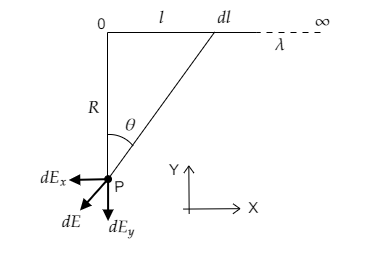
In the above figure, we have a uniform wire of linear charge density $\lambda $ whose length increases infinitely in one direction. The electric field intensity at the point P is to be determined.
For that, we consider a small elemental length $dl$ of charge $dq = \lambda dl$ of the wire at a distance $l$ from its finite end. The point P is at a distance $R$ from the finite end. The electric field vector due to the small element $dE$ at P makes an angle $\theta $. The electric field components due to the small elemental charge $dq$ are given to be $d{E_x}$ and $d{E_y}$.
Step 2: Express the components of the electric field vector at P due to the small elemental charge.
From the figure, we get the distance between the point P and the elemental charge to be $\sqrt {{R^2} + {l^2}} $.
The magnitude of the electric field $dE$ at P due to the elemental charge $dq$ is given by, $dE = \dfrac{1}{{4\pi {\varepsilon _0}}}\left( {\dfrac{{dq}}{{{R^2} + {l^2}}}} \right)$ -------- (1)
Then the components of $dE$ are $d{E_x} = - dE\cos \theta $ and $d{E_y} = - dE\sin \theta $ .
Using equation (1) we get, the x-component of the elemental field intensity,
$d{E_x} = \dfrac{{ - \cos \theta }}{{4\pi {\varepsilon _0}}}\left( {\dfrac{{dq}}{{{R^2} + {l^2}}}} \right)$ ----- (2)
and the y-component of the elemental field intensity, $d{E_y} = \dfrac{{ - \sin \theta }}{{4\pi {\varepsilon _0}}}\left( {\dfrac{{dq}}{{{R^2} + {l^2}}}} \right)$ ------ (3)
From the figure we have $\cos \theta = \dfrac{R}{{\sqrt {{R^2} + {l^2}} }}$ and $\sin \theta = \dfrac{l}{{\sqrt {{R^2} + {l^2}} }}$
Then substitute for $\cos \theta = \dfrac{R}{{\sqrt {{R^2} + {l^2}} }}$, $\sin \theta = \dfrac{l}{{\sqrt {{R^2} + {l^2}} }}$ and $dq = \lambda dl$ in equations (2) and (3).
We then have, $d{E_x} = \dfrac{{ - R}}{{4\pi {\varepsilon _0}}}\left( {\dfrac{{\lambda dl}}{{{{\left( {{R^2} + {l^2}} \right)}^{3/2}}}}} \right)$ ----- (4) and $d{E_y} = \dfrac{{ - l}}{{4\pi {\varepsilon _0}}}\left( {\dfrac{{\lambda dl}}{{{{\left( {{R^2} + {l^2}} \right)}^{3/2}}}}} \right)$ ------ (5)
Integrate both equations (4) and (5) to obtain the electric field intensity at P due to the entire charge.
i.e., integrating equation (4) we have ${E_x} = \int\limits_0^\infty {\dfrac{{ - R}}{{4\pi {\varepsilon _0}}}\left( {\dfrac{{\lambda dl}}{{{{\left( {{R^2} + {l^2}} \right)}^{3/2}}}}} \right)} = \dfrac{{ - \lambda R}}{{4\pi {\varepsilon _0}}}\int\limits_0^\infty {{{\left( {{R^2} + {l^2}} \right)}^{ - 3/2}}} dl$
$ \Rightarrow {E_x} = \dfrac{{ - \lambda }}{{4\pi {\varepsilon _0}R}}$
Integrating equation (5) we have ${E_y} = \int\limits_0^\infty {\dfrac{{ - R}}{{4\pi {\varepsilon _0}}}\left( {\dfrac{{\lambda dl}}{{{{\left( {{R^2} + {l^2}} \right)}^{3/2}}}}} \right)} = \dfrac{{ - \lambda R}}{{4\pi {\varepsilon _0}}}\int\limits_0^\infty {\dfrac{{ldl}}{{{{\left( {{R^2} + {l^2}} \right)}^{3/2}}}}} $
$ \Rightarrow {E_y} = \dfrac{{ - \lambda }}{{4\pi {\varepsilon _0}R}}$
Step 3: Use the components of the field intensity to find the magnitude of the electric field intensity at P.
The magnitude of the field intensity is given by, $E = \sqrt {{{\left( {{E_x}} \right)}^2} + {{\left( {{E_y}} \right)}^2}} $ -------- (6)
Substituting for ${E_x} = {E_y} = \dfrac{{ - \lambda }}{{4\pi {\varepsilon _0}R}}$ in equation (6) we get, $E = \sqrt {{{\left( {\dfrac{{ - \lambda }}{{4\pi {\varepsilon _0}R}}} \right)}^2} + {{\left( {\dfrac{{ - \lambda }}{{4\pi {\varepsilon _0}R}}} \right)}^2}} = \sqrt {\dfrac{{2{\lambda ^2}}}{{16{\pi ^2}{\varepsilon _0}^2{R^2}}}} $
$ \Rightarrow E = \dfrac{\lambda }{{2\sqrt 2 \pi {\varepsilon _0}R}}$
The direction of the electric field is given by, $\tan \theta = \dfrac{{{E_x}}}{{{E_y}}} = 1$
$ \Rightarrow \theta = 45^\circ $ .
Thus the magnitude of the electric field intensity at P is $E = \dfrac{\lambda }{{2\sqrt 2 \pi {\varepsilon _0}R}}$ and is directed at $\theta = 45^\circ $.
Note: It is mentioned that the uniform wire is semi-infinite i.e., it extends to infinity at one end. So we integrate equations (4) and (5) from $0$ to $\infty $. Also, it is given that the point P lies perpendicularly to the uniform wire at its finite end. So the electric field vector, the length $l$ and the distance $R$ form the sides of a right-angled triangle and we use Pythagoras theorem to determine the distance between the point P and the small element as $\sqrt {{R^2} + {l^2}} $ .
Formula Used:
The magnitude of a vector $\vec A$ will be $A = \sqrt {{{\left( {{A_x}} \right)}^2} + {{\left( {{A_y}} \right)}^2}} $ where ${A_x}$ and ${A_y}$ are the x-component and y-component of the vector respectively.
The direction of a vector is given by, $\tan \theta = \dfrac{{{A_x}}}{{{A_y}}}$ where ${A_x}$ and ${A_y}$ are the x-component and y-component of the vector $\vec A$ respectively.
The charge in a wire of length $l$ and linear charge density $\lambda $ is given by, $q = \lambda l$ .
The magnitude of the electric field at a distance $R$ due to a charge $q$ is given by, $E = \dfrac{1}{{4\pi {\varepsilon _0}}}\left( {\dfrac{q}{{{R^2}}}} \right)$ .
Complete step by step answer:
Step 1: Sketch an appropriate figure describing the uniform wire and the point at which the field intensity is to be determined.
In the above figure, we have a uniform wire of linear charge density $\lambda $ whose length increases infinitely in one direction. The electric field intensity at the point P is to be determined.
For that, we consider a small elemental length $dl$ of charge $dq = \lambda dl$ of the wire at a distance $l$ from its finite end. The point P is at a distance $R$ from the finite end. The electric field vector due to the small element $dE$ at P makes an angle $\theta $. The electric field components due to the small elemental charge $dq$ are given to be $d{E_x}$ and $d{E_y}$.
Step 2: Express the components of the electric field vector at P due to the small elemental charge.
From the figure, we get the distance between the point P and the elemental charge to be $\sqrt {{R^2} + {l^2}} $.
The magnitude of the electric field $dE$ at P due to the elemental charge $dq$ is given by, $dE = \dfrac{1}{{4\pi {\varepsilon _0}}}\left( {\dfrac{{dq}}{{{R^2} + {l^2}}}} \right)$ -------- (1)
Then the components of $dE$ are $d{E_x} = - dE\cos \theta $ and $d{E_y} = - dE\sin \theta $ .
Using equation (1) we get, the x-component of the elemental field intensity,
$d{E_x} = \dfrac{{ - \cos \theta }}{{4\pi {\varepsilon _0}}}\left( {\dfrac{{dq}}{{{R^2} + {l^2}}}} \right)$ ----- (2)
and the y-component of the elemental field intensity, $d{E_y} = \dfrac{{ - \sin \theta }}{{4\pi {\varepsilon _0}}}\left( {\dfrac{{dq}}{{{R^2} + {l^2}}}} \right)$ ------ (3)
From the figure we have $\cos \theta = \dfrac{R}{{\sqrt {{R^2} + {l^2}} }}$ and $\sin \theta = \dfrac{l}{{\sqrt {{R^2} + {l^2}} }}$
Then substitute for $\cos \theta = \dfrac{R}{{\sqrt {{R^2} + {l^2}} }}$, $\sin \theta = \dfrac{l}{{\sqrt {{R^2} + {l^2}} }}$ and $dq = \lambda dl$ in equations (2) and (3).
We then have, $d{E_x} = \dfrac{{ - R}}{{4\pi {\varepsilon _0}}}\left( {\dfrac{{\lambda dl}}{{{{\left( {{R^2} + {l^2}} \right)}^{3/2}}}}} \right)$ ----- (4) and $d{E_y} = \dfrac{{ - l}}{{4\pi {\varepsilon _0}}}\left( {\dfrac{{\lambda dl}}{{{{\left( {{R^2} + {l^2}} \right)}^{3/2}}}}} \right)$ ------ (5)
Integrate both equations (4) and (5) to obtain the electric field intensity at P due to the entire charge.
i.e., integrating equation (4) we have ${E_x} = \int\limits_0^\infty {\dfrac{{ - R}}{{4\pi {\varepsilon _0}}}\left( {\dfrac{{\lambda dl}}{{{{\left( {{R^2} + {l^2}} \right)}^{3/2}}}}} \right)} = \dfrac{{ - \lambda R}}{{4\pi {\varepsilon _0}}}\int\limits_0^\infty {{{\left( {{R^2} + {l^2}} \right)}^{ - 3/2}}} dl$
$ \Rightarrow {E_x} = \dfrac{{ - \lambda }}{{4\pi {\varepsilon _0}R}}$
Integrating equation (5) we have ${E_y} = \int\limits_0^\infty {\dfrac{{ - R}}{{4\pi {\varepsilon _0}}}\left( {\dfrac{{\lambda dl}}{{{{\left( {{R^2} + {l^2}} \right)}^{3/2}}}}} \right)} = \dfrac{{ - \lambda R}}{{4\pi {\varepsilon _0}}}\int\limits_0^\infty {\dfrac{{ldl}}{{{{\left( {{R^2} + {l^2}} \right)}^{3/2}}}}} $
$ \Rightarrow {E_y} = \dfrac{{ - \lambda }}{{4\pi {\varepsilon _0}R}}$
Step 3: Use the components of the field intensity to find the magnitude of the electric field intensity at P.
The magnitude of the field intensity is given by, $E = \sqrt {{{\left( {{E_x}} \right)}^2} + {{\left( {{E_y}} \right)}^2}} $ -------- (6)
Substituting for ${E_x} = {E_y} = \dfrac{{ - \lambda }}{{4\pi {\varepsilon _0}R}}$ in equation (6) we get, $E = \sqrt {{{\left( {\dfrac{{ - \lambda }}{{4\pi {\varepsilon _0}R}}} \right)}^2} + {{\left( {\dfrac{{ - \lambda }}{{4\pi {\varepsilon _0}R}}} \right)}^2}} = \sqrt {\dfrac{{2{\lambda ^2}}}{{16{\pi ^2}{\varepsilon _0}^2{R^2}}}} $
$ \Rightarrow E = \dfrac{\lambda }{{2\sqrt 2 \pi {\varepsilon _0}R}}$
The direction of the electric field is given by, $\tan \theta = \dfrac{{{E_x}}}{{{E_y}}} = 1$
$ \Rightarrow \theta = 45^\circ $ .
Thus the magnitude of the electric field intensity at P is $E = \dfrac{\lambda }{{2\sqrt 2 \pi {\varepsilon _0}R}}$ and is directed at $\theta = 45^\circ $.
Note: It is mentioned that the uniform wire is semi-infinite i.e., it extends to infinity at one end. So we integrate equations (4) and (5) from $0$ to $\infty $. Also, it is given that the point P lies perpendicularly to the uniform wire at its finite end. So the electric field vector, the length $l$ and the distance $R$ form the sides of a right-angled triangle and we use Pythagoras theorem to determine the distance between the point P and the small element as $\sqrt {{R^2} + {l^2}} $ .
Recently Updated Pages
Master Class 12 Social Science: Engaging Questions & Answers for Success

Master Class 12 Physics: Engaging Questions & Answers for Success
Master Class 12 Maths: Engaging Questions & Answers for Success
Master Class 12 Economics: Engaging Questions & Answers for Success
Master Class 12 Chemistry: Engaging Questions & Answers for Success
Master Class 12 Business Studies: Engaging Questions & Answers for Success
Trending doubts
Which are the Top 10 Largest Countries of the World?
Draw a labelled sketch of the human eye class 12 physics CBSE
Explain the structure of megasporangium class 12 biology CBSE
What are the major means of transport Explain each class 12 social science CBSE
How many chromosomes are found in human ovum a 46 b class 12 biology CBSE
The diagram of the section of a maize grain is given class 12 biology CBSE