




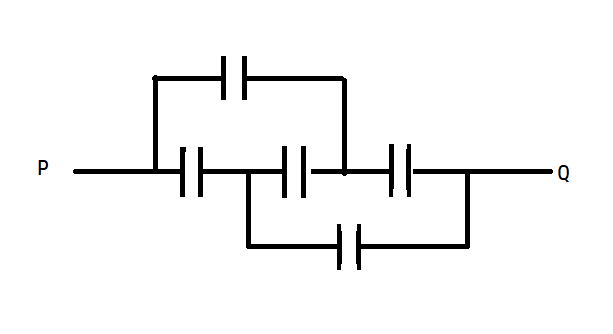
Find the effective capacitance between the points P and Q of the arrangement as shown in the figure below. The capacitance all are of 4 uF
Answer
 Verified
579.6k+ views
Hint:
We know capacitance of a parallel plate capacitor is given by , and d here is the separation between the two plates. Here, we are given a combination of capacitors and we have to figure out the series and the parallel combinations.
Step by step answer:
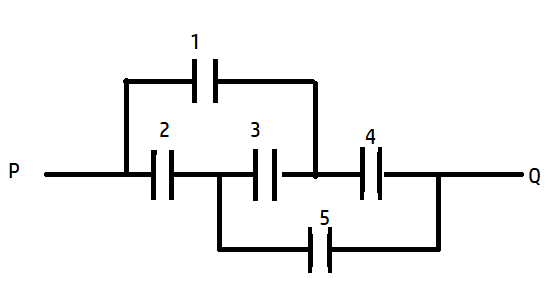
We have given numbers to the capacitors as 1,2,3,4 & 5. We can redraw it in this way:
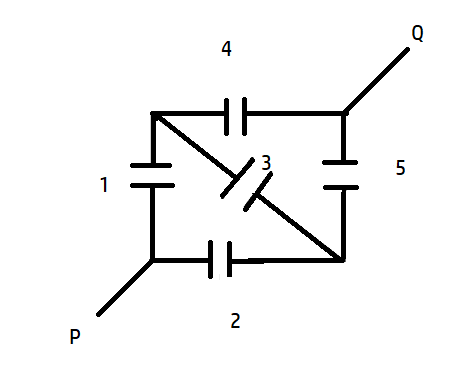
Now the capacitance of all the capacitors are equal. This is a Wheatstone bridge for capacitors. The capacitor in the middle can thus be neglected.
Thus, 1 & 2 are in series and 4 & 5 are in series and resultant of both are in parallel.
For 1 & 2 \[C'=\dfrac{4\times 4}{4+4}=2\mu F\] and for 3 & 4 \[C''=\dfrac{4\times 4}{4+4}=2\mu F\]
Now they are in parallel, thus net resistance of the circuit is \[{{C}_{net}}=2+2=4\mu F\]
Additional Information:
Apart from parallel plate capacitors, there exist a class of capacitors which are cylindrical in shape. A cylindrical capacitor consists of a hollow or a solid cylindrical conductor surrounded by another concentric hollow spherical cylinder. Here the length is the same for both but the radius is different. The charges are equal in magnitude but opposite in polarity.
Note: The capacitance in series is added just in the way the resistors are in parallel. And the capacitance in parallel is added just in the way the resistors are in series. The capacitor stores charge and once it gets fully charged no current flows through it.
We know capacitance of a parallel plate capacitor is given by , and d here is the separation between the two plates. Here, we are given a combination of capacitors and we have to figure out the series and the parallel combinations.
Step by step answer:
We have given numbers to the capacitors as 1,2,3,4 & 5. We can redraw it in this way:
Now the capacitance of all the capacitors are equal. This is a Wheatstone bridge for capacitors. The capacitor in the middle can thus be neglected.
Thus, 1 & 2 are in series and 4 & 5 are in series and resultant of both are in parallel.
For 1 & 2 \[C'=\dfrac{4\times 4}{4+4}=2\mu F\] and for 3 & 4 \[C''=\dfrac{4\times 4}{4+4}=2\mu F\]
Now they are in parallel, thus net resistance of the circuit is \[{{C}_{net}}=2+2=4\mu F\]
Additional Information:
Apart from parallel plate capacitors, there exist a class of capacitors which are cylindrical in shape. A cylindrical capacitor consists of a hollow or a solid cylindrical conductor surrounded by another concentric hollow spherical cylinder. Here the length is the same for both but the radius is different. The charges are equal in magnitude but opposite in polarity.
Note: The capacitance in series is added just in the way the resistors are in parallel. And the capacitance in parallel is added just in the way the resistors are in series. The capacitor stores charge and once it gets fully charged no current flows through it.
Recently Updated Pages
Master Class 12 Economics: Engaging Questions & Answers for Success

Master Class 12 Physics: Engaging Questions & Answers for Success
Master Class 12 English: Engaging Questions & Answers for Success
Master Class 12 Social Science: Engaging Questions & Answers for Success
Master Class 12 Maths: Engaging Questions & Answers for Success
Master Class 12 Business Studies: Engaging Questions & Answers for Success
Trending doubts
Which are the Top 10 Largest Countries of the World?
What are the major means of transport Explain each class 12 social science CBSE
Draw a labelled sketch of the human eye class 12 physics CBSE
Why cannot DNA pass through cell membranes class 12 biology CBSE
Differentiate between insitu conservation and exsitu class 12 biology CBSE
Draw a neat and well labeled diagram of TS of ovary class 12 biology CBSE