




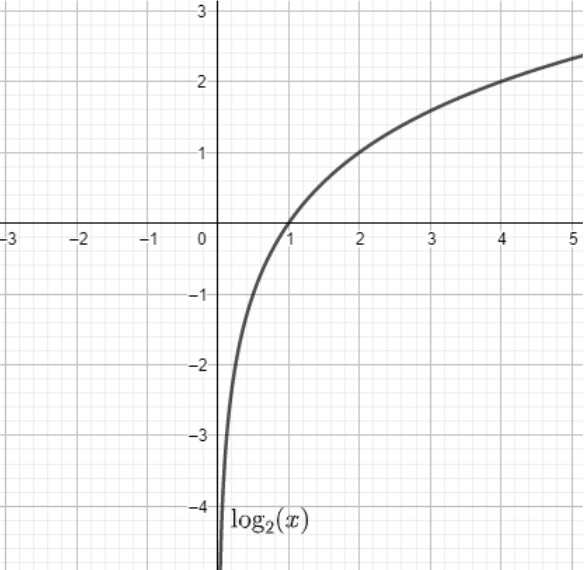
Find the domain of \[y={{\log }_{2}}x\] ?
Answer
 Verified
601.5k+ views
Hint: The domain of a function is the set of its possible inputs where for which the function is defined. We should remember that the base of a logarithm must be a positive number and it should not be equal to 1. The base of \[y={{\log }_{2}}x\] is x. So, x should be greater than 0 and should be equal to 1.
Complete step-by-step solution:
Before solving question we should know that the logarithmic function\[y={{\log }_{b}}a\] is defined to be equivalent to the exponential equation \[a={{b}^{y}}\] under the conditions \[a>0,b>0,a\ne 1,b\ne 1\]. We know that the domain of a function is the set of all possible inputs given to a function where the function is defined. The range is said to be defined as all the possible values obtained from the domain of the function.
From the question, we are given a function \[y={{\log }_{2}}x\].
By comparing the function \[y={{\log }_{2}}x\] with\[y={{\log }_{b}}a\] , we get \[a=x,b=2\].
We know that for a logarithm \[y={{\log }_{b}}a\] the following conditions are needed to be followed:
\[\begin{align}
& 1)a>0 \\
& 2)a\ne 1 \\
& 3)b>0 \\
& 4)b\ne 1 \\
\end{align}\]
As the value of \[b=2\], condition (3) and condition (4) are satisfied.
The value of \[a=x\], so to get condition (1) and condition (2) satisfied.
The value of x should be greater than 1 and equal to zero. \[x>0,x\ne 1\].
So, the domain the function \[y={{\log }_{2}}x\] is \[(0,1)\cup (1,\infty )\].
Note: There is an alternative method to solve this problem. We know that the logarithmic function \[y={{\log }_{b}}a\] is defined to be equivalent to the exponential equation \[a={{b}^{y}}\] under the conditions \[a>0,b>0,a\ne 1,b\ne 1\]. In the similar manner, we will write \[y={{\log }_{2}}x\] as \[{{2}^{y}}=x\]. Now, applying the condition on \[{{2}^{y}}=x\] from the conditions that we have shown for \[a={{b}^{y}}\].
2 is already greater than 0 and x must be greater than 0.
$x>0$ ……… (1)
Also 2 and x must not be equal to 1. As it is clear that 2 is not equal to 1 and also x must not be equal to 1.
$x\ne 1$ ………… (2)
Combining (1) and (2) we get,
\[x\in (0,1)\cup (1,\infty )\]
So, the domain the function \[y={{\log }_{2}}x\] is:
\[(0,1)\cup (1,\infty )\]
Complete step-by-step solution:
Before solving question we should know that the logarithmic function\[y={{\log }_{b}}a\] is defined to be equivalent to the exponential equation \[a={{b}^{y}}\] under the conditions \[a>0,b>0,a\ne 1,b\ne 1\]. We know that the domain of a function is the set of all possible inputs given to a function where the function is defined. The range is said to be defined as all the possible values obtained from the domain of the function.
From the question, we are given a function \[y={{\log }_{2}}x\].
By comparing the function \[y={{\log }_{2}}x\] with\[y={{\log }_{b}}a\] , we get \[a=x,b=2\].
We know that for a logarithm \[y={{\log }_{b}}a\] the following conditions are needed to be followed:
\[\begin{align}
& 1)a>0 \\
& 2)a\ne 1 \\
& 3)b>0 \\
& 4)b\ne 1 \\
\end{align}\]
As the value of \[b=2\], condition (3) and condition (4) are satisfied.
The value of \[a=x\], so to get condition (1) and condition (2) satisfied.
The value of x should be greater than 1 and equal to zero. \[x>0,x\ne 1\].
So, the domain the function \[y={{\log }_{2}}x\] is \[(0,1)\cup (1,\infty )\].
Note: There is an alternative method to solve this problem. We know that the logarithmic function \[y={{\log }_{b}}a\] is defined to be equivalent to the exponential equation \[a={{b}^{y}}\] under the conditions \[a>0,b>0,a\ne 1,b\ne 1\]. In the similar manner, we will write \[y={{\log }_{2}}x\] as \[{{2}^{y}}=x\]. Now, applying the condition on \[{{2}^{y}}=x\] from the conditions that we have shown for \[a={{b}^{y}}\].
2 is already greater than 0 and x must be greater than 0.
$x>0$ ……… (1)
Also 2 and x must not be equal to 1. As it is clear that 2 is not equal to 1 and also x must not be equal to 1.
$x\ne 1$ ………… (2)
Combining (1) and (2) we get,
\[x\in (0,1)\cup (1,\infty )\]
So, the domain the function \[y={{\log }_{2}}x\] is:
\[(0,1)\cup (1,\infty )\]
Recently Updated Pages
Master Class 12 Business Studies: Engaging Questions & Answers for Success

Master Class 12 Biology: Engaging Questions & Answers for Success
Master Class 12 Chemistry: Engaging Questions & Answers for Success
Class 12 Question and Answer - Your Ultimate Solutions Guide
Master Class 11 Social Science: Engaging Questions & Answers for Success
Master Class 11 English: Engaging Questions & Answers for Success
Trending doubts
Which is more stable and why class 12 chemistry CBSE
Which are the Top 10 Largest Countries of the World?
Draw a labelled sketch of the human eye class 12 physics CBSE
Differentiate between homogeneous and heterogeneous class 12 chemistry CBSE
What are the major means of transport Explain each class 12 social science CBSE
Sulphuric acid is known as the king of acids State class 12 chemistry CBSE