




Find the direction cosines of the z-axis.
Answer
 Verified
558.5k+ views
Hint: In order to solve this problem, we need to find the understanding of the term of direction cosine. Direction cosines of the vector are the cosines of the angles between the vector and the three coordinate axes.
The direction cosines are given by l, m, n. The angles made by vectors with x, y and z axes are $ \alpha ,\beta ,\gamma $ respectively. Therefore, the direction cosines of the vector with the x-axis, y-axis and z-axis are given by $ l=\cos \alpha $ , $ m=\cos \beta $ , $ n=\cos \gamma $ .
Complete step-by-step answer:
We are asked to find the direction cosine of the z-axis.
Let's understand what direction cosines are.
Direction cosines of the vector are the cosines of the angles between the vector and the three coordinate axes.
The direction cosines are given by l, m, n.
The angles made by vectors with x, y and z axes are $ \alpha ,\beta ,\gamma $ respectively.
Therefore, the direction cosine of the vector with the x-axis is given by $ l=\cos \alpha $ .
The direction cosine of the vector with y-axis is given by $ m=\cos \beta $ .
The direction cosine of the vector with z-axis is given by $ n=\cos \gamma $ .
We can show the axis as follows,
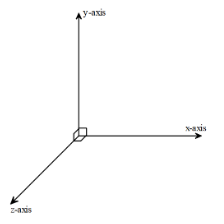
All the coordinate axes are perpendicular to each other.
We need to find the direction cosine of the z-axis.
As the vector is along the z-axis the angle made by x-axis is $ {{90}^{\circ }} $ .
The angle made by the z-axis is hence zero.
The angle made by the y-axis with the vector is $ {{90}^{\circ }} $ .
Hence, the angles are $ \alpha ={{90}^{\circ }},\beta ={{90}^{\circ }},\gamma ={{0}^{\circ }} $ .
Taking the cosine of all angles we get,
$ l=\cos 90,m=\cos 90,n=\cos 0 $ .
Finding the values, we get,
$ l=0,m=0,n=1 $
Therefore, the direction cosines are $ \left( l,m,n \right)=\left( 0,0,1 \right) $
Note: We need to understand that all the angles are calculated from the positive axis of all the three coordinates. These direction cosines can find the relationship of any vector with all the coordinate axes.We can similarly find the direction cosine of the x-axis. By symmetry, we can see that the direction cosine of the x-axis is $ \left( l,m,n \right)=\left( 1,0,0 \right) $ and that of the y-axis is $ \left( l,m,n \right)=\left( 0,1,0 \right) $ .
The direction cosines are given by l, m, n. The angles made by vectors with x, y and z axes are $ \alpha ,\beta ,\gamma $ respectively. Therefore, the direction cosines of the vector with the x-axis, y-axis and z-axis are given by $ l=\cos \alpha $ , $ m=\cos \beta $ , $ n=\cos \gamma $ .
Complete step-by-step answer:
We are asked to find the direction cosine of the z-axis.
Let's understand what direction cosines are.
Direction cosines of the vector are the cosines of the angles between the vector and the three coordinate axes.
The direction cosines are given by l, m, n.
The angles made by vectors with x, y and z axes are $ \alpha ,\beta ,\gamma $ respectively.
Therefore, the direction cosine of the vector with the x-axis is given by $ l=\cos \alpha $ .
The direction cosine of the vector with y-axis is given by $ m=\cos \beta $ .
The direction cosine of the vector with z-axis is given by $ n=\cos \gamma $ .
We can show the axis as follows,
All the coordinate axes are perpendicular to each other.
We need to find the direction cosine of the z-axis.
As the vector is along the z-axis the angle made by x-axis is $ {{90}^{\circ }} $ .
The angle made by the z-axis is hence zero.
The angle made by the y-axis with the vector is $ {{90}^{\circ }} $ .
Hence, the angles are $ \alpha ={{90}^{\circ }},\beta ={{90}^{\circ }},\gamma ={{0}^{\circ }} $ .
Taking the cosine of all angles we get,
$ l=\cos 90,m=\cos 90,n=\cos 0 $ .
Finding the values, we get,
$ l=0,m=0,n=1 $
Therefore, the direction cosines are $ \left( l,m,n \right)=\left( 0,0,1 \right) $
Note: We need to understand that all the angles are calculated from the positive axis of all the three coordinates. These direction cosines can find the relationship of any vector with all the coordinate axes.We can similarly find the direction cosine of the x-axis. By symmetry, we can see that the direction cosine of the x-axis is $ \left( l,m,n \right)=\left( 1,0,0 \right) $ and that of the y-axis is $ \left( l,m,n \right)=\left( 0,1,0 \right) $ .
Recently Updated Pages
Master Class 12 Economics: Engaging Questions & Answers for Success

Master Class 12 English: Engaging Questions & Answers for Success
Master Class 12 Social Science: Engaging Questions & Answers for Success
Master Class 12 Maths: Engaging Questions & Answers for Success
Master Class 12 Physics: Engaging Questions & Answers for Success
Master Class 12 Business Studies: Engaging Questions & Answers for Success
Trending doubts
Which are the Top 10 Largest Countries of the World?
Draw a labelled sketch of the human eye class 12 physics CBSE
Differentiate between homogeneous and heterogeneous class 12 chemistry CBSE
Why is the cell called the structural and functional class 12 biology CBSE
Draw ray diagrams each showing i myopic eye and ii class 12 physics CBSE
Which is the correct genotypic ratio of mendel dihybrid class 12 biology CBSE