




Find the dimensions of the rectangle of the largest area that can be inscribed in a circle of radius r.
Answer
 Verified
585.9k+ views
Hint: A rectangle has two dimensions namely length and breadth. To find its maximum value, we differentiate the function and put the obtained derivative equal to zero. But for differentiating the area function, we have to first convert it into a function of only one variable. As the radius of the circle is constant, its derivative will be zero so use the relation between length, breadth and radius of the circle to find out the correct answer.
Complete step-by-step answer:
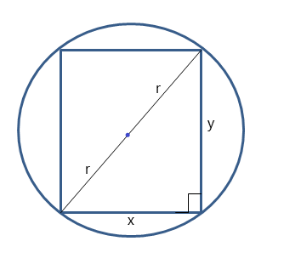
Let a rectangle of dimensions $ x \times y $ be inscribed in a circle of radius r.
Applying Pythagoras theorem on the right-angled triangle,
$
\Rightarrow {x^2} + {y^2} = {(2r)^2} \\
\Rightarrow {x^2} + {y^2} = 4{r^2} \\
\Rightarrow {y^2} = 4{r^2} - {x^2} \\
\Rightarrow y = \sqrt {4{r^2} - {x^2}} \;
$
As dimensions of any shape cannot be negative so $ y = - \sqrt {4{r^2} - {x^2}} $ is not considered.
Area of the rectangle,
$
\Rightarrow A = x \times y \\
\Rightarrow A = x\sqrt {4{r^2} - {x^2}} \;
$
Differentiating both sides with respect to x, we get –
$ \dfrac{{dA}}{{dx}} = \dfrac{d}{{dx}}(x\sqrt {4{r^2} - {x^2}} ) $
Use the product rule to differentiate the above result –
$
{A^1}(x) = x\dfrac{{d(\sqrt {4{r^2} - {x^2}} )}}{{dx}} + \sqrt {4{r^2} - {x^2}} \dfrac{{d(x)}}{{dx}} \\
{A^1}(x) = x\dfrac{{d\sqrt {4{r^2} - {x^2}} }}{{d(4{r^2} - {x^2})}}\dfrac{{d(4{r^2} - {x^2})}}{{dx}} + \sqrt {4{r^2} - {x^2}} (1) \\
{A^1}(x) = x\dfrac{1}{{2\sqrt {4{r^2} - {x^2}} }}( - 2x) + \sqrt {4{r^2} - {x^2}} \\
{A^1}(x) = \dfrac{{ - {x^2} + 4{r^2} - {x^2}}}{{\sqrt {4{r^2} - {x^2}} }} \\
{A^1}(x) = \dfrac{{ - 2{x^2} + 4{r^2}}}{{\sqrt {4{r^2} - {x^2}} }} \;
$
Now to get the maximum value, put $ {A^1}(x) = 0 $
$
\dfrac{{ - 2{x^2} + 4{r^2}}}{{\sqrt {4{r^2} - {x^2}} }} = 0 \\
\Rightarrow 4{r^2} = 2{x^2} \\
{x^2} = 2{r^2} \\
x = \sqrt 2 r \;
$
The negative value of x is rejected.
$ \Rightarrow y = \sqrt {4{r^2} - {x^2}} = r\sqrt 2 $
$
A(r\sqrt 2 ) = r\sqrt 2 (\sqrt {4{r^2} - 2{r^2}} \\
A(r\sqrt 2 ) = r\sqrt 2 (r\sqrt 2 ) = 2{r^2} \;
$
The maximum area of a rectangle inscribed in a circle is $ 2{r^2}\,units $ and its dimensions are $ r\sqrt 2 \,units \times r\sqrt 2 \,units $ .
So, the correct answer is “ $ 2{r^2}\,units $ ”.
Note: To verify that the area found out is the maximum, we take the second derivative test.
If the second derivative comes out to be negative at that point then the point gives maximum value and if the second derivative comes out to be positive then the point gives minimum value. You can verify the above answer by doing its second derivative test. We also observe that the length is equal to the breadth of the rectangle for the maximum area that is a rectangle of maximum area that can be inscribed in a circle is a square.
Complete step-by-step answer:
Let a rectangle of dimensions $ x \times y $ be inscribed in a circle of radius r.
Applying Pythagoras theorem on the right-angled triangle,
$
\Rightarrow {x^2} + {y^2} = {(2r)^2} \\
\Rightarrow {x^2} + {y^2} = 4{r^2} \\
\Rightarrow {y^2} = 4{r^2} - {x^2} \\
\Rightarrow y = \sqrt {4{r^2} - {x^2}} \;
$
As dimensions of any shape cannot be negative so $ y = - \sqrt {4{r^2} - {x^2}} $ is not considered.
Area of the rectangle,
$
\Rightarrow A = x \times y \\
\Rightarrow A = x\sqrt {4{r^2} - {x^2}} \;
$
Differentiating both sides with respect to x, we get –
$ \dfrac{{dA}}{{dx}} = \dfrac{d}{{dx}}(x\sqrt {4{r^2} - {x^2}} ) $
Use the product rule to differentiate the above result –
$
{A^1}(x) = x\dfrac{{d(\sqrt {4{r^2} - {x^2}} )}}{{dx}} + \sqrt {4{r^2} - {x^2}} \dfrac{{d(x)}}{{dx}} \\
{A^1}(x) = x\dfrac{{d\sqrt {4{r^2} - {x^2}} }}{{d(4{r^2} - {x^2})}}\dfrac{{d(4{r^2} - {x^2})}}{{dx}} + \sqrt {4{r^2} - {x^2}} (1) \\
{A^1}(x) = x\dfrac{1}{{2\sqrt {4{r^2} - {x^2}} }}( - 2x) + \sqrt {4{r^2} - {x^2}} \\
{A^1}(x) = \dfrac{{ - {x^2} + 4{r^2} - {x^2}}}{{\sqrt {4{r^2} - {x^2}} }} \\
{A^1}(x) = \dfrac{{ - 2{x^2} + 4{r^2}}}{{\sqrt {4{r^2} - {x^2}} }} \;
$
Now to get the maximum value, put $ {A^1}(x) = 0 $
$
\dfrac{{ - 2{x^2} + 4{r^2}}}{{\sqrt {4{r^2} - {x^2}} }} = 0 \\
\Rightarrow 4{r^2} = 2{x^2} \\
{x^2} = 2{r^2} \\
x = \sqrt 2 r \;
$
The negative value of x is rejected.
$ \Rightarrow y = \sqrt {4{r^2} - {x^2}} = r\sqrt 2 $
$
A(r\sqrt 2 ) = r\sqrt 2 (\sqrt {4{r^2} - 2{r^2}} \\
A(r\sqrt 2 ) = r\sqrt 2 (r\sqrt 2 ) = 2{r^2} \;
$
The maximum area of a rectangle inscribed in a circle is $ 2{r^2}\,units $ and its dimensions are $ r\sqrt 2 \,units \times r\sqrt 2 \,units $ .
So, the correct answer is “ $ 2{r^2}\,units $ ”.
Note: To verify that the area found out is the maximum, we take the second derivative test.
If the second derivative comes out to be negative at that point then the point gives maximum value and if the second derivative comes out to be positive then the point gives minimum value. You can verify the above answer by doing its second derivative test. We also observe that the length is equal to the breadth of the rectangle for the maximum area that is a rectangle of maximum area that can be inscribed in a circle is a square.
Recently Updated Pages
Master Class 12 Social Science: Engaging Questions & Answers for Success

Master Class 12 Physics: Engaging Questions & Answers for Success
Master Class 12 Maths: Engaging Questions & Answers for Success
Master Class 12 Economics: Engaging Questions & Answers for Success
Master Class 12 Chemistry: Engaging Questions & Answers for Success
Master Class 12 Business Studies: Engaging Questions & Answers for Success
Trending doubts
Which are the Top 10 Largest Countries of the World?
Draw a labelled sketch of the human eye class 12 physics CBSE
Explain the structure of megasporangium class 12 biology CBSE
What are the major means of transport Explain each class 12 social science CBSE
How many chromosomes are found in human ovum a 46 b class 12 biology CBSE
The diagram of the section of a maize grain is given class 12 biology CBSE