




Find the diagonal of a square whose side is 14 cm.
Answer
 Verified
654k+ views
Hint: In this question, we will divide a square into two right angled triangles and then apply Pythagoras theorem to one of them to find the length of the diagonal.
Complete step-by-step answer:
Let us consider a square ABCD with each side of length 14 cm. Let us now draw a diagonal AC by joining point A and C of the square.
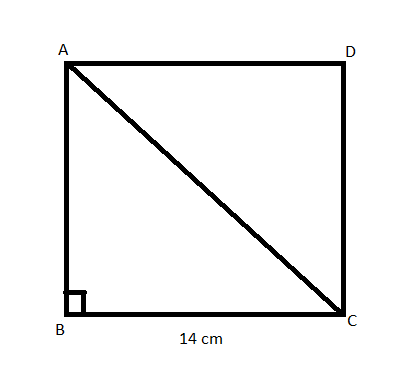
Now, in a square, all its four sides are equal in length. And here, all four sides of the square are of the length 14 cm.
Therefore, \[\text{AB=BC=CD=DA=14 cm}\].
And, all the angles of a square are ${{90}^{\circ }}$.
Therefore, $\angle \text{ABC}={{90}^{\circ }}$.
Also, according to Pythagoras theorem, in a right-angled triangle PQR, right angled at Q,$\text{P}{{\text{Q}}^{\text{2}}}\text{+Q}{{\text{R}}^{\text{2}}}\text{=P}{{\text{R}}^{\text{2}}}$.
Now, considering a triangle ABC in a square ABCD.
It is right angled at B, so applying Pythagoras theorem here, we get,
$\text{A}{{\text{B}}^{\text{2}}}\text{+B}{{\text{C}}^{\text{2}}}\text{=A}{{\text{C}}^{\text{2}}}$
Putting the values of AB and BC here, we get,
$\begin{align}
& \text{1}{{\text{4}}^{\text{2}}}\text{c}{{\text{m}}^{2}}\text{+1}{{\text{4}}^{\text{2}}}\text{c}{{\text{m}}^{2}}\text{=A}{{\text{C}}^{\text{2}}} \\
& \Rightarrow \text{A}{{\text{C}}^{\text{2}}}\text{=}\left( \text{1}{{\text{4}}^{\text{2}}}\text{+1}{{\text{4}}^{\text{2}}} \right)\text{c}{{\text{m}}^{\text{2}}} \\
& \Rightarrow \text{A}{{\text{C}}^{\text{2}}}\text{=2}\times \text{1}{{\text{4}}^{\text{2}}}\text{c}{{\text{m}}^{\text{2}}} \\
\end{align}$
Taking square root on both sides of the equation here, we get,
$\begin{align}
& \sqrt{\text{A}{{\text{C}}^{\text{2}}}}\text{=}\sqrt{\text{2 }\!\!\times\!\!\text{ 1}{{\text{4}}^{\text{2}}}\,\text{c}{{\text{m}}^{\text{2}}}} \\
& \Rightarrow \sqrt{\text{A}{{\text{C}}^{\text{2}}}}\text{=}\sqrt{\text{2}}\sqrt{\text{1}{{\text{4}}^{\text{2}}}\,\text{c}{{\text{m}}^{\text{2}}}} \\
\end{align}$
Here, cancelling square root with whole square, we get,
$\text{AC=14}\sqrt{\text{2}}\,\text{cm}$.
Hence, the diagonal of a square whose side is 14 cm is $14\sqrt{2}$ cm.
Note: This question can also be done directly with the formula that, in all squares, the length of a diagonal is always $\sqrt{2}$ times the length of the side of the square.
Complete step-by-step answer:
Let us consider a square ABCD with each side of length 14 cm. Let us now draw a diagonal AC by joining point A and C of the square.
Now, in a square, all its four sides are equal in length. And here, all four sides of the square are of the length 14 cm.
Therefore, \[\text{AB=BC=CD=DA=14 cm}\].
And, all the angles of a square are ${{90}^{\circ }}$.
Therefore, $\angle \text{ABC}={{90}^{\circ }}$.
Also, according to Pythagoras theorem, in a right-angled triangle PQR, right angled at Q,$\text{P}{{\text{Q}}^{\text{2}}}\text{+Q}{{\text{R}}^{\text{2}}}\text{=P}{{\text{R}}^{\text{2}}}$.
Now, considering a triangle ABC in a square ABCD.
It is right angled at B, so applying Pythagoras theorem here, we get,
$\text{A}{{\text{B}}^{\text{2}}}\text{+B}{{\text{C}}^{\text{2}}}\text{=A}{{\text{C}}^{\text{2}}}$
Putting the values of AB and BC here, we get,
$\begin{align}
& \text{1}{{\text{4}}^{\text{2}}}\text{c}{{\text{m}}^{2}}\text{+1}{{\text{4}}^{\text{2}}}\text{c}{{\text{m}}^{2}}\text{=A}{{\text{C}}^{\text{2}}} \\
& \Rightarrow \text{A}{{\text{C}}^{\text{2}}}\text{=}\left( \text{1}{{\text{4}}^{\text{2}}}\text{+1}{{\text{4}}^{\text{2}}} \right)\text{c}{{\text{m}}^{\text{2}}} \\
& \Rightarrow \text{A}{{\text{C}}^{\text{2}}}\text{=2}\times \text{1}{{\text{4}}^{\text{2}}}\text{c}{{\text{m}}^{\text{2}}} \\
\end{align}$
Taking square root on both sides of the equation here, we get,
$\begin{align}
& \sqrt{\text{A}{{\text{C}}^{\text{2}}}}\text{=}\sqrt{\text{2 }\!\!\times\!\!\text{ 1}{{\text{4}}^{\text{2}}}\,\text{c}{{\text{m}}^{\text{2}}}} \\
& \Rightarrow \sqrt{\text{A}{{\text{C}}^{\text{2}}}}\text{=}\sqrt{\text{2}}\sqrt{\text{1}{{\text{4}}^{\text{2}}}\,\text{c}{{\text{m}}^{\text{2}}}} \\
\end{align}$
Here, cancelling square root with whole square, we get,
$\text{AC=14}\sqrt{\text{2}}\,\text{cm}$.
Hence, the diagonal of a square whose side is 14 cm is $14\sqrt{2}$ cm.
Note: This question can also be done directly with the formula that, in all squares, the length of a diagonal is always $\sqrt{2}$ times the length of the side of the square.
Recently Updated Pages
Master Class 11 English: Engaging Questions & Answers for Success

Master Class 11 Social Science: Engaging Questions & Answers for Success
Master Class 11 Maths: Engaging Questions & Answers for Success
Master Class 11 Biology: Engaging Questions & Answers for Success
Master Class 11 Physics: Engaging Questions & Answers for Success
Master Class 11 Chemistry: Engaging Questions & Answers for Success
Trending doubts
Explain the Treaty of Vienna of 1815 class 10 social science CBSE
What is the full form of POSCO class 10 social science CBSE
Define Potential, Developed, Stock and Reserved resources
The diagonals of a rhombus are 10cm and 24cm Find the class 10 maths CBSE
Fill the blanks with proper collective nouns 1 A of class 10 english CBSE
What planets have no moons Which one has only one moon class 10 physics CBSE