




Find the current through the circuit when switch is opened and switch is closed;
Answer
 Verified
604.5k+ views
Hint: When a circuit is open, there will not be any current as there is no conducting material for the current to pass through. The voltage in any circuit can be calculated as the product of the resistance in the circuit and the current flowing through the circuit.
Formula used:
$V=IR$
Complete step-by-step answer:
Let us assume the current through the given circuit in both the cases as $I,{{I}_{1}}$. In the first case, when the switch is open, the current passing through the circuit will be
$I=0$ as there is no conductor through which the current can travel in the circuit.
In the second case, the current in the circuit will be
$\begin{align}
& {{I}_{1}}=\dfrac{V}{R} \\
& {{I}_{1}}=\dfrac{10V}{2.5k\Omega } \\
& {{I}_{1}}=4\times {{10}^{-3}}A \\
\end{align}$
Therefore, the current through the circuit when the switch is open is $4\times {{10}^{-3}}A$
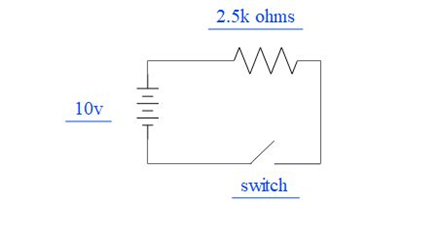
Additional Information: When a switch in a circuit is open, the whole circuit becomes open which in turn causes the current passing through the circuit as zero. If the switch is closed, some amount of current is passed through the entire circuit. A circuit is told to be open when the continuity has been broken by any means of interruption in the path for current to flow. A closed circuit whereas, is the one with good continuity throughout. A device which is used to open and close a circuit under controlled conditions is called a switch.
Note: When a circuit consists of different resistors and is connected in multiple ways, the current through the whole circuit will still be flowing if one of the switches is opened and the rest are closed. There are many applications in real life too. Circuits connected in parallel can utilize this procedure to minimize the current flow and threats as overflow, high current etc.
Formula used:
$V=IR$
Complete step-by-step answer:
Let us assume the current through the given circuit in both the cases as $I,{{I}_{1}}$. In the first case, when the switch is open, the current passing through the circuit will be
$I=0$ as there is no conductor through which the current can travel in the circuit.
In the second case, the current in the circuit will be
$\begin{align}
& {{I}_{1}}=\dfrac{V}{R} \\
& {{I}_{1}}=\dfrac{10V}{2.5k\Omega } \\
& {{I}_{1}}=4\times {{10}^{-3}}A \\
\end{align}$
Therefore, the current through the circuit when the switch is open is $4\times {{10}^{-3}}A$
Additional Information: When a switch in a circuit is open, the whole circuit becomes open which in turn causes the current passing through the circuit as zero. If the switch is closed, some amount of current is passed through the entire circuit. A circuit is told to be open when the continuity has been broken by any means of interruption in the path for current to flow. A closed circuit whereas, is the one with good continuity throughout. A device which is used to open and close a circuit under controlled conditions is called a switch.
Note: When a circuit consists of different resistors and is connected in multiple ways, the current through the whole circuit will still be flowing if one of the switches is opened and the rest are closed. There are many applications in real life too. Circuits connected in parallel can utilize this procedure to minimize the current flow and threats as overflow, high current etc.
Recently Updated Pages
Master Class 12 Social Science: Engaging Questions & Answers for Success

Master Class 12 Physics: Engaging Questions & Answers for Success
Master Class 12 Maths: Engaging Questions & Answers for Success
Master Class 12 Economics: Engaging Questions & Answers for Success
Master Class 12 Chemistry: Engaging Questions & Answers for Success
Master Class 12 Business Studies: Engaging Questions & Answers for Success
Trending doubts
Explain the structure of megasporangium class 12 biology CBSE
What are the major means of transport Explain each class 12 social science CBSE
How many chromosomes are found in human ovum a 46 b class 12 biology CBSE
The diagram of the section of a maize grain is given class 12 biology CBSE
No of 5 membered ring in left Caleft EDTA right right2 class 12 chemistry CBSE
How many 176Omega resistors in parallel are required class 12 physics CBSE