




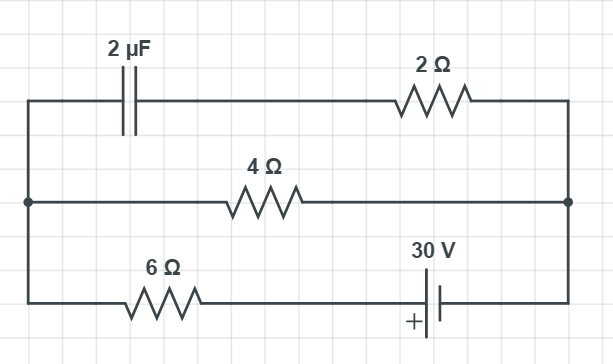
Find the charge stored in the capacitor
A) $24\,\mu C$
B) $12\,\mu C$
C) $16\,\mu C$
D) $20\,\mu C$
Answer
 Verified
606.9k+ views
Hint: In this type of questions, it’s better to first understand the circuit properly and then find the information that is not mentioned in the question, such as current, potential difference and voltage across the resistors. After all the information is calculated, then using the formula for calculating charge, we can get the charge stored in the capacitor.
Formula used:
$V=IR$
Complete answer:
In steady state current flows in the lower loop of the circuit only, due to which the resistor of $4\,\Omega \,\text{and}\,6\,\Omega $ are connected in series, so the net resistance is:
$\begin{align}
& {{R}_{Net}}=(6+4)\,\Omega \\
& \therefore {{R}_{Net}}=10\,\Omega \\
\end{align}$
Using Ohm’s Law,
$V=IR$
where,
‘$I$’ is Current,
‘$V$’ is Voltage, and
‘$R$’ is Resistance.
Substituting the value of V and R in the above equation, we get –
$\begin{align}
& 30\,V=I\times 10\,\Omega \\
& \therefore I=3\,A \\
\end{align}$
Since, Potential difference across capacitor is equal to the potential difference across the $4\,\Omega $ resistance, so
$\text{Potential Difference across Capacitor}=IR=(3\,\times \,4)\,V=12\,V$.
Now, the charge stored in the capacitor can be found using the formula,
$q=CV$
where,
‘$q$’ is Charge,
‘$C$’ is Capacitor value, and
‘$V$’ is Potential Difference.
Substituting the given and obtained value in the above equation, we get –
$\begin{align}
& q=(2\,\mu F)(12\,V) \\
& \therefore q=24\,\mu C \\
\end{align}$
Therefore, the correct answer is Option (A).
Note:
Questions related to the circuit diagram are very frequently asked in papers and are easy to solve as well. To solve this type of questions, first understand the circuit diagram properly and make a list of details that are given in the question and also the details that need to be calculated, which will help to break the questions in small parts and solve the question part by part easily.
Formula used:
$V=IR$
Complete answer:
In steady state current flows in the lower loop of the circuit only, due to which the resistor of $4\,\Omega \,\text{and}\,6\,\Omega $ are connected in series, so the net resistance is:
$\begin{align}
& {{R}_{Net}}=(6+4)\,\Omega \\
& \therefore {{R}_{Net}}=10\,\Omega \\
\end{align}$
Using Ohm’s Law,
$V=IR$
where,
‘$I$’ is Current,
‘$V$’ is Voltage, and
‘$R$’ is Resistance.
Substituting the value of V and R in the above equation, we get –
$\begin{align}
& 30\,V=I\times 10\,\Omega \\
& \therefore I=3\,A \\
\end{align}$
Since, Potential difference across capacitor is equal to the potential difference across the $4\,\Omega $ resistance, so
$\text{Potential Difference across Capacitor}=IR=(3\,\times \,4)\,V=12\,V$.
Now, the charge stored in the capacitor can be found using the formula,
$q=CV$
where,
‘$q$’ is Charge,
‘$C$’ is Capacitor value, and
‘$V$’ is Potential Difference.
Substituting the given and obtained value in the above equation, we get –
$\begin{align}
& q=(2\,\mu F)(12\,V) \\
& \therefore q=24\,\mu C \\
\end{align}$
Therefore, the correct answer is Option (A).
Note:
Questions related to the circuit diagram are very frequently asked in papers and are easy to solve as well. To solve this type of questions, first understand the circuit diagram properly and make a list of details that are given in the question and also the details that need to be calculated, which will help to break the questions in small parts and solve the question part by part easily.
Recently Updated Pages
Master Class 11 English: Engaging Questions & Answers for Success

Master Class 11 Physics: Engaging Questions & Answers for Success
Master Class 11 Computer Science: Engaging Questions & Answers for Success
Master Class 11 Chemistry: Engaging Questions & Answers for Success
Master Class 11 Social Science: Engaging Questions & Answers for Success
Master Class 11 Accountancy: Engaging Questions & Answers for Success
Trending doubts
Draw a diagram of a plant cell and label at least eight class 11 biology CBSE
Proton was discovered by A Thomson B Rutherford C Chadwick class 11 chemistry CBSE
What is the purity of pure gold in carat class 11 chemistry CBSE
Can anyone list 10 advantages and disadvantages of friction
Lysosomes are known as suicidal bags of cell why class 11 biology CBSE
Derive the equation of motion by the calculus method class 11 physics CBSE