




Find the area of the greatest rectangle that can be inscribed in an ellipse \[\dfrac{{{x}^{2}}}{{{a}^{2}}}+\dfrac{{{y}^{2}}}{{{b}^{2}}}=1\]
Answer
 Verified
650.7k+ views
Hint: We can assume a rectangle inside an ellipse now we know that general coordinates of any point is \[(acos\theta ,bsin\theta )\] , so we consider 4 vertices of rectangles as \[(acos\theta ,bsin\theta ), (acos\theta ,-bsin\theta ), (-acos\theta ,bsin\theta ) and (-acos\theta ,-bsin\theta )\]
So side length of rectangle will be \[2acos\theta \] and \[2bsin\theta \] so its area will be \[ab4sin\theta cos\theta \]
Now we have to maximize area by differentiating and equating 0, and double differentiating and equating < 0.
Complete step-by-step solution:
We are given an ellipse \[\dfrac{{{x}^{2}}}{{{a}^{2}}}+\dfrac{{{y}^{2}}}{{{b}^{2}}}=1\] and a rectangle is inscribed in it so as we know general coordinates of any point in ellipse of equation \[\dfrac{{{x}^{2}}}{{{a}^{2}}}+\dfrac{{{y}^{2}}}{{{b}^{2}}}=1\] is \[(acos\theta ,bsin\theta )\]
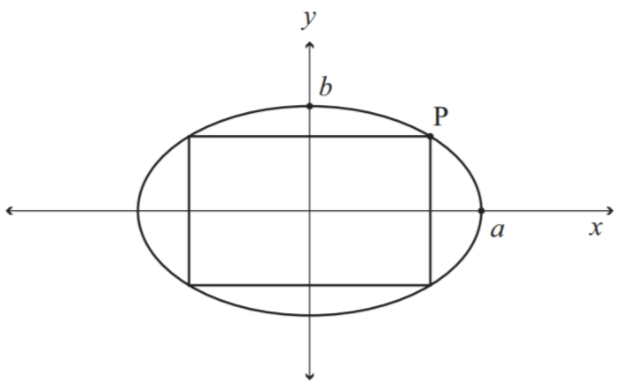
So, we take general vertices of rectangle as \[(acos\theta, bsin\theta ), (acos\theta, -bsin\theta ), (-acos\theta, bsin\theta ) and (-acos\theta, -bsin\theta )\]
So, we can see that length and breadth of rectangle is \[2acos\theta \] and \[2bsin\theta \]
So, its area will be \[ab4sin\theta cos\theta \] (length x Breadth)
Applying trigonometric formula \[2sin\theta cos\theta =\sin 2\theta \], let area equals to A
Now \[A=2ab\sin 2\theta \]
Now as its the area is maximum given in question, we have to differentiate it with respect to \[\theta \]
\[\dfrac{dA}{d\theta }=2ab\cos 2\theta \times 2\] (using \[\dfrac{d\sin 2\theta }{d\theta }=2\cos 2\theta \])
Equating \[\dfrac{dA}{d\theta }=2ab\cos 2\theta \times 2=0\], it means \[\cos 2\theta =0\] , which means \[2\theta =\dfrac{\pi }{2}\] and \[\theta =\dfrac{\pi }{4}\]
But we have to check that at \[\theta =\dfrac{\pi }{4}\] area is maximum and not minimum
For that we have to calculate \[\dfrac{{{d}^{2}}A}{d{{\theta }^{2}}}\]
Which will be equals to \[\dfrac{{{d}^{2}}A}{d{{\theta }^{2}}}=4ab(-\sin 2\theta )\times 2\]
On solving further equals to \[\dfrac{{{d}^{2}}A}{d{{\theta }^{2}}}=-8ab(\sin 2\theta )\] now putting \[\theta =\dfrac{\pi }{4}\] we get
\[\dfrac{{{d}^{2}}A}{d{{\theta }^{2}}}=-8ab\], which is a negative quantity hence we can say that area is maximum at \[\theta =\dfrac{\pi }{4}\]
So now we to put \[\theta =\dfrac{\pi }{4}\] in equation of area which is \[A=2ab\sin 2\theta \]
We get as \[A=2ab\sin 2\dfrac{\pi }{4}=2ab\sin \dfrac{\pi }{2}=2ab\]
Hence max area of rectangle inside ellipse is \[2ab\].
Note: If instead of ellipse we are given a circle \[{{x}^{2}}+{{y}^{2}}={{r}^{2}}\] and to find area of the greatest rectangle that can be inscribed in it , again we can apply same procedure but this time the coordinates are \[(rcos\theta ,rsin\theta ),(rcos\theta ,-rsin\theta ),(-rcos\theta ,rsin\theta )and(-rcos\theta ,-rsin\theta )\]
So, we can see that length and breadth of the rectangle is \[2rcos\theta \] and \[2rsin\theta \]. So, its area will be \[{{r}^{2}}4sin\theta cos\theta \] (length x Breadth)
And after differentiating it results into \[2{{r}^{2}}\]
So side length of rectangle will be \[2acos\theta \] and \[2bsin\theta \] so its area will be \[ab4sin\theta cos\theta \]
Now we have to maximize area by differentiating and equating 0, and double differentiating and equating < 0.
Complete step-by-step solution:
We are given an ellipse \[\dfrac{{{x}^{2}}}{{{a}^{2}}}+\dfrac{{{y}^{2}}}{{{b}^{2}}}=1\] and a rectangle is inscribed in it so as we know general coordinates of any point in ellipse of equation \[\dfrac{{{x}^{2}}}{{{a}^{2}}}+\dfrac{{{y}^{2}}}{{{b}^{2}}}=1\] is \[(acos\theta ,bsin\theta )\]
So, we take general vertices of rectangle as \[(acos\theta, bsin\theta ), (acos\theta, -bsin\theta ), (-acos\theta, bsin\theta ) and (-acos\theta, -bsin\theta )\]
So, we can see that length and breadth of rectangle is \[2acos\theta \] and \[2bsin\theta \]
So, its area will be \[ab4sin\theta cos\theta \] (length x Breadth)
Applying trigonometric formula \[2sin\theta cos\theta =\sin 2\theta \], let area equals to A
Now \[A=2ab\sin 2\theta \]
Now as its the area is maximum given in question, we have to differentiate it with respect to \[\theta \]
\[\dfrac{dA}{d\theta }=2ab\cos 2\theta \times 2\] (using \[\dfrac{d\sin 2\theta }{d\theta }=2\cos 2\theta \])
Equating \[\dfrac{dA}{d\theta }=2ab\cos 2\theta \times 2=0\], it means \[\cos 2\theta =0\] , which means \[2\theta =\dfrac{\pi }{2}\] and \[\theta =\dfrac{\pi }{4}\]
But we have to check that at \[\theta =\dfrac{\pi }{4}\] area is maximum and not minimum
For that we have to calculate \[\dfrac{{{d}^{2}}A}{d{{\theta }^{2}}}\]
Which will be equals to \[\dfrac{{{d}^{2}}A}{d{{\theta }^{2}}}=4ab(-\sin 2\theta )\times 2\]
On solving further equals to \[\dfrac{{{d}^{2}}A}{d{{\theta }^{2}}}=-8ab(\sin 2\theta )\] now putting \[\theta =\dfrac{\pi }{4}\] we get
\[\dfrac{{{d}^{2}}A}{d{{\theta }^{2}}}=-8ab\], which is a negative quantity hence we can say that area is maximum at \[\theta =\dfrac{\pi }{4}\]
So now we to put \[\theta =\dfrac{\pi }{4}\] in equation of area which is \[A=2ab\sin 2\theta \]
We get as \[A=2ab\sin 2\dfrac{\pi }{4}=2ab\sin \dfrac{\pi }{2}=2ab\]
Hence max area of rectangle inside ellipse is \[2ab\].
Note: If instead of ellipse we are given a circle \[{{x}^{2}}+{{y}^{2}}={{r}^{2}}\] and to find area of the greatest rectangle that can be inscribed in it , again we can apply same procedure but this time the coordinates are \[(rcos\theta ,rsin\theta ),(rcos\theta ,-rsin\theta ),(-rcos\theta ,rsin\theta )and(-rcos\theta ,-rsin\theta )\]
So, we can see that length and breadth of the rectangle is \[2rcos\theta \] and \[2rsin\theta \]. So, its area will be \[{{r}^{2}}4sin\theta cos\theta \] (length x Breadth)
And after differentiating it results into \[2{{r}^{2}}\]
Recently Updated Pages
Explain the structure of megasporangium class 12 biology CBSE

Why is chloroform kept in dark coloured bottles class 12 chemistry CBSE
Derive the balancing condition of a Wheatstone bri class 12 physics CBSE
Draw VI characteristics of a pn junction diode Explain class 12 physics CBSE
Is it possible to carry pride in ones language too class 12 english CBSE
In a population at Hardy Weinberg equilibrium the allele class 12 biology CBSE
Trending doubts
Draw a labelled sketch of the human eye class 12 physics CBSE
Which are the Top 10 Largest Countries of the World?
Draw ray diagrams each showing i myopic eye and ii class 12 physics CBSE
Which is the correct genotypic ratio of mendel dihybrid class 12 biology CBSE
Differentiate between homogeneous and heterogeneous class 12 chemistry CBSE
Which animal never drinks water in its entire life class 12 biology CBSE