




Find the area of region, $\{(x,y):{{y}^{2}}\le 4x,4{{x}^{2}}+4{{y}^{2}}\le a\}$ using the method of integration.
Answer
 Verified
589.8k+ views
Hint: First, see the region by making the graph in $xy$-plane and try to evaluate the limits of $x$ and $y$, such that one of the limits has constant value and then solve the double integration with respect to $x$ and $y$ .
Complete step by step answer:
In the question , we are given a region whose area we have to evaluate and we know that for evaluating the area of a region we evaluate double integration with respect to $x$ and $y$ .
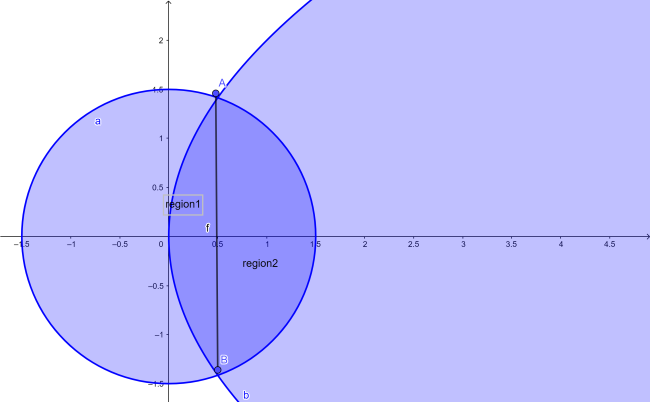
Hence,
Area of the region $\begin{align}
& =\iint{dxdy} \\
&
\end{align}$
As we can see that the whole region cannot be evaluated simultaneously under a single curve as the 2 subregions have the area under 2 different curves, so we have to evaluate them separately.
$=\iint{{}}$region 1 $+\iint{{}}$ region2
Intersection point of the curves will be,
$\begin{align}
& \dfrac{-4{{x}^{2}}+9}{4}=4x \\
&\Rightarrow -4{{x}^{2}}+9=16x \\
&\Rightarrow 4{{x}^{2}}+16x-9=0 \\
&\Rightarrow x=\dfrac{1}{2}
\end{align}$
Hence, for the first region $x$ has range from 0 to $\dfrac{1}{2}$
And in region 1 we have area under the parabola
, so $y$ will range from 0 to $2\sqrt{x}$
and for the second region $x$ will range from $\dfrac{1}{2}$ to $\dfrac{3}{2}$
and since in region 2 we have area under circle, $y$ will range from 0 to $\dfrac{1}{2}\sqrt{9-4{{x}^{2}}}$
By putting the limits, we get
[While solving this, we are going to get an integration of the form $\int{\sqrt{{{a}^{2}}-{{x}^{2}}}}$
Which is equal to $\dfrac{1}{2}x\sqrt{{{a}^{2}}-{{x}^{2}}}+\dfrac{1}{2}{{a}^{2}}{{\operatorname{Sin}}^{-1}}\dfrac{x}{a}$ , but the form in our question involves $2x$ instead of $x$ , so now we will use the same formula for $2x$ and divide the RHS of the formula by 2]
\[\begin{align}
& =2\int\limits_{0}^{\dfrac{1}{2}}{\int\limits_{0}^{2\sqrt{x}}{dxdy+\dfrac{1}{2}\int\limits_{\dfrac{1}{2}}^{\dfrac{3}{2}}{\int\limits_{0}^{\dfrac{1}{2}\sqrt{9-4{{x}^{2}}}}{dxdy}}}} \\
& =2\int\limits_{0}^{\dfrac{1}{2}}{2\sqrt{x}dx+}\dfrac{1}{2}\int\limits_{\dfrac{1}{2}}^{\dfrac{3}{2}}{\dfrac{1}{2}\sqrt{9-4{{x}^{2}}}dx} \\
& =\left. 4\left[ \dfrac{{{x}^{\dfrac{3}{2}}}}{\dfrac{3}{2}} \right]_{0}^{\dfrac{1}{2}}+\dfrac{1}{2}\left( \dfrac{1}{2}2x\sqrt{9-4{{x}^{2}}}+\dfrac{9}{2}{{\operatorname{Sin}}^{-1}}\left( \dfrac{2x}{3} \right) \right) \right|_{\dfrac{1}{2}}^{\dfrac{3}{2}} \\
& =\dfrac{8}{3}\dfrac{1}{2\sqrt{2}}+\dfrac{9}{4}{{\operatorname{Sin}}^{-1}}1-\dfrac{1}{4}\sqrt{8}-\dfrac{9}{4}{{\operatorname{Sin}}^{-1}}\dfrac{1}{3} \\
& =\dfrac{\sqrt{2}}{6}+\dfrac{9\pi }{8}-\dfrac{9}{4}{{\operatorname{Sin}}^{-1}}\dfrac{1}{3}
\end{align}\]
Note: The possibility of mistake here is , sometimes we forget here that there are 2 separate regions , 2 separate regions under 2 different curves , so we have to evaluate them separately, taking the limits with respect to the area under that curve.
Complete step by step answer:
In the question , we are given a region whose area we have to evaluate and we know that for evaluating the area of a region we evaluate double integration with respect to $x$ and $y$ .
Hence,
Area of the region $\begin{align}
& =\iint{dxdy} \\
&
\end{align}$
As we can see that the whole region cannot be evaluated simultaneously under a single curve as the 2 subregions have the area under 2 different curves, so we have to evaluate them separately.
$=\iint{{}}$region 1 $+\iint{{}}$ region2
Intersection point of the curves will be,
$\begin{align}
& \dfrac{-4{{x}^{2}}+9}{4}=4x \\
&\Rightarrow -4{{x}^{2}}+9=16x \\
&\Rightarrow 4{{x}^{2}}+16x-9=0 \\
&\Rightarrow x=\dfrac{1}{2}
\end{align}$
Hence, for the first region $x$ has range from 0 to $\dfrac{1}{2}$
And in region 1 we have area under the parabola
, so $y$ will range from 0 to $2\sqrt{x}$
and for the second region $x$ will range from $\dfrac{1}{2}$ to $\dfrac{3}{2}$
and since in region 2 we have area under circle, $y$ will range from 0 to $\dfrac{1}{2}\sqrt{9-4{{x}^{2}}}$
By putting the limits, we get
[While solving this, we are going to get an integration of the form $\int{\sqrt{{{a}^{2}}-{{x}^{2}}}}$
Which is equal to $\dfrac{1}{2}x\sqrt{{{a}^{2}}-{{x}^{2}}}+\dfrac{1}{2}{{a}^{2}}{{\operatorname{Sin}}^{-1}}\dfrac{x}{a}$ , but the form in our question involves $2x$ instead of $x$ , so now we will use the same formula for $2x$ and divide the RHS of the formula by 2]
\[\begin{align}
& =2\int\limits_{0}^{\dfrac{1}{2}}{\int\limits_{0}^{2\sqrt{x}}{dxdy+\dfrac{1}{2}\int\limits_{\dfrac{1}{2}}^{\dfrac{3}{2}}{\int\limits_{0}^{\dfrac{1}{2}\sqrt{9-4{{x}^{2}}}}{dxdy}}}} \\
& =2\int\limits_{0}^{\dfrac{1}{2}}{2\sqrt{x}dx+}\dfrac{1}{2}\int\limits_{\dfrac{1}{2}}^{\dfrac{3}{2}}{\dfrac{1}{2}\sqrt{9-4{{x}^{2}}}dx} \\
& =\left. 4\left[ \dfrac{{{x}^{\dfrac{3}{2}}}}{\dfrac{3}{2}} \right]_{0}^{\dfrac{1}{2}}+\dfrac{1}{2}\left( \dfrac{1}{2}2x\sqrt{9-4{{x}^{2}}}+\dfrac{9}{2}{{\operatorname{Sin}}^{-1}}\left( \dfrac{2x}{3} \right) \right) \right|_{\dfrac{1}{2}}^{\dfrac{3}{2}} \\
& =\dfrac{8}{3}\dfrac{1}{2\sqrt{2}}+\dfrac{9}{4}{{\operatorname{Sin}}^{-1}}1-\dfrac{1}{4}\sqrt{8}-\dfrac{9}{4}{{\operatorname{Sin}}^{-1}}\dfrac{1}{3} \\
& =\dfrac{\sqrt{2}}{6}+\dfrac{9\pi }{8}-\dfrac{9}{4}{{\operatorname{Sin}}^{-1}}\dfrac{1}{3}
\end{align}\]
Note: The possibility of mistake here is , sometimes we forget here that there are 2 separate regions , 2 separate regions under 2 different curves , so we have to evaluate them separately, taking the limits with respect to the area under that curve.
Recently Updated Pages
Basicity of sulphurous acid and sulphuric acid are

Master Class 12 English: Engaging Questions & Answers for Success
Master Class 12 Social Science: Engaging Questions & Answers for Success
Master Class 12 Maths: Engaging Questions & Answers for Success
Master Class 12 Economics: Engaging Questions & Answers for Success
Master Class 12 Physics: Engaging Questions & Answers for Success
Trending doubts
Give 10 examples of unisexual and bisexual flowers
Coming together federation is practiced in A India class 12 social science CBSE
Write the formula to find the shortest distance between class 12 maths CBSE
Find the foot of the perpendicular from point232to class 12 maths CBSE
How was the Civil Disobedience Movement different from class 12 social science CBSE
How is democracy better than other forms of government class 12 social science CBSE