




Find the area in(sq. units) of the region bounded by the curve $y = f\left( x \right){\text{ and y}} = g\left( x \right)$ between the lines $2x = 1{\text{ and }}2x = \sqrt 3 $ , when $f\left( x \right){\text{ and }}g\left( x \right)$ are given as:
$f\left( x \right) = \left\{ \begin{gathered}
x,0 \leqslant x < \dfrac{1}{2} \\
\dfrac{1}{2},x = \dfrac{1}{2} \\
1 - x,\dfrac{1}{2} < x \leqslant 1 \\
\end{gathered} \right\}{\text{ }}$ and
${\text{g}}\left( x \right) = {\left( {x - \dfrac{1}{2}} \right)^2},x \in R$
A. $\dfrac{1}{3} + \dfrac{{\sqrt 3 }}{4}$
B. $\dfrac{1}{2} - \dfrac{{\sqrt 3 }}{4}$
C. $\dfrac{1}{2} + \dfrac{{\sqrt 3 }}{4}$
D. $\dfrac{{\sqrt 3 }}{4} - \dfrac{1}{3}$
Answer
 Verified
543.9k+ views
Hint: First, plot the graph of the given equations and make a rough sketch of the area to be founded.
Then find the limits within which curve is bounded i.e. x=a to x= b. In this question the limits are already given i.e. $x = \dfrac{1}{2}{\text{ }}$to ${\text{ }}x = \dfrac{{\sqrt 3 }}{2}$. These limits will become the limits for the integration.
The area bounded between two curves is given by:
$\int\limits_{x = a}^{x = b} {\left( {{y_2} - {y_1}} \right)dx} $
Where, $y_2$ represents the upper bounding curve and $y_1$ represents the lower bounding curve.
Complete step by step solution:
The given equations are:
$y = {\text{ }}x{\text{ }}$when ${\text{0}} \leqslant x < \dfrac{1}{2}{\text{ }} - - - (i)$
${\text{y = }}\dfrac{1}{2}$ when $x = \dfrac{1}{2}{\text{ - - - - - - - - - - - - - - - - - - - - - - - - - - }}\left( {ii} \right)$
${\text{y = }}1 - x$ when $\dfrac{1}{2} < x \leqslant 1{\text{ - - - - - - - - - - - - - - - - - - }}\left( {iii} \right)$
And ${\text{ }}y = {\left( {x - \dfrac{1}{2}} \right)^2}{\text{ - - - - - - - - - - - - - - - - - - - - - - - - - - - - - }}\left( {iv} \right)$
Equation (i) represents a straight line passing through origin, and making an angle of $45^\circ $ with x-axis,
between $x = 0$ and $x = \dfrac{1}{2}$.
Equation (ii) represents the point $\left( {\dfrac{1}{2},\dfrac{1}{2}} \right)$.
Equation (iii) represents a straight line.
Putting $y = 0$ and $x = 0$ respectively in equation (iii), we obtain:
$x = 1$ and $y = 1$ respectively.
So, the straight line passes through points $\left( {1,0} \right)$and $\left( {0,1} \right)$, but required portion is only between $x = \dfrac{1}{2}$and $x = 1$.
Equation (iv) represents a parabola having vertex at $\left( {\dfrac{1}{2},0} \right)$ , and axis along the positive y-axis.
The area bounded by these curves between lines $2x = 1$and $2x = \sqrt 3 $ is shown below.
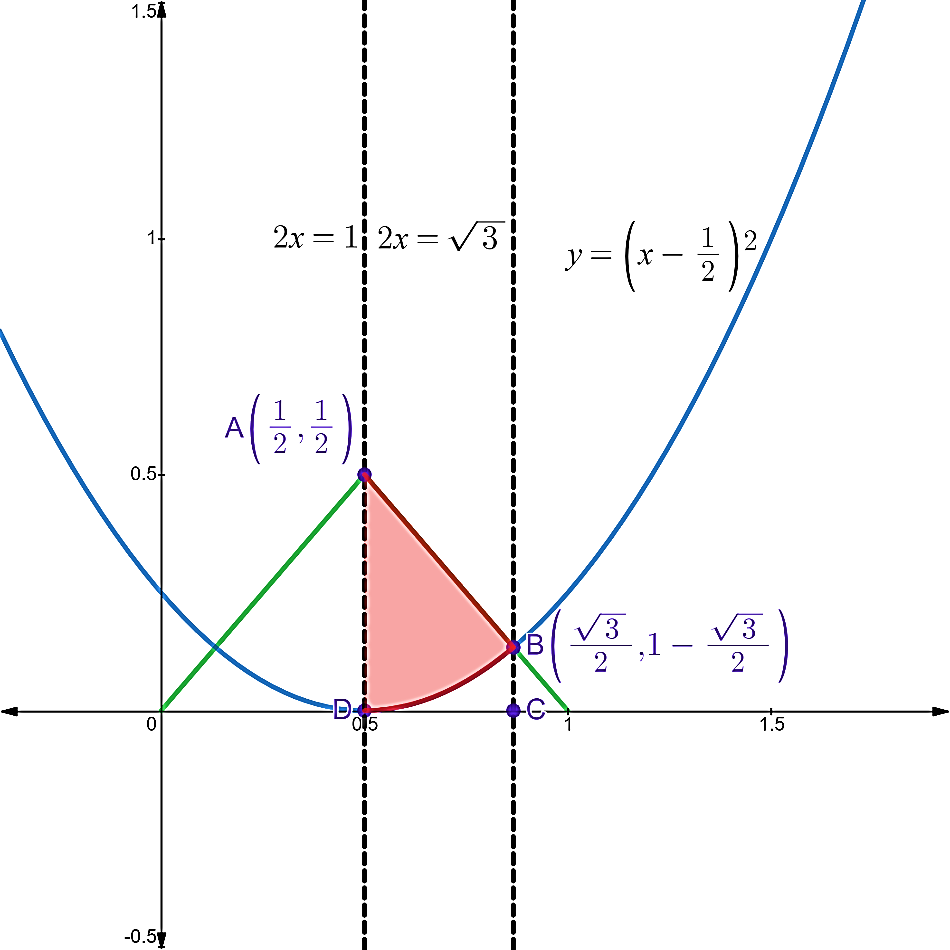
In order to find the point of intersection of line and parabola we solve the equations (iii) and (iv) simultaneously.
From (iii) we get, $y = 1 - x$
Putting this value of y in (iv), we get:
$1 - x = {\left( {x - \dfrac{1}{2}} \right)^2}$
$1 - x = {\left( {\dfrac{{2x - 1}}{2}} \right)^2}$
\[1 - x = \dfrac{{{{\left( {2x - 1} \right)}^2}}}{4}\]
Using the identity \[{(a - b)^2} = {a^2} + {b^2} - 2ab\], we have
$ \Rightarrow 1 - x = \dfrac{{4{x^2} - 4x + 1}}{4}$
Cross multiplying we have,
$ \Rightarrow 4 - 4x = 4{x^2} - 4x + 1$
Cancelling ‘4x’ we have,
$ \Rightarrow 4{x^2} = 3$
Divide by 4 on both sides of the equation
$ \Rightarrow {x^2} = \dfrac{3}{4}$
Taking square root on both side we have,
$ \Rightarrow x = \dfrac{{\sqrt 3 }}{2}$
Putting $x = \dfrac{{\sqrt 3 }}{2}$ , in equation (iii)
$ \Rightarrow y = 1 - \dfrac{{\sqrt 3 }}{2}$
There intersection point is:
$B\left( {\dfrac{{\sqrt 3 }}{2},1 - \dfrac{{\sqrt 3 }}{2}} \right)$
Now, we have to find the area of the bounded region ABDA.
Area of region ABDA:
= area under line AB – area under the parabola between $x = \dfrac{1}{2}$ and $x = \dfrac{{\sqrt 3 }}{2}$
Area bounded between two curves is given by:
$\int\limits_{{x_1}}^{{x_2}} {\left( {{y_2} - {y_1}} \right)dx} $
Where, y2 represents the upper bounding curve and y1 represents the lower bounding curve.
Here, upper bounding curve is:
${y_2} = 1 - x$
and lower bounding curve is:
${y_1} = {\left( {x - \dfrac{1}{2}} \right)^2}$
Area of region ABDA after substituting the values we have,
$ = \int\limits_{\dfrac{1}{2}}^{\dfrac{{\sqrt 3 }}{2}} {\left( {\left( {1 - x} \right) - {{\left( {x - \dfrac{1}{2}} \right)}^2}} \right)dx} $
Using the identity \[{(a - b)^2} = {a^2} + {b^2} - 2ab\], we have
$ = \int\limits_{\dfrac{1}{2}}^{\dfrac{{\sqrt 3 }}{2}} {\left( {1 - x - {x^2} + x - \dfrac{1}{4}} \right)dx} $
Cancelling ‘x’ we get:
$ = \int\limits_{\dfrac{1}{2}}^{\dfrac{{\sqrt 3 }}{2}} {\left( {\dfrac{3}{4} - {x^2}} \right)dx} $
integrating we have,
$ = \left[ {\dfrac{{3x}}{4} - \dfrac{{{x^3}}}{3}} \right]_{\dfrac{1}{2}}^{\dfrac{{\sqrt 3 }}{2}}$
Applying upper and lower bond we have,
$ = \left[ {\dfrac{{3\sqrt 3 }}{8} - \dfrac{{3\sqrt 3 }}{{24}}} \right] - \left[ {\dfrac{3}{8} - \dfrac{1}{{24}}} \right]$
$ \Rightarrow \left[ {\dfrac{{9\sqrt 3 - 3\sqrt 3 }}{{24}}} \right] - \left[ {\dfrac{{9 - 1}}{{24}}} \right]$
$ \Rightarrow \left[ {\dfrac{{3\sqrt 3 - \sqrt 3 }}{8}} \right] - \left[ {\dfrac{7}{{24}}} \right]$
$ \Rightarrow \left[ {\dfrac{{\sqrt 3 (3 - 1)}}{8}} \right] - \left[ {\dfrac{7}{{24}}} \right]$
$ \Rightarrow \left[ {\dfrac{{2\sqrt 3 }}{8}} \right] - \left[ {\dfrac{7}{{24}}} \right]$
$ \Rightarrow \dfrac{{\sqrt 3 }}{4} - \dfrac{1}{3}$
So, the correct answer is Option D.
Note: If the functions give are in the form of $x = f\left( y \right)$ and $x = g\left( y \right)$ and bounded by lines $y = c$ and $y = d$ then area Is given by formula:
$ = \int\limits_c^d {\left( {f(y) - g\left( y \right)} \right)dy} $ where $f\left( y \right) > g\left( y \right)$.
Then find the limits within which curve is bounded i.e. x=a to x= b. In this question the limits are already given i.e. $x = \dfrac{1}{2}{\text{ }}$to ${\text{ }}x = \dfrac{{\sqrt 3 }}{2}$. These limits will become the limits for the integration.
The area bounded between two curves is given by:
$\int\limits_{x = a}^{x = b} {\left( {{y_2} - {y_1}} \right)dx} $
Where, $y_2$ represents the upper bounding curve and $y_1$ represents the lower bounding curve.
Complete step by step solution:
The given equations are:
$y = {\text{ }}x{\text{ }}$when ${\text{0}} \leqslant x < \dfrac{1}{2}{\text{ }} - - - (i)$
${\text{y = }}\dfrac{1}{2}$ when $x = \dfrac{1}{2}{\text{ - - - - - - - - - - - - - - - - - - - - - - - - - - }}\left( {ii} \right)$
${\text{y = }}1 - x$ when $\dfrac{1}{2} < x \leqslant 1{\text{ - - - - - - - - - - - - - - - - - - }}\left( {iii} \right)$
And ${\text{ }}y = {\left( {x - \dfrac{1}{2}} \right)^2}{\text{ - - - - - - - - - - - - - - - - - - - - - - - - - - - - - }}\left( {iv} \right)$
Equation (i) represents a straight line passing through origin, and making an angle of $45^\circ $ with x-axis,
between $x = 0$ and $x = \dfrac{1}{2}$.
Equation (ii) represents the point $\left( {\dfrac{1}{2},\dfrac{1}{2}} \right)$.
Equation (iii) represents a straight line.
Putting $y = 0$ and $x = 0$ respectively in equation (iii), we obtain:
$x = 1$ and $y = 1$ respectively.
So, the straight line passes through points $\left( {1,0} \right)$and $\left( {0,1} \right)$, but required portion is only between $x = \dfrac{1}{2}$and $x = 1$.
Equation (iv) represents a parabola having vertex at $\left( {\dfrac{1}{2},0} \right)$ , and axis along the positive y-axis.
The area bounded by these curves between lines $2x = 1$and $2x = \sqrt 3 $ is shown below.
In order to find the point of intersection of line and parabola we solve the equations (iii) and (iv) simultaneously.
From (iii) we get, $y = 1 - x$
Putting this value of y in (iv), we get:
$1 - x = {\left( {x - \dfrac{1}{2}} \right)^2}$
$1 - x = {\left( {\dfrac{{2x - 1}}{2}} \right)^2}$
\[1 - x = \dfrac{{{{\left( {2x - 1} \right)}^2}}}{4}\]
Using the identity \[{(a - b)^2} = {a^2} + {b^2} - 2ab\], we have
$ \Rightarrow 1 - x = \dfrac{{4{x^2} - 4x + 1}}{4}$
Cross multiplying we have,
$ \Rightarrow 4 - 4x = 4{x^2} - 4x + 1$
Cancelling ‘4x’ we have,
$ \Rightarrow 4{x^2} = 3$
Divide by 4 on both sides of the equation
$ \Rightarrow {x^2} = \dfrac{3}{4}$
Taking square root on both side we have,
$ \Rightarrow x = \dfrac{{\sqrt 3 }}{2}$
Putting $x = \dfrac{{\sqrt 3 }}{2}$ , in equation (iii)
$ \Rightarrow y = 1 - \dfrac{{\sqrt 3 }}{2}$
There intersection point is:
$B\left( {\dfrac{{\sqrt 3 }}{2},1 - \dfrac{{\sqrt 3 }}{2}} \right)$
Now, we have to find the area of the bounded region ABDA.
Area of region ABDA:
= area under line AB – area under the parabola between $x = \dfrac{1}{2}$ and $x = \dfrac{{\sqrt 3 }}{2}$
Area bounded between two curves is given by:
$\int\limits_{{x_1}}^{{x_2}} {\left( {{y_2} - {y_1}} \right)dx} $
Where, y2 represents the upper bounding curve and y1 represents the lower bounding curve.
Here, upper bounding curve is:
${y_2} = 1 - x$
and lower bounding curve is:
${y_1} = {\left( {x - \dfrac{1}{2}} \right)^2}$
Area of region ABDA after substituting the values we have,
$ = \int\limits_{\dfrac{1}{2}}^{\dfrac{{\sqrt 3 }}{2}} {\left( {\left( {1 - x} \right) - {{\left( {x - \dfrac{1}{2}} \right)}^2}} \right)dx} $
Using the identity \[{(a - b)^2} = {a^2} + {b^2} - 2ab\], we have
$ = \int\limits_{\dfrac{1}{2}}^{\dfrac{{\sqrt 3 }}{2}} {\left( {1 - x - {x^2} + x - \dfrac{1}{4}} \right)dx} $
Cancelling ‘x’ we get:
$ = \int\limits_{\dfrac{1}{2}}^{\dfrac{{\sqrt 3 }}{2}} {\left( {\dfrac{3}{4} - {x^2}} \right)dx} $
integrating we have,
$ = \left[ {\dfrac{{3x}}{4} - \dfrac{{{x^3}}}{3}} \right]_{\dfrac{1}{2}}^{\dfrac{{\sqrt 3 }}{2}}$
Applying upper and lower bond we have,
$ = \left[ {\dfrac{{3\sqrt 3 }}{8} - \dfrac{{3\sqrt 3 }}{{24}}} \right] - \left[ {\dfrac{3}{8} - \dfrac{1}{{24}}} \right]$
$ \Rightarrow \left[ {\dfrac{{9\sqrt 3 - 3\sqrt 3 }}{{24}}} \right] - \left[ {\dfrac{{9 - 1}}{{24}}} \right]$
$ \Rightarrow \left[ {\dfrac{{3\sqrt 3 - \sqrt 3 }}{8}} \right] - \left[ {\dfrac{7}{{24}}} \right]$
$ \Rightarrow \left[ {\dfrac{{\sqrt 3 (3 - 1)}}{8}} \right] - \left[ {\dfrac{7}{{24}}} \right]$
$ \Rightarrow \left[ {\dfrac{{2\sqrt 3 }}{8}} \right] - \left[ {\dfrac{7}{{24}}} \right]$
$ \Rightarrow \dfrac{{\sqrt 3 }}{4} - \dfrac{1}{3}$
So, the correct answer is Option D.
Note: If the functions give are in the form of $x = f\left( y \right)$ and $x = g\left( y \right)$ and bounded by lines $y = c$ and $y = d$ then area Is given by formula:
$ = \int\limits_c^d {\left( {f(y) - g\left( y \right)} \right)dy} $ where $f\left( y \right) > g\left( y \right)$.
Recently Updated Pages
Master Class 12 Economics: Engaging Questions & Answers for Success

Master Class 12 Physics: Engaging Questions & Answers for Success
Master Class 12 English: Engaging Questions & Answers for Success
Master Class 12 Social Science: Engaging Questions & Answers for Success
Master Class 12 Maths: Engaging Questions & Answers for Success
Master Class 12 Business Studies: Engaging Questions & Answers for Success
Trending doubts
Which are the Top 10 Largest Countries of the World?
What are the major means of transport Explain each class 12 social science CBSE
Draw a labelled sketch of the human eye class 12 physics CBSE
Why cannot DNA pass through cell membranes class 12 biology CBSE
Differentiate between insitu conservation and exsitu class 12 biology CBSE
Draw a neat and well labeled diagram of TS of ovary class 12 biology CBSE