




Find the area enclosed between the parabola $4y = 3{x^2}$ and the straight line $3x - 2y + 12 = 0$
Answer
 Verified
624.9k+ views
Hint-In order to solve this question firstly, we have to find the area enclosed between the parabola using integration. Then we will get our desired answer. There is need to aware about some basic integration methods and formulas
Complete step-by-step solution -
The area under a curve between two points can be found by doing a definite integral between the two points. To find the area under the curve y=f(x) between x = a and x = b, integrate y=f(x) between the limits of an and b. Areas under the x-axis will come out negative and areas above the x-axis will be positive.
The given equations are –
$y{\text{ = }}\dfrac{{3{x^2}}}{4}$ ……… (1)
And, $3x - 2y + 12 = 0$ …….. (2)
Solving equations (1) and (2) we get
$y = \dfrac{{3x + 12}}{2}$
Now, by using the quadratic equation to solve the equation of parabola,
$
4y = 3{x^2} \\
4\left( {\dfrac{{3x + 12}}{2}} \right) = 3{x^2} \\
2\left( {3x + 12} \right) = 3{x^2} \\
3{x^2} - 6x - 24 = 0 \\
3\left( {{x^2} - 2x - 8} \right) = 0 \\
$
$
{x^2} - 2x - 8 = 0 \\
{x^2} - 4x + 2x - 8 = 0 \\
x\left( {x - 4} \right) + 2\left( {x - 4} \right) = 0 \\
\left( {x + 2} \right)\left( {x - 4} \right) = 0 \\
$
For, $
x = 4, \\
y = \dfrac{{3 \times 4 + 12}}{2} = 12 \\
\Rightarrow y = 12 \\
$
For $
x = - 2, \\
y = \dfrac{{3 \times ( - 2) + 12}}{2} = 12 \\
\Rightarrow y = 3 \\
$
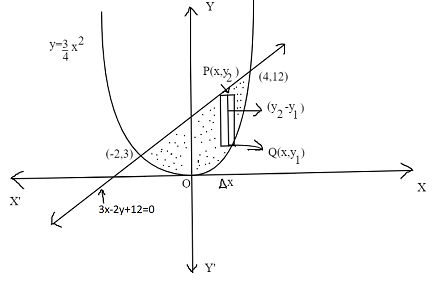
$\therefore $ intersection points are (-2, 3) & (4, 12)
Hence, the required area will be a shaded region.
$
A = \int\limits_{ - 2}^4 {\left( {\dfrac{{3x - 12}}{2}{\text{ - }}\dfrac{3}{4}{x^2}} \right)} dx \\
\Rightarrow A = \left[ {\dfrac{3}{4}{x^2} + 6x - \dfrac{{{x^3}}}{4}} \right]_{ - 2}^4 \\
= \left( {12 + 24 - 16} \right) - \left( {3 - 12 + 2} \right) \\
= 20 + 7 \\
\Rightarrow A = 27sq.{\text{ units}}{\text{.}} \\
$
Required area= 27 units.
Note- Whenever we come up with this type of problem, one should know that we have to use integration to find the area enclosed between a parabola and a straight line and quadratic equations to find the points of intersection. By using this approach, we will get our answer.
Complete step-by-step solution -
The area under a curve between two points can be found by doing a definite integral between the two points. To find the area under the curve y=f(x) between x = a and x = b, integrate y=f(x) between the limits of an and b. Areas under the x-axis will come out negative and areas above the x-axis will be positive.
The given equations are –
$y{\text{ = }}\dfrac{{3{x^2}}}{4}$ ……… (1)
And, $3x - 2y + 12 = 0$ …….. (2)
Solving equations (1) and (2) we get
$y = \dfrac{{3x + 12}}{2}$
Now, by using the quadratic equation to solve the equation of parabola,
$
4y = 3{x^2} \\
4\left( {\dfrac{{3x + 12}}{2}} \right) = 3{x^2} \\
2\left( {3x + 12} \right) = 3{x^2} \\
3{x^2} - 6x - 24 = 0 \\
3\left( {{x^2} - 2x - 8} \right) = 0 \\
$
$
{x^2} - 2x - 8 = 0 \\
{x^2} - 4x + 2x - 8 = 0 \\
x\left( {x - 4} \right) + 2\left( {x - 4} \right) = 0 \\
\left( {x + 2} \right)\left( {x - 4} \right) = 0 \\
$
For, $
x = 4, \\
y = \dfrac{{3 \times 4 + 12}}{2} = 12 \\
\Rightarrow y = 12 \\
$
For $
x = - 2, \\
y = \dfrac{{3 \times ( - 2) + 12}}{2} = 12 \\
\Rightarrow y = 3 \\
$
$\therefore $ intersection points are (-2, 3) & (4, 12)
Hence, the required area will be a shaded region.
$
A = \int\limits_{ - 2}^4 {\left( {\dfrac{{3x - 12}}{2}{\text{ - }}\dfrac{3}{4}{x^2}} \right)} dx \\
\Rightarrow A = \left[ {\dfrac{3}{4}{x^2} + 6x - \dfrac{{{x^3}}}{4}} \right]_{ - 2}^4 \\
= \left( {12 + 24 - 16} \right) - \left( {3 - 12 + 2} \right) \\
= 20 + 7 \\
\Rightarrow A = 27sq.{\text{ units}}{\text{.}} \\
$
Required area= 27 units.
Note- Whenever we come up with this type of problem, one should know that we have to use integration to find the area enclosed between a parabola and a straight line and quadratic equations to find the points of intersection. By using this approach, we will get our answer.
Recently Updated Pages
Basicity of sulphurous acid and sulphuric acid are

Master Class 12 English: Engaging Questions & Answers for Success
Master Class 12 Social Science: Engaging Questions & Answers for Success
Master Class 12 Maths: Engaging Questions & Answers for Success
Master Class 12 Economics: Engaging Questions & Answers for Success
Master Class 12 Physics: Engaging Questions & Answers for Success
Trending doubts
Which are the Top 10 Largest Countries of the World?
Draw a labelled sketch of the human eye class 12 physics CBSE
Draw ray diagrams each showing i myopic eye and ii class 12 physics CBSE
Give 10 examples of unisexual and bisexual flowers
Coming together federation is practiced in A India class 12 social science CBSE
How was the Civil Disobedience Movement different from class 12 social science CBSE