




How do you find the area between $ x = 4 - {y^2} $ and $ x = y - 2 $ ?
Answer
 Verified
592.2k+ views
Hint: In order to find the area, we need to know the region between the equations, and from the equation we can see that the first equation would represent a parabola and the second one would represent a straight line. Compare the two equations to find the points of intersection then using integration find the area inside them.
Formula used:
$ \int {{x^n}dx = \dfrac{{{x^{n + 1}}}}{{n + 1}}} $
$ \int {adx = } a\int {dx} $
Complete step-by-step answer:
The first Equation given is: $ x = 4 - {y^2} $ and the second is $ x = y - 2 $ .
Since, value of $ x $ is given in both, so comparing the two equations, we get:
$
4 - {y^2} = y - 2 \\
{y^2} + y - 6 = 0 \;
$
Comparing the obtained Quadratic Equation with the standard Quadratic Equation $ a{x^2} + bx + c = 0 $ , we get:
$
a = 1 \\
b = 1 \\
c = - 6 \;
$
Solving for discriminant, we get:
$
D = \sqrt {{b^2} - 4ac} \\
D = \sqrt {{1^2} - 4 \times 1 \times \left( { - 6} \right)} \\
D = \sqrt {1 + 24} \\
D = \sqrt {25} = 5 \;
$
Quadratic Formula to find both roots of a quadratic equation as
$ y_1 = \dfrac{{ - b + \sqrt {{b^2} - 4ac} }}{{2a}} $ and $ y_2 = \dfrac{{ - b - \sqrt {{b^2} - 4ac} }}{{2a}} $
$ y_1,y_2 $ are root to quadratic equations $ a{x^2} + bx + c $ .
For, $ y_1 $ :
$
y_1 = \dfrac{{ - b + \sqrt {{b^2} - 4ac} }}{{2a}} \\
y_1 = \dfrac{{ - 1 + 5}}{{2 \times 1}} = \dfrac{4}{2} = 2 \\
$
For, $ y_2 $ :
$
y_2 = \dfrac{{ - b - \sqrt {{b^2} - 4ac} }}{{2a}} \\
y_2 = \dfrac{{ - 1 - 5}}{{2 \times 1}} = \dfrac{{ - 6}}{2} = - 3 \;
$
Hence the factors will be $ (y - y_1)\,and\,(y - y_2)\, $ that is $ (y - 2)\,and\,(y + 3)\, $ .
Putting the values of $ y_1 $ and $ y_2 $ in the equation $ x = y - 2 $ one by one to get $ x_1 $ and $ x_2 $ :
$ x_1 = y_1 - 2 = 2 - 2 = 0 $
$ x_2 = y_2 - 2 = - 3 - 2 = - 5 $
Therefore, the points of intersection are:
$ (x_1,y_1)\,and\,(x_2,y_2)\, $ , which are $ (0,2)\,and\,( - 5, - 3)\, $ .
According to the points obtained, the graph would be:
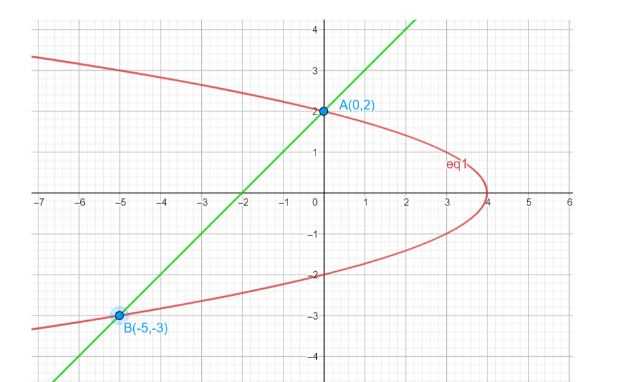
Since, the starting and ending points for the y-axis are: $ - 3and2 $ .So, the area is starting from $ - 3to2 $ .
Writing the first and second equation in terms of $ y $ and we get:
$ x = 4 - {y^2} = > y = \sqrt {4 - x} $
$ x = y - 2 = > y = x + 2 $
The area under the equation is:
$ A = \int\limits_{ - 3}^2 {\left[ {\left( {4 - {y^2}} \right) - \left( {y - 2} \right)} \right]} dy $
On further solving, we get:
$
A = \int\limits_{ - 3}^2 {\left[ {\left( {4 - {y^2}} \right) - \left( {y - 2} \right)} \right]} dy \\
A = \int\limits_{ - 3}^2 {\left[ {4 - {y^2} - y + 2} \right]} dy \\
A = \int\limits_{ - 3}^2 {\left[ { - {y^2} - y + 6} \right]} dy \\
A = - \int\limits_{ - 3}^2 {{y^2}} dy - \int\limits_{ - 3}^2 y dy + 6\int\limits_{ - 3}^2 {dy} \\
A = - {\left[ {\dfrac{{{y^3}}}{3}} \right]_{ - 3}}^2 - {\left[ {\dfrac{{{y^2}}}{2}} \right]^2}_{ - 3} + 6{\left[ y \right]^2}_{ - 3} \\
A = - \left[ {\dfrac{{{2^3}}}{3} - \dfrac{{{{\left( { - 3} \right)}^3}}}{3}} \right] - \left[ {\dfrac{{{2^2}}}{2} - \dfrac{{{{\left( { - 3} \right)}^2}}}{2}} \right] + 6\left[ {2 - \left( { - 3} \right)} \right] \\
A = - \left[ {\dfrac{8}{3} + 9} \right] - \left[ {2 - \dfrac{9}{2}} \right] + 6\left[ {2 + 3} \right] \\
A = - \dfrac{8}{3} - 9 - 2 + \dfrac{9}{2} + 30 \\
A = - \dfrac{8}{3} - 11 + \dfrac{9}{2} + 30 \\
A = \dfrac{{125}}{6} = 20.833 \;
$
Therefore, the area between $ x = 4 - {y^2} $ and $ x = y - 2 $ is $ 20.833 $ sq. units.
So, the correct answer is “ $ 20.833 $ sq. units.”.
Note: It's important to find the intersecting points to know the area covered by the parabola and the straight line.
We can also take the value of $ x $ instead of y to find the area, just the values inside the integration would be written in terms of $ x $ and $ dx $ .
Formula used:
$ \int {{x^n}dx = \dfrac{{{x^{n + 1}}}}{{n + 1}}} $
$ \int {adx = } a\int {dx} $
Complete step-by-step answer:
The first Equation given is: $ x = 4 - {y^2} $ and the second is $ x = y - 2 $ .
Since, value of $ x $ is given in both, so comparing the two equations, we get:
$
4 - {y^2} = y - 2 \\
{y^2} + y - 6 = 0 \;
$
Comparing the obtained Quadratic Equation with the standard Quadratic Equation $ a{x^2} + bx + c = 0 $ , we get:
$
a = 1 \\
b = 1 \\
c = - 6 \;
$
Solving for discriminant, we get:
$
D = \sqrt {{b^2} - 4ac} \\
D = \sqrt {{1^2} - 4 \times 1 \times \left( { - 6} \right)} \\
D = \sqrt {1 + 24} \\
D = \sqrt {25} = 5 \;
$
Quadratic Formula to find both roots of a quadratic equation as
$ y_1 = \dfrac{{ - b + \sqrt {{b^2} - 4ac} }}{{2a}} $ and $ y_2 = \dfrac{{ - b - \sqrt {{b^2} - 4ac} }}{{2a}} $
$ y_1,y_2 $ are root to quadratic equations $ a{x^2} + bx + c $ .
For, $ y_1 $ :
$
y_1 = \dfrac{{ - b + \sqrt {{b^2} - 4ac} }}{{2a}} \\
y_1 = \dfrac{{ - 1 + 5}}{{2 \times 1}} = \dfrac{4}{2} = 2 \\
$
For, $ y_2 $ :
$
y_2 = \dfrac{{ - b - \sqrt {{b^2} - 4ac} }}{{2a}} \\
y_2 = \dfrac{{ - 1 - 5}}{{2 \times 1}} = \dfrac{{ - 6}}{2} = - 3 \;
$
Hence the factors will be $ (y - y_1)\,and\,(y - y_2)\, $ that is $ (y - 2)\,and\,(y + 3)\, $ .
Putting the values of $ y_1 $ and $ y_2 $ in the equation $ x = y - 2 $ one by one to get $ x_1 $ and $ x_2 $ :
$ x_1 = y_1 - 2 = 2 - 2 = 0 $
$ x_2 = y_2 - 2 = - 3 - 2 = - 5 $
Therefore, the points of intersection are:
$ (x_1,y_1)\,and\,(x_2,y_2)\, $ , which are $ (0,2)\,and\,( - 5, - 3)\, $ .
According to the points obtained, the graph would be:
Since, the starting and ending points for the y-axis are: $ - 3and2 $ .So, the area is starting from $ - 3to2 $ .
Writing the first and second equation in terms of $ y $ and we get:
$ x = 4 - {y^2} = > y = \sqrt {4 - x} $
$ x = y - 2 = > y = x + 2 $
The area under the equation is:
$ A = \int\limits_{ - 3}^2 {\left[ {\left( {4 - {y^2}} \right) - \left( {y - 2} \right)} \right]} dy $
On further solving, we get:
$
A = \int\limits_{ - 3}^2 {\left[ {\left( {4 - {y^2}} \right) - \left( {y - 2} \right)} \right]} dy \\
A = \int\limits_{ - 3}^2 {\left[ {4 - {y^2} - y + 2} \right]} dy \\
A = \int\limits_{ - 3}^2 {\left[ { - {y^2} - y + 6} \right]} dy \\
A = - \int\limits_{ - 3}^2 {{y^2}} dy - \int\limits_{ - 3}^2 y dy + 6\int\limits_{ - 3}^2 {dy} \\
A = - {\left[ {\dfrac{{{y^3}}}{3}} \right]_{ - 3}}^2 - {\left[ {\dfrac{{{y^2}}}{2}} \right]^2}_{ - 3} + 6{\left[ y \right]^2}_{ - 3} \\
A = - \left[ {\dfrac{{{2^3}}}{3} - \dfrac{{{{\left( { - 3} \right)}^3}}}{3}} \right] - \left[ {\dfrac{{{2^2}}}{2} - \dfrac{{{{\left( { - 3} \right)}^2}}}{2}} \right] + 6\left[ {2 - \left( { - 3} \right)} \right] \\
A = - \left[ {\dfrac{8}{3} + 9} \right] - \left[ {2 - \dfrac{9}{2}} \right] + 6\left[ {2 + 3} \right] \\
A = - \dfrac{8}{3} - 9 - 2 + \dfrac{9}{2} + 30 \\
A = - \dfrac{8}{3} - 11 + \dfrac{9}{2} + 30 \\
A = \dfrac{{125}}{6} = 20.833 \;
$
Therefore, the area between $ x = 4 - {y^2} $ and $ x = y - 2 $ is $ 20.833 $ sq. units.
So, the correct answer is “ $ 20.833 $ sq. units.”.
Note: It's important to find the intersecting points to know the area covered by the parabola and the straight line.
We can also take the value of $ x $ instead of y to find the area, just the values inside the integration would be written in terms of $ x $ and $ dx $ .
Recently Updated Pages
Which of the following graphs shows the variation of class 12 physics CBSE

Draw a labelled diagram of the human male reproductive class 12 biology CBSE
Describe the experiment to compare the emf of two cells class 12 physics CBSE
What is standard hydrogen electrode
What is conventional current and electric current class 12 physics CBSE
2Bromopentane is treated with an alcoholic KOH solution class 12 chemistry CBSE
Trending doubts
Draw a labelled sketch of the human eye class 12 physics CBSE
Which are the Top 10 Largest Countries of the World?
Differentiate between homogeneous and heterogeneous class 12 chemistry CBSE
Draw ray diagrams each showing i myopic eye and ii class 12 physics CBSE
Which is the correct genotypic ratio of mendel dihybrid class 12 biology CBSE
What is the Full Form of PVC, PET, HDPE, LDPE, PP and PS ?