




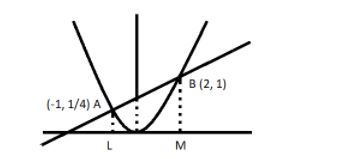
Find the area between the curves ${x^2} = 4y$ and the line x = 4y – 2.
Answer
 Verified
619.2k+ views
Hint: In this particular question use the concept of area under the curve by integration method which is given as $A = \int_{x = {x_1}}^{x = {x_2}} {\left( {{y_1} - {y_2}} \right)dx} $, where ${y_1}{\text{ and }}{y_2}$ are the upper and lower curves and ${x_1}{\text{ and }}{x_2}$ are the upper and lower limits so use these concepts to reach the solution of the question.
Complete step-by-step answer:
Given data:
There are two curves, ${x^2} = 4y$ and the line x = 4y – 2.
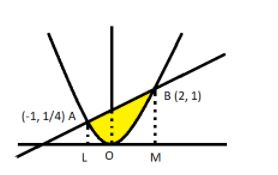
Now as we know that ${x^2} = 4y$ is a parabola and x = 4y – 2 is a line so the area bounded by the curves are marked in the figure by the yellow color.
So the required area is AOB.
Now as we know that to calculate the area under the curves the simplest method is by integration method, which is given as, $A = \int_{x = {x_1}}^{x = {x_2}} {\left( {{y_1} - {y_2}} \right)dx} $, where ${y_1}{\text{ and }}{y_2}$ are the upper and lower curves and ${x_1}{\text{ and }}{x_2}$ are the upper and lower limits.
Therefore, from equation of line, ${y_1} = \dfrac{{x + 2}}{4}$ and from equation of parabola, ${y_2} = \dfrac{{{x^2}}}{4}$.
And lower x limit i.e. ${x_1} = - 1$ and upper x limit i.e. ${x_2} = 2$
Now substitute the values in the above integration formula we have,
$A = \int_{x = - 1}^{x = 2} {\left( {\dfrac{{x + 2}}{4} - \dfrac{{{x^2}}}{4}} \right)dx} $
Now simplify it we have,
$ \Rightarrow A = \dfrac{1}{4}\int_{ - 1}^2 {\left( {x + 2 - {x^2}} \right)dx} $
Now as we know that $\int {{x^n}dx} = \dfrac{{{x^{n + 1}}}}{{n + 1}} + c$, where c is some arbitrary integration constant, so use this property in the above equation we have,
$ \Rightarrow A = \dfrac{1}{4}\left[ {\dfrac{{{x^2}}}{2} + 2x - \dfrac{{{x^3}}}{3}} \right]_{ - 1}^2$
Now apply integration limits we have,
\[ \Rightarrow A = \dfrac{1}{4}\left[ {\dfrac{{{2^2}}}{2} + 2\left( 2 \right) - \dfrac{{{2^3}}}{3} - \left( {\dfrac{{{{\left( { - 1} \right)}^2}}}{2} + 2\left( { - 1} \right) - \dfrac{{{{\left( { - 1} \right)}^3}}}{3}} \right)} \right]\]
Now simplify we have,
$ \Rightarrow A = \dfrac{1}{4}\left[ {2 + 4 - \dfrac{8}{3} - \dfrac{1}{2} + 2 - \dfrac{1}{3}} \right]$
$ \Rightarrow A = \dfrac{1}{4}\left[ {8 - \dfrac{1}{2} + \dfrac{{ - 8 - 1}}{3}} \right]$
$ \Rightarrow A = \dfrac{1}{4}\left[ {8 - \dfrac{1}{2} - 3} \right]$
$ \Rightarrow A = \dfrac{1}{4}\left[ {5 - \dfrac{1}{2}} \right]$
$ \Rightarrow A = \dfrac{9}{8}$ Sq. units.
So this is the required area bounded by the two curves.
Note: Whenever we face such types of questions the key concept we have to remember is that always recall the basic integration formula such as, $\int {{x^n}dx} = \dfrac{{{x^{n + 1}}}}{{n + 1}} + c$, where c is some arbitrary integration constant and the formula of area under the curve using integration method which is stated above.
Complete step-by-step answer:
Given data:
There are two curves, ${x^2} = 4y$ and the line x = 4y – 2.
Now as we know that ${x^2} = 4y$ is a parabola and x = 4y – 2 is a line so the area bounded by the curves are marked in the figure by the yellow color.
So the required area is AOB.
Now as we know that to calculate the area under the curves the simplest method is by integration method, which is given as, $A = \int_{x = {x_1}}^{x = {x_2}} {\left( {{y_1} - {y_2}} \right)dx} $, where ${y_1}{\text{ and }}{y_2}$ are the upper and lower curves and ${x_1}{\text{ and }}{x_2}$ are the upper and lower limits.
Therefore, from equation of line, ${y_1} = \dfrac{{x + 2}}{4}$ and from equation of parabola, ${y_2} = \dfrac{{{x^2}}}{4}$.
And lower x limit i.e. ${x_1} = - 1$ and upper x limit i.e. ${x_2} = 2$
Now substitute the values in the above integration formula we have,
$A = \int_{x = - 1}^{x = 2} {\left( {\dfrac{{x + 2}}{4} - \dfrac{{{x^2}}}{4}} \right)dx} $
Now simplify it we have,
$ \Rightarrow A = \dfrac{1}{4}\int_{ - 1}^2 {\left( {x + 2 - {x^2}} \right)dx} $
Now as we know that $\int {{x^n}dx} = \dfrac{{{x^{n + 1}}}}{{n + 1}} + c$, where c is some arbitrary integration constant, so use this property in the above equation we have,
$ \Rightarrow A = \dfrac{1}{4}\left[ {\dfrac{{{x^2}}}{2} + 2x - \dfrac{{{x^3}}}{3}} \right]_{ - 1}^2$
Now apply integration limits we have,
\[ \Rightarrow A = \dfrac{1}{4}\left[ {\dfrac{{{2^2}}}{2} + 2\left( 2 \right) - \dfrac{{{2^3}}}{3} - \left( {\dfrac{{{{\left( { - 1} \right)}^2}}}{2} + 2\left( { - 1} \right) - \dfrac{{{{\left( { - 1} \right)}^3}}}{3}} \right)} \right]\]
Now simplify we have,
$ \Rightarrow A = \dfrac{1}{4}\left[ {2 + 4 - \dfrac{8}{3} - \dfrac{1}{2} + 2 - \dfrac{1}{3}} \right]$
$ \Rightarrow A = \dfrac{1}{4}\left[ {8 - \dfrac{1}{2} + \dfrac{{ - 8 - 1}}{3}} \right]$
$ \Rightarrow A = \dfrac{1}{4}\left[ {8 - \dfrac{1}{2} - 3} \right]$
$ \Rightarrow A = \dfrac{1}{4}\left[ {5 - \dfrac{1}{2}} \right]$
$ \Rightarrow A = \dfrac{9}{8}$ Sq. units.
So this is the required area bounded by the two curves.
Note: Whenever we face such types of questions the key concept we have to remember is that always recall the basic integration formula such as, $\int {{x^n}dx} = \dfrac{{{x^{n + 1}}}}{{n + 1}} + c$, where c is some arbitrary integration constant and the formula of area under the curve using integration method which is stated above.
Recently Updated Pages
Master Class 12 Business Studies: Engaging Questions & Answers for Success

Master Class 12 Chemistry: Engaging Questions & Answers for Success
Master Class 12 Biology: Engaging Questions & Answers for Success
Class 12 Question and Answer - Your Ultimate Solutions Guide
Master Class 11 English: Engaging Questions & Answers for Success
Master Class 11 Maths: Engaging Questions & Answers for Success
Trending doubts
Which is more stable and why class 12 chemistry CBSE
Which are the Top 10 Largest Countries of the World?
Draw a labelled sketch of the human eye class 12 physics CBSE
Differentiate between homogeneous and heterogeneous class 12 chemistry CBSE
What are the major means of transport Explain each class 12 social science CBSE
Sulphuric acid is known as the king of acids State class 12 chemistry CBSE