




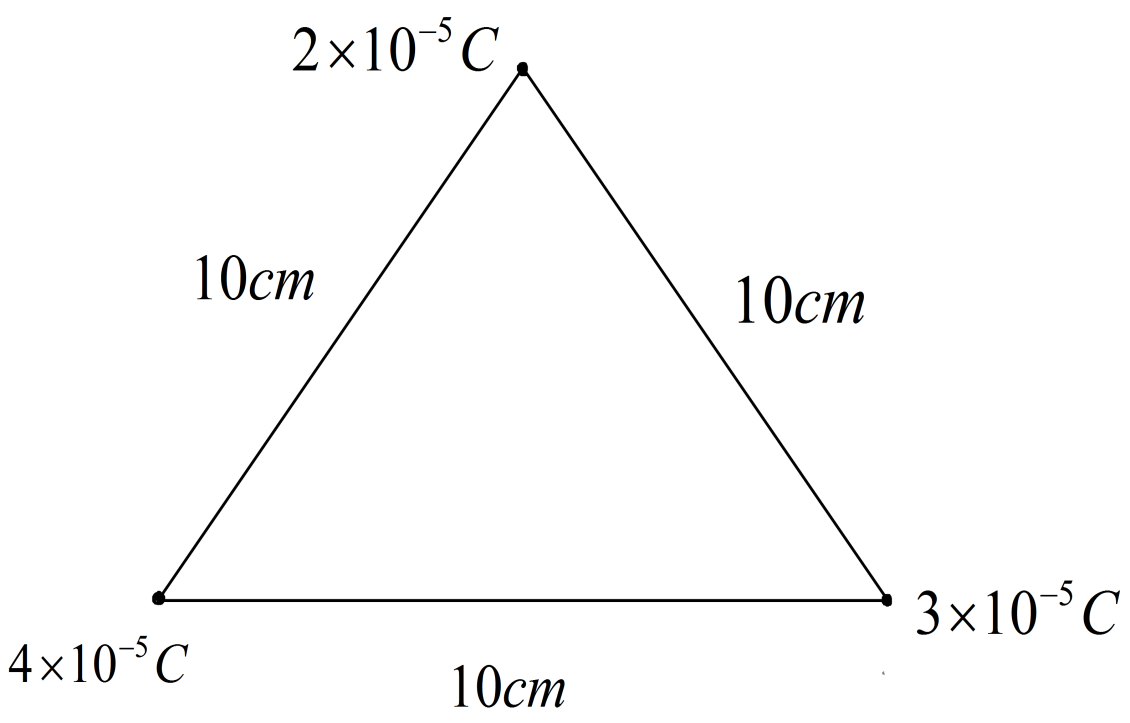
Find the amount of work that has to be done in assembling three charged particles at the vertices of an equilateral triangle as shown in the figure.
(A) $ 434J $
(B) $ 334J $
(C) $ 234J $
(D) $ 134J $
Answer
 Verified
546.9k+ views
Hint: Use the formula to find the electrostatic energy to find the work done in assembling the charges. The electrostatic energy of a system of $ N $ charges is given by,
$ U = \dfrac{1}{2}\sum\limits_{i = 1}^N {\sum\limits_{l}
j = 1 \\
j \ne i^N {\dfrac{1}{{4\pi {\varepsilon _0}}}} } \dfrac{{{q_i}{q_j}}}{{{r_{ij}}}} $ . Where, $ {r_{ij}} $ is the distance between the charge $ {q_i} $ and $ {q_j} $ .
Complete Step By Step Answer:
We know that the electrostatic energy due to a system of $ N $ charges is given by $ U = \dfrac{1}{2}\sum\limits_{i = 1}^N {\sum\limits_{l}
j = 1 \\
j \ne i
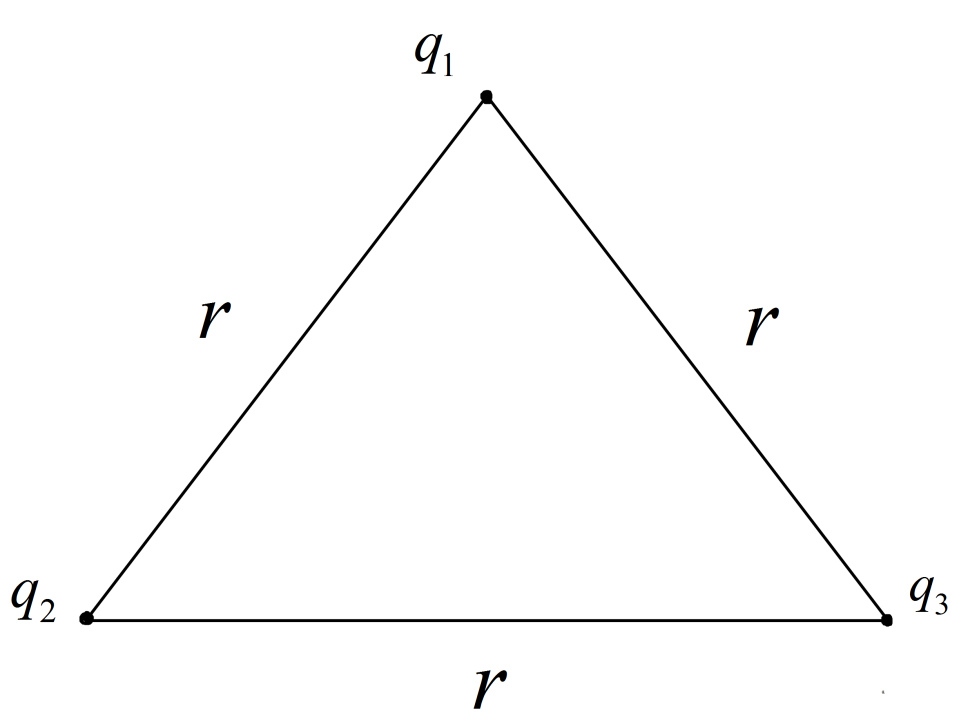
^N {\dfrac{1}{{4\pi {\varepsilon _0}}}} } \dfrac{{{q_i}{q_j}}}{{{r_{ij}}}} $ . Where, $ {r_{ij}} $ is the distance between the charge $ {q_i} $ and $ {q_j} $ .Here, we have the charges at the vertices of the equilateral triangle that means the distance between the charges are equal.
Now, also we know from work energy theorem, work done on the system is the change in energy of the system. Hence, we can say, the total energy of the system of charges is equal to the work done in assembling the charges.
So, we can write work done,
$ W = U = \dfrac{1}{2}\sum\limits_{i = 1}^3 {\sum\limits_{l}
j = 1 \\
j \ne i ^3 {\dfrac{1}{{4\pi {\varepsilon _0}}}} } \dfrac{{{q_i}{q_j}}}{{{r_{ij}}}} $ . Since, we have three charges at the vertices.
Now, putting the values of $ i $ and $ j $ we get, $ W = \dfrac{1}{{8\pi {\varepsilon _0}}}[\dfrac{{{q_1}{q_2}}}{r} + \dfrac{{{q_3}{q_1}}}{r} + \dfrac{{{q_2}{q_3}}}{r} + \dfrac{{{q_2}{q_1}}}{r} + \dfrac{{{q_3}{q_1}}}{r} + \dfrac{{{q_3}{q_2}}}{r}] $
Upon simplifying we get, $ W = \dfrac{1}{{4\pi {\varepsilon _0}r}}\left[ {{q_1}{q_2} + {q_3}{q_2} + {q_3}{q_1}} \right] $
Putting the values of $ {q_1} = 2 \times {10^{ - 5}}C $ , $ {q_2} = 4 \times {10^{ - 5}}C $ and $ {q_3} = 3 \times {10^{ - 5}}C $ . Distance between the charges $ r = 10cm = 0.1m $ we get,
$ W = \dfrac{{9 \times {{10}^9}}}{{{{10}^{ - 1}}}} \times \left[ {4 \times 2 \times {{10}^{ - 5}} \times {{10}^{ - 5}} + 4 \times 3 \times {{10}^{ - 5}} \times {{10}^{ - 5}} + 3 \times 2 \times {{10}^{ - 5}} \times {{10}^{ - 5}}} \right] $
On simplifying we get, $ W = \dfrac{{9 \times {{10}^9}}}{{{{10}^{ - 1}}}} \times {10^{ - 10}} \times \left( {8 + 12 + 6} \right) $
Or, $ W = 9 \times \left( {8 + 12 + 6} \right) $
Or, $ W = 9 \times 26 = 234 $
Hence, work done in assembling the charges on the equilateral triangle is $ 234J $ .
Hence, option (C) is correct.
Note:
Here, to assemble the first charge (in bringing the charge from infinity) no energy has been used, since at the beginning there was no force acting on it. Hence, no work needed to be done. The work done to bring the second charge was due to the presence of the first charge and to bring the last charge work was due to the presence of the other two charges.
$ U = \dfrac{1}{2}\sum\limits_{i = 1}^N {\sum\limits_{l}
j = 1 \\
j \ne i^N {\dfrac{1}{{4\pi {\varepsilon _0}}}} } \dfrac{{{q_i}{q_j}}}{{{r_{ij}}}} $ . Where, $ {r_{ij}} $ is the distance between the charge $ {q_i} $ and $ {q_j} $ .
Complete Step By Step Answer:
We know that the electrostatic energy due to a system of $ N $ charges is given by $ U = \dfrac{1}{2}\sum\limits_{i = 1}^N {\sum\limits_{l}
j = 1 \\
j \ne i
^N {\dfrac{1}{{4\pi {\varepsilon _0}}}} } \dfrac{{{q_i}{q_j}}}{{{r_{ij}}}} $ . Where, $ {r_{ij}} $ is the distance between the charge $ {q_i} $ and $ {q_j} $ .Here, we have the charges at the vertices of the equilateral triangle that means the distance between the charges are equal.
Now, also we know from work energy theorem, work done on the system is the change in energy of the system. Hence, we can say, the total energy of the system of charges is equal to the work done in assembling the charges.
So, we can write work done,
$ W = U = \dfrac{1}{2}\sum\limits_{i = 1}^3 {\sum\limits_{l}
j = 1 \\
j \ne i ^3 {\dfrac{1}{{4\pi {\varepsilon _0}}}} } \dfrac{{{q_i}{q_j}}}{{{r_{ij}}}} $ . Since, we have three charges at the vertices.
Now, putting the values of $ i $ and $ j $ we get, $ W = \dfrac{1}{{8\pi {\varepsilon _0}}}[\dfrac{{{q_1}{q_2}}}{r} + \dfrac{{{q_3}{q_1}}}{r} + \dfrac{{{q_2}{q_3}}}{r} + \dfrac{{{q_2}{q_1}}}{r} + \dfrac{{{q_3}{q_1}}}{r} + \dfrac{{{q_3}{q_2}}}{r}] $
Upon simplifying we get, $ W = \dfrac{1}{{4\pi {\varepsilon _0}r}}\left[ {{q_1}{q_2} + {q_3}{q_2} + {q_3}{q_1}} \right] $
Putting the values of $ {q_1} = 2 \times {10^{ - 5}}C $ , $ {q_2} = 4 \times {10^{ - 5}}C $ and $ {q_3} = 3 \times {10^{ - 5}}C $ . Distance between the charges $ r = 10cm = 0.1m $ we get,
$ W = \dfrac{{9 \times {{10}^9}}}{{{{10}^{ - 1}}}} \times \left[ {4 \times 2 \times {{10}^{ - 5}} \times {{10}^{ - 5}} + 4 \times 3 \times {{10}^{ - 5}} \times {{10}^{ - 5}} + 3 \times 2 \times {{10}^{ - 5}} \times {{10}^{ - 5}}} \right] $
On simplifying we get, $ W = \dfrac{{9 \times {{10}^9}}}{{{{10}^{ - 1}}}} \times {10^{ - 10}} \times \left( {8 + 12 + 6} \right) $
Or, $ W = 9 \times \left( {8 + 12 + 6} \right) $
Or, $ W = 9 \times 26 = 234 $
Hence, work done in assembling the charges on the equilateral triangle is $ 234J $ .
Hence, option (C) is correct.
Note:
Here, to assemble the first charge (in bringing the charge from infinity) no energy has been used, since at the beginning there was no force acting on it. Hence, no work needed to be done. The work done to bring the second charge was due to the presence of the first charge and to bring the last charge work was due to the presence of the other two charges.
Recently Updated Pages
Master Class 12 Social Science: Engaging Questions & Answers for Success

Master Class 12 Physics: Engaging Questions & Answers for Success
Master Class 12 Maths: Engaging Questions & Answers for Success
Master Class 12 Economics: Engaging Questions & Answers for Success
Master Class 12 Chemistry: Engaging Questions & Answers for Success
Master Class 12 Business Studies: Engaging Questions & Answers for Success
Trending doubts
Which are the Top 10 Largest Countries of the World?
Draw a labelled sketch of the human eye class 12 physics CBSE
Explain the structure of megasporangium class 12 biology CBSE
What are the major means of transport Explain each class 12 social science CBSE
How many chromosomes are found in human ovum a 46 b class 12 biology CBSE
The diagram of the section of a maize grain is given class 12 biology CBSE