




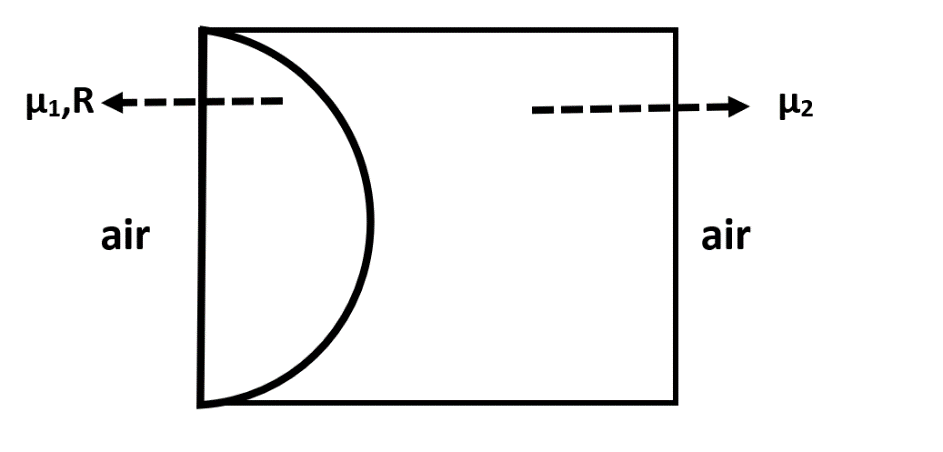
Find out the equivalent focal length of the given lens combination.
$\begin{align}
& (A)\dfrac{R}{{{\mu }_{1}}-{{\mu }_{2}}} \\
& (B)\dfrac{2R}{{{\mu }_{1}}-{{\mu }_{2}}} \\
& (C)\dfrac{4R}{{{\mu }_{1}}-{{\mu }_{2}}} \\
& (D)\dfrac{R}{{{\mu }_{1}}+{{\mu }_{2}}} \\
\end{align}$
Answer
 Verified
601.5k+ views
Hint: The combination of lenses in the given figure are plano convex lens and plano concave lens and these lenses have a common surface of contact. Also on the other side of the convex lens we have air and on the other side of the concave lens, we have air. Thus we shall find the focal length of both lenses separately and use the formula of finding the combined focal length of more than one lens set up.
Complete answer:
Since these are lenses with two different focal lengths at each side, therefore we will use Lens maker’s formula to write their respective focal lengths. Mathematically, the lens maker’s formula can be written as:
$\Rightarrow \dfrac{1}{f}=(\mu -1)\left[ \dfrac{1}{{{R}_{1}}}-\dfrac{1}{{{R}_{2}}} \right]$
Where,
$f$ is the focal length.
$\mu $ is the refractive index of glass used. And,
${{R}_{1}}$ and ${{R}_{2}}$ are the radius of curvature of two sides of the lens.
Now, let the focal length of plano convex lens be given by ${{f}_{1}}$ and let the focal length of plano concave lens be given by ${{f}_{2}}$ . Then, we can calculate them as follows:
$\begin{align}
& \Rightarrow \dfrac{1}{{{f}_{1}}}=({{\mu }_{1}}-1)\left[ \dfrac{1}{\infty }-\left( \dfrac{1}{-R} \right) \right] \\
& \Rightarrow \dfrac{1}{{{f}_{1}}}=\dfrac{({{\mu }_{1}}-1)}{R} \\
\end{align}$
And for second lens, we have:
$\begin{align}
& \Rightarrow \dfrac{1}{{{f}_{2}}}=({{\mu }_{2}}-1)\left[ \left( \dfrac{1}{-R} \right)-\dfrac{1}{\infty } \right] \\
& \Rightarrow \dfrac{1}{{{f}_{2}}}=\dfrac{({{\mu }_{2}}-1)}{-R} \\
\end{align}$
Now, for a combination of lens having different focal lengths, the resultant focal length (say ${{f}_{R}}$) can be written as:
$\Rightarrow \dfrac{1}{{{f}_{R}}}=\dfrac{1}{{{f}_{1}}}+\dfrac{1}{{{f}_{2}}}$
Putting the values of all the respective terms in the above equation, we get:
$\begin{align}
& \Rightarrow \dfrac{1}{{{f}_{R}}}=\dfrac{({{\mu }_{1}}-1)}{R}+\dfrac{({{\mu }_{2}}-1)}{-R} \\
& \Rightarrow \dfrac{1}{{{f}_{R}}}=\dfrac{{{\mu }_{1}}-1-{{\mu }_{2}}+1}{R} \\
& \Rightarrow \dfrac{1}{{{f}_{R}}}=\dfrac{{{\mu }_{1}}-{{\mu }_{2}}}{R} \\
& \therefore {{f}_{R}}=\dfrac{R}{{{\mu }_{1}}-{{\mu }_{2}}} \\
\end{align}$
Hence, the equivalent focal length of the given lens combination is equal to $\dfrac{R}{{{\mu }_{1}}-{{\mu }_{2}}}$.
Hence, option (A) is the correct option.
Note:
There are many different formulas and theories in the chapter of optics. So, one should know which formula is to be applied when. This lens used in this problem is attached perpendicularly. If they were attached side by side then the resultant lens would be a bifocal lens which is generally used by old people.
Complete answer:
Since these are lenses with two different focal lengths at each side, therefore we will use Lens maker’s formula to write their respective focal lengths. Mathematically, the lens maker’s formula can be written as:
$\Rightarrow \dfrac{1}{f}=(\mu -1)\left[ \dfrac{1}{{{R}_{1}}}-\dfrac{1}{{{R}_{2}}} \right]$
Where,
$f$ is the focal length.
$\mu $ is the refractive index of glass used. And,
${{R}_{1}}$ and ${{R}_{2}}$ are the radius of curvature of two sides of the lens.
Now, let the focal length of plano convex lens be given by ${{f}_{1}}$ and let the focal length of plano concave lens be given by ${{f}_{2}}$ . Then, we can calculate them as follows:
$\begin{align}
& \Rightarrow \dfrac{1}{{{f}_{1}}}=({{\mu }_{1}}-1)\left[ \dfrac{1}{\infty }-\left( \dfrac{1}{-R} \right) \right] \\
& \Rightarrow \dfrac{1}{{{f}_{1}}}=\dfrac{({{\mu }_{1}}-1)}{R} \\
\end{align}$
And for second lens, we have:
$\begin{align}
& \Rightarrow \dfrac{1}{{{f}_{2}}}=({{\mu }_{2}}-1)\left[ \left( \dfrac{1}{-R} \right)-\dfrac{1}{\infty } \right] \\
& \Rightarrow \dfrac{1}{{{f}_{2}}}=\dfrac{({{\mu }_{2}}-1)}{-R} \\
\end{align}$
Now, for a combination of lens having different focal lengths, the resultant focal length (say ${{f}_{R}}$) can be written as:
$\Rightarrow \dfrac{1}{{{f}_{R}}}=\dfrac{1}{{{f}_{1}}}+\dfrac{1}{{{f}_{2}}}$
Putting the values of all the respective terms in the above equation, we get:
$\begin{align}
& \Rightarrow \dfrac{1}{{{f}_{R}}}=\dfrac{({{\mu }_{1}}-1)}{R}+\dfrac{({{\mu }_{2}}-1)}{-R} \\
& \Rightarrow \dfrac{1}{{{f}_{R}}}=\dfrac{{{\mu }_{1}}-1-{{\mu }_{2}}+1}{R} \\
& \Rightarrow \dfrac{1}{{{f}_{R}}}=\dfrac{{{\mu }_{1}}-{{\mu }_{2}}}{R} \\
& \therefore {{f}_{R}}=\dfrac{R}{{{\mu }_{1}}-{{\mu }_{2}}} \\
\end{align}$
Hence, the equivalent focal length of the given lens combination is equal to $\dfrac{R}{{{\mu }_{1}}-{{\mu }_{2}}}$.
Hence, option (A) is the correct option.
Note:
There are many different formulas and theories in the chapter of optics. So, one should know which formula is to be applied when. This lens used in this problem is attached perpendicularly. If they were attached side by side then the resultant lens would be a bifocal lens which is generally used by old people.
Recently Updated Pages
Which of the following graphs shows the variation of class 12 physics CBSE

Draw a labelled diagram of the human male reproductive class 12 biology CBSE
Describe the experiment to compare the emf of two cells class 12 physics CBSE
What is standard hydrogen electrode
What is conventional current and electric current class 12 physics CBSE
2Bromopentane is treated with an alcoholic KOH solution class 12 chemistry CBSE
Trending doubts
Which are the Top 10 Largest Countries of the World?
Differentiate between internal fertilization and external class 12 biology CBSE
What is the Full Form of 1.DPT 2.DDT 3.BCG
Differentiate between lanthanoids and actinoids class 12 chemistry CBSE
Sketch and label the Malpighian body class 12 biology CBSE
Why is the cell called the structural and functional class 12 biology CBSE