




Find out the centre of mass of an isosceles triangle of base length a and altitude b. Assume that the mass of the triangle is uniformly distributed over its area.
A. $\dfrac{{2b}}{3}$ from the base
B. $\dfrac{{2b}}{3}$from the vertex
C. $\dfrac{b}{4}$ from the base
D. $\dfrac{{3b}}{4}$ from the vertex
Answer
 Verified
665.7k+ views
Hint: In such types of questions of variable or uniform distribution of mass we use the method integration. Doing this will solve your problem and will give you the right answer.
Formula used: \[{x_{CM}} = \dfrac{1}{M}\smallint xdm\]
Complete step-by-step solution -
The moment of inertia is defined as the ratio of the net angular momentum of the system to its angular velocity around the main axis, that is. Unless the angular momentum of the system is unchanged, the angular velocity will increase as the moment of inertia decreases.
Given, base length =a
Altitude = b
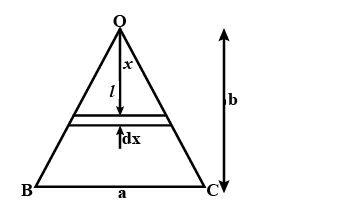
To locate the center of mass of the triangle, we take a strip of width dx at a distance x from the vertex of the triangle. Length of this strip can be evaluated by similar triangles as
\[I = x.(\dfrac{a}{b})\]
Mass of the strip is \[dm = \dfrac{{2M}}{{ab}}ldx\]
Distance of center of mass from the vertex of the triangle is
\[{x_{CM}} = \dfrac{1}{M}\smallint xdm\]
$ = \int_0^b {\dfrac{{2{x^2}}}{{{b^2}}}dx} \\
= \dfrac{2}{3}b \\ $
Hence, the correct answer is \[\dfrac{2}{3}b\] and the correct option is (B).
Note: The center of mass of a distribution of mass in space (sometimes referred to as the balance point) is the unique point where the weighted relative position of the distributed mass sums to zero. Centre of mass of a figure in X- coordinate and Y- coordinate is \[{y_{CM}} = \dfrac{1}{M}\smallint ydm\] \[{x_{CM}} = \dfrac{1}{M}\smallint xdm\] and \[{y_{CM}} = \dfrac{1}{M}\smallint ydm\] respectively.
Formula used: \[{x_{CM}} = \dfrac{1}{M}\smallint xdm\]
Complete step-by-step solution -
The moment of inertia is defined as the ratio of the net angular momentum of the system to its angular velocity around the main axis, that is. Unless the angular momentum of the system is unchanged, the angular velocity will increase as the moment of inertia decreases.
Given, base length =a
Altitude = b
To locate the center of mass of the triangle, we take a strip of width dx at a distance x from the vertex of the triangle. Length of this strip can be evaluated by similar triangles as
\[I = x.(\dfrac{a}{b})\]
Mass of the strip is \[dm = \dfrac{{2M}}{{ab}}ldx\]
Distance of center of mass from the vertex of the triangle is
\[{x_{CM}} = \dfrac{1}{M}\smallint xdm\]
$ = \int_0^b {\dfrac{{2{x^2}}}{{{b^2}}}dx} \\
= \dfrac{2}{3}b \\ $
Hence, the correct answer is \[\dfrac{2}{3}b\] and the correct option is (B).
Note: The center of mass of a distribution of mass in space (sometimes referred to as the balance point) is the unique point where the weighted relative position of the distributed mass sums to zero. Centre of mass of a figure in X- coordinate and Y- coordinate is \[{y_{CM}} = \dfrac{1}{M}\smallint ydm\] \[{x_{CM}} = \dfrac{1}{M}\smallint xdm\] and \[{y_{CM}} = \dfrac{1}{M}\smallint ydm\] respectively.
Recently Updated Pages
Which of the following graphs shows the variation of class 12 physics CBSE

Draw a labelled diagram of the human male reproductive class 12 biology CBSE
Describe the experiment to compare the emf of two cells class 12 physics CBSE
What is standard hydrogen electrode
What is conventional current and electric current class 12 physics CBSE
2Bromopentane is treated with an alcoholic KOH solution class 12 chemistry CBSE
Trending doubts
Draw a labelled sketch of the human eye class 12 physics CBSE
Which are the Top 10 Largest Countries of the World?
Differentiate between homogeneous and heterogeneous class 12 chemistry CBSE
Draw ray diagrams each showing i myopic eye and ii class 12 physics CBSE
Which is the correct genotypic ratio of mendel dihybrid class 12 biology CBSE
What is the Full Form of PVC, PET, HDPE, LDPE, PP and PS ?