




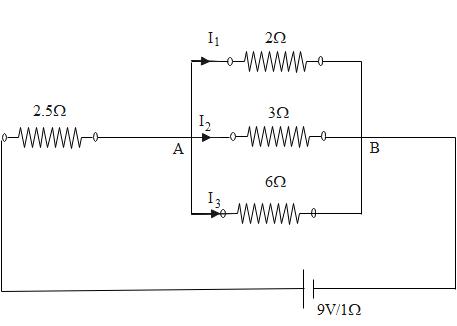
Find ${I_1}$ and ${I_2}$ in the given figure.
$
{\text{A}}{\text{. 2}}{\text{.0}}A{\text{, }}\dfrac{4}{3}A \\
{\text{B}}{\text{. 1}}A{\text{, }}\dfrac{2}{3}A \\
{\text{C}}{\text{. 2}}A{\text{, }}\dfrac{2}{3}A \\
{\text{D}}{\text{. 1}}A{\text{, }}\dfrac{1}{3}A \\
$
Answer
 Verified
615.9k+ views
Hint: We can calculate the total current in the circuit by using the Ohm’s law as values of voltage and resistance for battery are given. Then by using the facts that current remains same in series combination of resistance while the voltage remains same in the parallel combination of resistances, we can obtain the required answer.
Formula used:
The Ohm’s law for electrical circuits is given as
$V = IR$
Here V is the potential difference or voltage, I represents the current while R represents the resistance of the circuit.
Complete step-by-step answer:
In the given circuit, the battery has voltage 9V and the internal resistance of the battery is equal to 1 ohm.
The resultant of three resistances connected in parallel is calculated in the following way.
$
\dfrac{1}{{{R_P}}} = \dfrac{1}{2} + \dfrac{1}{3} + \dfrac{1}{6} = \dfrac{{3 + 2 + 1}}{6} = 1 \\
\Rightarrow {R_P} = 1V \\
$
Therefore, by using Ohm's law, we get the total current through the circuit to be equal to $\dfrac{{9V}}{{1\Omega + 1\Omega + 2.5\Omega }} = 2A$.
Since the current remains the same in the series combination of resistances, the total current through the three branches is 9A. Therefore, we can write that
${I_1} + {I_2} + {I_3} = 2A$
Now in parallel combinations, the voltage remains the same while it gets distributed between the resistances in series combination. Now the voltage through parallel branches is $2 \times {R_P} = 2V$
Since this voltage is the same for all three branches, we can now easily calculate the values of various currents from the resistances in the respective branches by using Ohm's law.
$
{I_1} = \dfrac{{{V_P}}}{{2\Omega }} = \dfrac{2}{2} = 1A \\
{I_2} = \dfrac{{{V_P}}}{{3\Omega }} = \dfrac{2}{3}A \\
$
So, the correct answer is “Option B”.
Note: It should be noted that we can also verify if our answer is correct by calculating the current ${I_3}$ in the same way as the other two values have been found. If the sum of the three obtained values of current is equal to 2A then our answer is correct.
Formula used:
The Ohm’s law for electrical circuits is given as
$V = IR$
Here V is the potential difference or voltage, I represents the current while R represents the resistance of the circuit.
Complete step-by-step answer:
In the given circuit, the battery has voltage 9V and the internal resistance of the battery is equal to 1 ohm.
The resultant of three resistances connected in parallel is calculated in the following way.
$
\dfrac{1}{{{R_P}}} = \dfrac{1}{2} + \dfrac{1}{3} + \dfrac{1}{6} = \dfrac{{3 + 2 + 1}}{6} = 1 \\
\Rightarrow {R_P} = 1V \\
$
Therefore, by using Ohm's law, we get the total current through the circuit to be equal to $\dfrac{{9V}}{{1\Omega + 1\Omega + 2.5\Omega }} = 2A$.
Since the current remains the same in the series combination of resistances, the total current through the three branches is 9A. Therefore, we can write that
${I_1} + {I_2} + {I_3} = 2A$
Now in parallel combinations, the voltage remains the same while it gets distributed between the resistances in series combination. Now the voltage through parallel branches is $2 \times {R_P} = 2V$
Since this voltage is the same for all three branches, we can now easily calculate the values of various currents from the resistances in the respective branches by using Ohm's law.
$
{I_1} = \dfrac{{{V_P}}}{{2\Omega }} = \dfrac{2}{2} = 1A \\
{I_2} = \dfrac{{{V_P}}}{{3\Omega }} = \dfrac{2}{3}A \\
$
So, the correct answer is “Option B”.
Note: It should be noted that we can also verify if our answer is correct by calculating the current ${I_3}$ in the same way as the other two values have been found. If the sum of the three obtained values of current is equal to 2A then our answer is correct.
Recently Updated Pages
Master Class 9 General Knowledge: Engaging Questions & Answers for Success

Master Class 9 Maths: Engaging Questions & Answers for Success
Master Class 9 Science: Engaging Questions & Answers for Success
Master Class 9 English: Engaging Questions & Answers for Success
Master Class 9 Social Science: Engaging Questions & Answers for Success
Class 9 Question and Answer - Your Ultimate Solutions Guide
Trending doubts
Which are the Top 10 Largest Countries of the World?
Draw a labelled sketch of the human eye class 12 physics CBSE
Differentiate between homogeneous and heterogeneous class 12 chemistry CBSE
Sulphuric acid is known as the king of acids State class 12 chemistry CBSE
Why is the cell called the structural and functional class 12 biology CBSE
A dentist uses a small mirror that gives a magnification class 12 physics CBSE