




How do you find absolute minimum and maximum in calculus?
Answer
 Verified
538.8k+ views
Hint: We first explain the concept and then take an example of $f\left( x \right)=-{{x}^{3}}-6{{x}^{2}}-9x-2$. We equate it with 0. Extremum points in a curve have slope value 0. We solve the quadratic solution to find the coordinates and the points.
Complete step by step answer:
To find the extremum points we need to find the slope of a function and also the value of the point where the slope will be 0. Extremum points in a curve have slope value 0.
The slope of the function can be found from the derivative of the function ${{f}^{'}}\left( x \right)=\dfrac{d}{dx}\left[ f\left( x \right) \right]$
We now take an example to understand the concept better. We find the relative extrema of the function $f\left( x \right)=-{{x}^{3}}-6{{x}^{2}}-9x-2$.
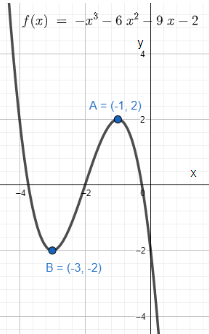
We differentiate both sides of the function $f\left( x \right)=-{{x}^{3}}-6{{x}^{2}}-9x-2$ with respect to $x$.
$\begin{align}
& f\left( x \right)=-{{x}^{3}}-6{{x}^{2}}-9x-2 \\
& \Rightarrow {{f}^{'}}\left( x \right)=\dfrac{d}{dx}\left[ f\left( x \right) \right]=\dfrac{d}{dx}\left[ -{{x}^{3}}-6{{x}^{2}}-9x-2 \right] \\
\end{align}$.
We know that the differentiation form for ${{n}^{th}}$ power of $x$ is $\dfrac{d}{dx}\left[ {{x}^{n}} \right]=n{{x}^{n-1}}$.
Therefore, ${{f}^{'}}\left( x \right)=\dfrac{d}{dx}\left( -{{x}^{3}} \right)+\dfrac{d}{dx}\left( -6{{x}^{2}} \right)+\dfrac{d}{dx}\left( -9x \right)+\dfrac{d}{dx}\left( -2 \right)=-3{{x}^{2}}-12x-9$.
To find the $x$ coordinates of the extremum point we take $-3{{x}^{2}}-12x-9=0$.
Solving the given quadratic equation
$\begin{align}
& -3{{x}^{2}}-12x-9=0 \\
& \Rightarrow {{x}^{2}}+4x+3=0 \\
\end{align}$
We know for a general equation of quadratic $a{{x}^{2}}+bx+c=0$, the value of the roots of x will be $x=\dfrac{-b\pm \sqrt{{{b}^{2}}-4ac}}{2a}$.
In the given equation we have ${{x}^{2}}+4x+3=0$. The values of $a,b,c$ is $1,4,3$ respectively.
We put the values and get $x$ as $x=\dfrac{-4\pm \sqrt{{{4}^{2}}-4\times 1\times 3}}{2\times 1}=\dfrac{-4\pm \sqrt{4}}{2}=\dfrac{-4\pm 2}{2}=-1,-3$.
Therefore, from the value of the $x$ coordinates of the extremum points, we find their $y$ coordinates.
We put values of $x=-1,-3$ in $f\left( x \right)=-{{x}^{3}}-6{{x}^{2}}-9x-2$.
For $x=-1$, the value of \[y=f\left( -1 \right)=-{{\left( -1 \right)}^{3}}-6{{\left( -1 \right)}^{2}}-9\left( -1 \right)-2=2\].
For $x=-3$, the value of \[y=f\left( -3 \right)=-{{\left( -3 \right)}^{3}}-6{{\left( -3 \right)}^{2}}-9\left( -3 \right)-2=-2\].
Therefore, the extremum points are $\left( -1,2 \right);\left( -3,-2 \right)$.
Note: We also can find which point is maxima and minima by finding ${{f}^{''}}\left( x \right)=\dfrac{d}{dx}\left[ {{f}^{'}}\left( x \right) \right]$. If for $x=a,b$, we find ${{f}^{''}}\left( x \right)$ being negative value then the point is maxima and ${{f}^{''}}\left( x \right)$ being positive value then the point is minima.
For ${{f}^{'}}\left( x \right)=-3{{x}^{2}}-12x-9$, we get ${{f}^{''}}\left( x \right)=-6x-12$.
At $x=-1$, ${{f}^{''}}\left( -1 \right)=-6<0$. The point $\left( -1,2 \right)$ is maxima.
At $x=-3$, ${{f}^{''}}\left( -3 \right)=6>0$. The point $\left( -3,-2 \right)$ is minima.
Complete step by step answer:
To find the extremum points we need to find the slope of a function and also the value of the point where the slope will be 0. Extremum points in a curve have slope value 0.
The slope of the function can be found from the derivative of the function ${{f}^{'}}\left( x \right)=\dfrac{d}{dx}\left[ f\left( x \right) \right]$
We now take an example to understand the concept better. We find the relative extrema of the function $f\left( x \right)=-{{x}^{3}}-6{{x}^{2}}-9x-2$.
We differentiate both sides of the function $f\left( x \right)=-{{x}^{3}}-6{{x}^{2}}-9x-2$ with respect to $x$.
$\begin{align}
& f\left( x \right)=-{{x}^{3}}-6{{x}^{2}}-9x-2 \\
& \Rightarrow {{f}^{'}}\left( x \right)=\dfrac{d}{dx}\left[ f\left( x \right) \right]=\dfrac{d}{dx}\left[ -{{x}^{3}}-6{{x}^{2}}-9x-2 \right] \\
\end{align}$.
We know that the differentiation form for ${{n}^{th}}$ power of $x$ is $\dfrac{d}{dx}\left[ {{x}^{n}} \right]=n{{x}^{n-1}}$.
Therefore, ${{f}^{'}}\left( x \right)=\dfrac{d}{dx}\left( -{{x}^{3}} \right)+\dfrac{d}{dx}\left( -6{{x}^{2}} \right)+\dfrac{d}{dx}\left( -9x \right)+\dfrac{d}{dx}\left( -2 \right)=-3{{x}^{2}}-12x-9$.
To find the $x$ coordinates of the extremum point we take $-3{{x}^{2}}-12x-9=0$.
Solving the given quadratic equation
$\begin{align}
& -3{{x}^{2}}-12x-9=0 \\
& \Rightarrow {{x}^{2}}+4x+3=0 \\
\end{align}$
We know for a general equation of quadratic $a{{x}^{2}}+bx+c=0$, the value of the roots of x will be $x=\dfrac{-b\pm \sqrt{{{b}^{2}}-4ac}}{2a}$.
In the given equation we have ${{x}^{2}}+4x+3=0$. The values of $a,b,c$ is $1,4,3$ respectively.
We put the values and get $x$ as $x=\dfrac{-4\pm \sqrt{{{4}^{2}}-4\times 1\times 3}}{2\times 1}=\dfrac{-4\pm \sqrt{4}}{2}=\dfrac{-4\pm 2}{2}=-1,-3$.
Therefore, from the value of the $x$ coordinates of the extremum points, we find their $y$ coordinates.
We put values of $x=-1,-3$ in $f\left( x \right)=-{{x}^{3}}-6{{x}^{2}}-9x-2$.
For $x=-1$, the value of \[y=f\left( -1 \right)=-{{\left( -1 \right)}^{3}}-6{{\left( -1 \right)}^{2}}-9\left( -1 \right)-2=2\].
For $x=-3$, the value of \[y=f\left( -3 \right)=-{{\left( -3 \right)}^{3}}-6{{\left( -3 \right)}^{2}}-9\left( -3 \right)-2=-2\].
Therefore, the extremum points are $\left( -1,2 \right);\left( -3,-2 \right)$.
Note: We also can find which point is maxima and minima by finding ${{f}^{''}}\left( x \right)=\dfrac{d}{dx}\left[ {{f}^{'}}\left( x \right) \right]$. If for $x=a,b$, we find ${{f}^{''}}\left( x \right)$ being negative value then the point is maxima and ${{f}^{''}}\left( x \right)$ being positive value then the point is minima.
For ${{f}^{'}}\left( x \right)=-3{{x}^{2}}-12x-9$, we get ${{f}^{''}}\left( x \right)=-6x-12$.
At $x=-1$, ${{f}^{''}}\left( -1 \right)=-6<0$. The point $\left( -1,2 \right)$ is maxima.
At $x=-3$, ${{f}^{''}}\left( -3 \right)=6>0$. The point $\left( -3,-2 \right)$ is minima.
Recently Updated Pages
Master Class 12 Economics: Engaging Questions & Answers for Success

Master Class 12 English: Engaging Questions & Answers for Success
Master Class 12 Social Science: Engaging Questions & Answers for Success
Master Class 12 Maths: Engaging Questions & Answers for Success
Master Class 12 Physics: Engaging Questions & Answers for Success
Master Class 9 General Knowledge: Engaging Questions & Answers for Success
Trending doubts
Which are the Top 10 Largest Countries of the World?
Draw a labelled sketch of the human eye class 12 physics CBSE
Differentiate between homogeneous and heterogeneous class 12 chemistry CBSE
Sulphuric acid is known as the king of acids State class 12 chemistry CBSE
Why is the cell called the structural and functional class 12 biology CBSE
A dentist uses a small mirror that gives a magnification class 12 physics CBSE