




Fill in the blank:
The space between the cornea and the eyes lens is filled with a liquid called?
Answer
 Verified
571.8k+ views
Hint: in this question, first we will see the basic definition of an eye. Next, we will discuss the cornea, this information will help us to get the answer to our question. Also, we will discuss myopia and how to recover myopia, for our better understanding.
Complete answer:
As we know that, an eye is our organ of sight. The eye has many components which include the cornea, iris, pupil, lens, retina, macula, optic nerve, choroid and vitreous, but these are not limited.
Here, the cornea is the clear front window of our eye that transmits and focuses light into the eye.
Further, the space between the cornea and the eye lens is filled with aqueous humor.
Aqueous humor is defined as the clear, watery fluid between the cornea and the front of the vitreous. Aqueous humor bathes and nourishes the lens and it also maintains the pressure within our eye. Now, as the lens and cornea have no blood supply, the aqueous humor performs the blood’s part of carrying nutrients to those structures of our eye.
Therefore we can conclude our answer by saying that the space between the cornea and the eyes lens is filled with a liquid called aqueous humor.
Additional information:
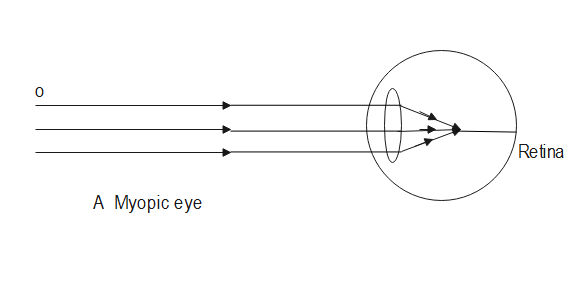
As we know that a person with myopia can see nearby objects clearly whereas he/she cannot see distant objects distinctly. So, we can say that a person with this defect i.e., myopia, has the far point nearer than infinity. In a myopic eye, the image of a distant object is formed in front of the retina and not on the retina itself. This is because of the excessive curvature of the eye lens or elongation of the eyeball.
In the below diagram, we can see a myopic eye, where the image is formed in front of the retina.
When we discuss myopia treatment, we can see that nearsightedness or myopia can be corrected by using eyeglasses, contact lenses or having refractive surgery.
Further, depending on the degree of myopia, a person can wear the glasses or contact lenses all the time or only when he/she needs very clear distance vision, like when driving, or studying.
We need to make good choices for eyeglass lenses for nearsightedness, which include high-index lenses and lenses with anti-reflective coating. Also, one can consider photo chromics to protect the eyes from UV rays and high-energy blue light. This will reduce the need for a separate pair of prescription of sunglasses when we are outdoors. Also, refractive surgery can reduce or even eliminate your need for glasses or contacts.
Note:
We should remember that an eye is a very important organ of any human being or any creature on the earth. One should take care of their eyes, by not giving stress to the eyes. Also, for a normal vision, the near point of a human is 25cm.
Complete answer:
As we know that, an eye is our organ of sight. The eye has many components which include the cornea, iris, pupil, lens, retina, macula, optic nerve, choroid and vitreous, but these are not limited.
Here, the cornea is the clear front window of our eye that transmits and focuses light into the eye.
Further, the space between the cornea and the eye lens is filled with aqueous humor.
Aqueous humor is defined as the clear, watery fluid between the cornea and the front of the vitreous. Aqueous humor bathes and nourishes the lens and it also maintains the pressure within our eye. Now, as the lens and cornea have no blood supply, the aqueous humor performs the blood’s part of carrying nutrients to those structures of our eye.
Therefore we can conclude our answer by saying that the space between the cornea and the eyes lens is filled with a liquid called aqueous humor.
Additional information:
As we know that a person with myopia can see nearby objects clearly whereas he/she cannot see distant objects distinctly. So, we can say that a person with this defect i.e., myopia, has the far point nearer than infinity. In a myopic eye, the image of a distant object is formed in front of the retina and not on the retina itself. This is because of the excessive curvature of the eye lens or elongation of the eyeball.
In the below diagram, we can see a myopic eye, where the image is formed in front of the retina.
When we discuss myopia treatment, we can see that nearsightedness or myopia can be corrected by using eyeglasses, contact lenses or having refractive surgery.
Further, depending on the degree of myopia, a person can wear the glasses or contact lenses all the time or only when he/she needs very clear distance vision, like when driving, or studying.
We need to make good choices for eyeglass lenses for nearsightedness, which include high-index lenses and lenses with anti-reflective coating. Also, one can consider photo chromics to protect the eyes from UV rays and high-energy blue light. This will reduce the need for a separate pair of prescription of sunglasses when we are outdoors. Also, refractive surgery can reduce or even eliminate your need for glasses or contacts.
Note:
We should remember that an eye is a very important organ of any human being or any creature on the earth. One should take care of their eyes, by not giving stress to the eyes. Also, for a normal vision, the near point of a human is 25cm.
Recently Updated Pages
Master Class 12 Economics: Engaging Questions & Answers for Success

Master Class 12 Physics: Engaging Questions & Answers for Success
Master Class 12 English: Engaging Questions & Answers for Success
Master Class 12 Social Science: Engaging Questions & Answers for Success
Master Class 12 Maths: Engaging Questions & Answers for Success
Master Class 12 Business Studies: Engaging Questions & Answers for Success
Trending doubts
Which are the Top 10 Largest Countries of the World?
What are the major means of transport Explain each class 12 social science CBSE
Draw a labelled sketch of the human eye class 12 physics CBSE
Why cannot DNA pass through cell membranes class 12 biology CBSE
Differentiate between insitu conservation and exsitu class 12 biology CBSE
Draw a neat and well labeled diagram of TS of ovary class 12 biology CBSE