




Filariasis is also called elephantiasis as-
(a)It is caused by ascaris
(b)It is caused by elephant
(c)It is caused entamoeba
(d)Body parts swell
Answer
 Verified
614.7k+ views
Hint: A neglected tropical disease is lymphatic filariasis, commonly known as elephantiasis. When filarial parasites are transmitted to humans through mosquitoes, infection occurs. Infection is typically acquired in infancy, causing the lymphatic system to experience secret damage.
Complete answer:
Lymphatic filariasis is a human disease caused by parasitic worms called filarial worms, also known as elephantiasis. There are no signs in most cases of the disease. However, some individuals experience a condition called elephantiasis, characterised by extreme swelling in the arms, legs, breasts, or genitals.
Elephantiasis is a disorder characterised by an area of the body, especially the limbs, being grossly swollen. Other frequently impacted areas include the external genitals. Elephantiasis is caused by obstruction of the lymphatic system, leading to the accumulation in the infected areas of a fluid called lymph.
Filariasis is a parasitic disease caused by infection with Filarioidea-type roundworms. Blood-feeding insects such as black flies and mosquitoes transmit these. They are in the category of diseases known as helminthiases. As a definitive host, human beings have eight known filarial worms.
Additional Information: Ascariasis, which is a species of roundworm, is an inflammation of the small intestine caused by Ascaris lumbricoides. Roundworms are a type of worm with parasites. There are fairly common infections caused by roundworms. The most common roundworm infection is Ascariasis.
Amebiasis is a disease that is caused by the Entamoeba histolytica parasite. It can affect anyone, although it is more prevalent in individuals living in tropical regions with poor sanitary conditions.
So, the correct answer is ‘body parts swell’.
Note: Currently, surgical techniques are being studied to treat elephantiasis. Elephantiasis is normally handled instead of treated, however. Elephantiasis treatment requires the wrapping of the infected limbs to avoid further swelling, and the washing of the limbs on a regular basis to prevent bacterial or fungal infections.
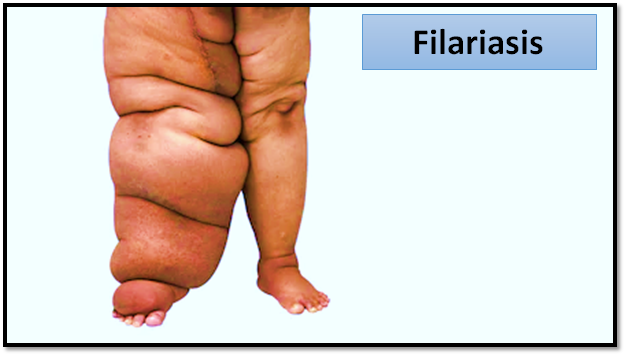
Complete answer:
Lymphatic filariasis is a human disease caused by parasitic worms called filarial worms, also known as elephantiasis. There are no signs in most cases of the disease. However, some individuals experience a condition called elephantiasis, characterised by extreme swelling in the arms, legs, breasts, or genitals.
Elephantiasis is a disorder characterised by an area of the body, especially the limbs, being grossly swollen. Other frequently impacted areas include the external genitals. Elephantiasis is caused by obstruction of the lymphatic system, leading to the accumulation in the infected areas of a fluid called lymph.
Filariasis is a parasitic disease caused by infection with Filarioidea-type roundworms. Blood-feeding insects such as black flies and mosquitoes transmit these. They are in the category of diseases known as helminthiases. As a definitive host, human beings have eight known filarial worms.
Additional Information: Ascariasis, which is a species of roundworm, is an inflammation of the small intestine caused by Ascaris lumbricoides. Roundworms are a type of worm with parasites. There are fairly common infections caused by roundworms. The most common roundworm infection is Ascariasis.
Amebiasis is a disease that is caused by the Entamoeba histolytica parasite. It can affect anyone, although it is more prevalent in individuals living in tropical regions with poor sanitary conditions.
So, the correct answer is ‘body parts swell’.
Note: Currently, surgical techniques are being studied to treat elephantiasis. Elephantiasis is normally handled instead of treated, however. Elephantiasis treatment requires the wrapping of the infected limbs to avoid further swelling, and the washing of the limbs on a regular basis to prevent bacterial or fungal infections.
Recently Updated Pages
Master Class 12 Economics: Engaging Questions & Answers for Success

Master Class 12 English: Engaging Questions & Answers for Success
Master Class 12 Social Science: Engaging Questions & Answers for Success
Master Class 12 Maths: Engaging Questions & Answers for Success
Master Class 12 Physics: Engaging Questions & Answers for Success
Master Class 9 General Knowledge: Engaging Questions & Answers for Success
Trending doubts
Which are the Top 10 Largest Countries of the World?
Draw a labelled sketch of the human eye class 12 physics CBSE
Differentiate between homogeneous and heterogeneous class 12 chemistry CBSE
Why is the cell called the structural and functional class 12 biology CBSE
Draw ray diagrams each showing i myopic eye and ii class 12 physics CBSE
Which is the correct genotypic ratio of mendel dihybrid class 12 biology CBSE