




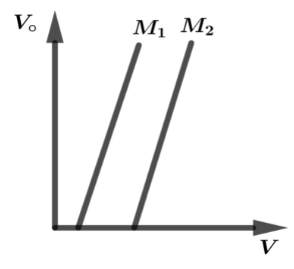
Figure shows variation of stopping potential $\left( {{V_ \circ }} \right)$ with the frequency $\left( V \right)$ for two photosensitive materials ${M_1}$ and ${M_2}$
(i) Why is the slope same for both lines?
(ii) For which material will the emitted electrons have greater kinetic energy for the incident radiation of the same frequency? Justify your answer.
Answer
 Verified
542.4k+ views
Hint:In the question and figure shows the variation of two slopes in that we have to find out that the two slopes have the same both lines are not. In the second condition we have to prove that the emitted electrons have greater kinetic energy for the incident radiation are not. For this process we have to use the condition of the Einstein equation.
Complete answer:
(i) We have drawn a graph between stopping potential $\left( {{V_ \circ }} \right)$ and frequency $\left( V \right)$. In that graph we have drawn two slopes equally ${M_1}$ and ${M_2}$. The slope stopping potential $\left( {{V_ \circ }} \right)$ versus frequency $\left( V \right)$ is equal to $\left( {\dfrac{h}{e}} \right)$ the universal constant, so the slope is same for both lines. Thus it doesn’t depend on the material.
(ii) The threshold frequency $\left( {{V_ \circ }} \right)$ is lesser for the slope ${M_1}$, so that the kinetic energy is greater for ${M_1}$ in same frequency $\left( V \right)$. Thus the kinetic energy is, $K.E = hV - h{V_ \circ }$. Emitted electrons are greater energy so, $\phi_0 = h{V_ \circ }$ which has lower energy material ${M_1}$. Thus the given two conditions are satisfied in the slope potential difference and frequency.
Note: For two photosensitive materials the same for both the lines. In kinetic energy the potential difference and frequency of an incident radiation for the same frequency is also satisfied. As we discussed in the solution part, for this we have used the Einstein condition.
Complete answer:
(i) We have drawn a graph between stopping potential $\left( {{V_ \circ }} \right)$ and frequency $\left( V \right)$. In that graph we have drawn two slopes equally ${M_1}$ and ${M_2}$. The slope stopping potential $\left( {{V_ \circ }} \right)$ versus frequency $\left( V \right)$ is equal to $\left( {\dfrac{h}{e}} \right)$ the universal constant, so the slope is same for both lines. Thus it doesn’t depend on the material.
(ii) The threshold frequency $\left( {{V_ \circ }} \right)$ is lesser for the slope ${M_1}$, so that the kinetic energy is greater for ${M_1}$ in same frequency $\left( V \right)$. Thus the kinetic energy is, $K.E = hV - h{V_ \circ }$. Emitted electrons are greater energy so, $\phi_0 = h{V_ \circ }$ which has lower energy material ${M_1}$. Thus the given two conditions are satisfied in the slope potential difference and frequency.
Note: For two photosensitive materials the same for both the lines. In kinetic energy the potential difference and frequency of an incident radiation for the same frequency is also satisfied. As we discussed in the solution part, for this we have used the Einstein condition.
Recently Updated Pages
Master Class 12 Business Studies: Engaging Questions & Answers for Success

Master Class 12 Biology: Engaging Questions & Answers for Success
Master Class 12 Chemistry: Engaging Questions & Answers for Success
Class 12 Question and Answer - Your Ultimate Solutions Guide
Master Class 11 Social Science: Engaging Questions & Answers for Success
Master Class 11 English: Engaging Questions & Answers for Success
Trending doubts
Which are the Top 10 Largest Countries of the World?
Draw a labelled sketch of the human eye class 12 physics CBSE
Differentiate between homogeneous and heterogeneous class 12 chemistry CBSE
Sulphuric acid is known as the king of acids State class 12 chemistry CBSE
Why is the cell called the structural and functional class 12 biology CBSE
Which is the correct genotypic ratio of mendel dihybrid class 12 biology CBSE