




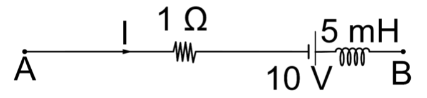
Figure shows part of a circuit. If $I{\text{ }} = {\text{ }}7{\text{ }}A$ and is decreasing at a constant rate of $500{\text{ }}A/s$, then ${V_B}{\text{ }} - {\text{ }}{V_A}$ is
A. $ - {\text{ }}1.5{\text{ }}V$
B. $2.5{\text{ }}V$
C. \[ - {\text{ }}3.5{\text{ }}V\]
D. \[5.5{\text{ }}V\]
Answer
 Verified
552.6k+ views
Hint: We will directly form an equation as we move from A to B using the conventions of Kirchhoff’s rule. Then, we will substitute the appropriate values and then evaluate the required solution.
Complete step by step answer:
Firstly we start from point A and we start the equation with ${V_A}$. Then, we move to the resistor and we observe that we are moving with the current in the resistor and thus we will have a potential drop thus, we proceed with ${V_A}{\text{ }} - {\text{ }}IR$.
Now, we reach the cell and we are moving from the negative to the positive end which means we are moving from a point of lower potential to a point of higher potential and thus, we will have a potential lift.Thus, we get
${V_A}{\text{ }} - {\text{ }}IR{\text{ }} + {\text{ }}V$
Then, we reach the inductor and we move along with the current and thus there is a potential drop.Thus, we get
${V_A}{\text{ }} - {\text{ }}IR{\text{ }} + {\text{ }}V{\text{ }} + {\text{ }}L{\text{ }}\dfrac{{dI}}{{dt}}$
Finally, we reach the final point B. Thus, we get
${V_A}{\text{ }} - {\text{ }}IR{\text{ }} + {\text{ }}V{\text{ }} + {\text{ }}L{\text{ }}\dfrac{{dI}}{{dt}}{\text{ }} = {\text{ }}{V_B}$
Further, we rearrange the equation and we get
${V_B}{\text{ }} - {\text{ }}{V_A}{\text{ }} = {\text{ }}V{\text{ }} + {\text{ }}L{\text{ }}\dfrac{{dI}}{{dt}}{\text{ }} - {\text{ }}IR{\text{ }} - - - - - - - {\text{ }}(i)$
Now, we will observe the given values
$V{\text{ }} = {\text{ }}10{\text{ }}V$
$\Rightarrow R{\text{ }} = {\text{ }}1{\text{ }}\Omega $
$\Rightarrow I{\text{ }} = {\text{ }}7{\text{ }}A$
As an inductor opposes the flowing current.
Thus, the value of inductance will be negative.
$L{\text{ }} = {\text{ }} - {\text{ }}5{\text{ }}mH{\text{ }} = {\text{ }} - {\text{ }}5{\text{ }} \times {\text{ }}{10^{ - 3}}{\text{ }}H$
Since, there is a current decay in the inductor. Thus, the value of $\dfrac{{dI}}{{dt}}$ is negative.Thus,
$\dfrac{{dI}}{{dt}}{\text{ }} = {\text{ }} - {\text{ }}5{\text{ }} \times {\text{ }}{10^2}{\text{ }}A/s$
Substituting these values in equation $(i)$, we get
${V_B}{\text{ }} - {\text{ }}{V_A}{\text{ }} = {\text{ }}10{\text{ }} + {\text{ }}\left( {5{\text{ }} \times {\text{ }}{{10}^{ - 3}}} \right){\text{ }} \times {\text{ }}\left( {5{\text{ }} \times {\text{ }}{{10}^2}} \right){\text{ }} - {\text{ }}7{\text{ }} \times {\text{ }}1$
Further, we get
${V_B}{\text{ }} - {\text{ }}{V_A}{\text{ }} = {\text{ }}10{\text{ }} + {\text{ }}25{\text{ }} \times {\text{ }}{10^{ - 1}}{\text{ }} - {\text{ }}7$
Then, we get
${V_B}{\text{ }} - {\text{ }}{V_A}{\text{ }} = {\text{ }}3{\text{ }} + {\text{ }}2.5$
Finally, we get
$\therefore {V_B}{\text{ }} - {\text{ }}{V_A}{\text{ }} = {\text{ }}5.5{\text{ }}V$
Hence, the correct answer is D.
Note: Students should be very cautious while using the values of inductance and current decay. Students should use the idea of exponents as otherwise, they will arrive into a situation of clumsy calculations.
Complete step by step answer:
Firstly we start from point A and we start the equation with ${V_A}$. Then, we move to the resistor and we observe that we are moving with the current in the resistor and thus we will have a potential drop thus, we proceed with ${V_A}{\text{ }} - {\text{ }}IR$.
Now, we reach the cell and we are moving from the negative to the positive end which means we are moving from a point of lower potential to a point of higher potential and thus, we will have a potential lift.Thus, we get
${V_A}{\text{ }} - {\text{ }}IR{\text{ }} + {\text{ }}V$
Then, we reach the inductor and we move along with the current and thus there is a potential drop.Thus, we get
${V_A}{\text{ }} - {\text{ }}IR{\text{ }} + {\text{ }}V{\text{ }} + {\text{ }}L{\text{ }}\dfrac{{dI}}{{dt}}$
Finally, we reach the final point B. Thus, we get
${V_A}{\text{ }} - {\text{ }}IR{\text{ }} + {\text{ }}V{\text{ }} + {\text{ }}L{\text{ }}\dfrac{{dI}}{{dt}}{\text{ }} = {\text{ }}{V_B}$
Further, we rearrange the equation and we get
${V_B}{\text{ }} - {\text{ }}{V_A}{\text{ }} = {\text{ }}V{\text{ }} + {\text{ }}L{\text{ }}\dfrac{{dI}}{{dt}}{\text{ }} - {\text{ }}IR{\text{ }} - - - - - - - {\text{ }}(i)$
Now, we will observe the given values
$V{\text{ }} = {\text{ }}10{\text{ }}V$
$\Rightarrow R{\text{ }} = {\text{ }}1{\text{ }}\Omega $
$\Rightarrow I{\text{ }} = {\text{ }}7{\text{ }}A$
As an inductor opposes the flowing current.
Thus, the value of inductance will be negative.
$L{\text{ }} = {\text{ }} - {\text{ }}5{\text{ }}mH{\text{ }} = {\text{ }} - {\text{ }}5{\text{ }} \times {\text{ }}{10^{ - 3}}{\text{ }}H$
Since, there is a current decay in the inductor. Thus, the value of $\dfrac{{dI}}{{dt}}$ is negative.Thus,
$\dfrac{{dI}}{{dt}}{\text{ }} = {\text{ }} - {\text{ }}5{\text{ }} \times {\text{ }}{10^2}{\text{ }}A/s$
Substituting these values in equation $(i)$, we get
${V_B}{\text{ }} - {\text{ }}{V_A}{\text{ }} = {\text{ }}10{\text{ }} + {\text{ }}\left( {5{\text{ }} \times {\text{ }}{{10}^{ - 3}}} \right){\text{ }} \times {\text{ }}\left( {5{\text{ }} \times {\text{ }}{{10}^2}} \right){\text{ }} - {\text{ }}7{\text{ }} \times {\text{ }}1$
Further, we get
${V_B}{\text{ }} - {\text{ }}{V_A}{\text{ }} = {\text{ }}10{\text{ }} + {\text{ }}25{\text{ }} \times {\text{ }}{10^{ - 1}}{\text{ }} - {\text{ }}7$
Then, we get
${V_B}{\text{ }} - {\text{ }}{V_A}{\text{ }} = {\text{ }}3{\text{ }} + {\text{ }}2.5$
Finally, we get
$\therefore {V_B}{\text{ }} - {\text{ }}{V_A}{\text{ }} = {\text{ }}5.5{\text{ }}V$
Hence, the correct answer is D.
Note: Students should be very cautious while using the values of inductance and current decay. Students should use the idea of exponents as otherwise, they will arrive into a situation of clumsy calculations.
Recently Updated Pages
Master Class 12 Economics: Engaging Questions & Answers for Success

Master Class 12 Social Science: Engaging Questions & Answers for Success
Master Class 12 English: Engaging Questions & Answers for Success
Master Class 12 Maths: Engaging Questions & Answers for Success
Master Class 12 Physics: Engaging Questions & Answers for Success
Master Class 12 Biology: Engaging Questions & Answers for Success
Trending doubts
Draw a labelled sketch of the human eye class 12 physics CBSE
Which are the Top 10 Largest Countries of the World?
Draw ray diagrams each showing i myopic eye and ii class 12 physics CBSE
Which is the correct genotypic ratio of mendel dihybrid class 12 biology CBSE
Differentiate between homogeneous and heterogeneous class 12 chemistry CBSE
Which animal never drinks water in its entire life class 12 biology CBSE