




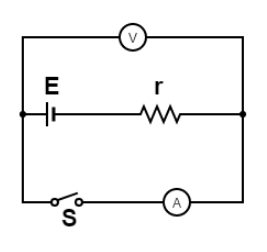
Figure shows an arrangement to measure the emf $\varepsilon $ and internal resistance $r$ of a battery. The voltmeter has a very high resistance and the ammeter also has some resistance. The voltmeter reads $1.52V$ when the switch S is open. When the switch is closed the voltmeter reading drops to $1.45V$ and the ammeter reads $1.0A$.Find the emf and the internal resistance of the battery.
Answer
 Verified
587.1k+ views
Hint: In order to solve this question we need to understand definition of emf. Emf is known as electromotive force, it is actually the force develop across battery due to potential difference since battery has internal resistance so force derive the electrons and hence current flows in opposite direction. Voltmeter is device which measure voltage in circuit whereas Ammeter is device which measures current in circuit.
Complete step by step answer:
First we consider the case when the switch is open. In this case there is no current in the ammeter arm as it is an open circuit. Also in voltmeter arm no current or very little current at all because of high resistance of voltmeter. So that’s why we can neglect current and in that case emf equals the voltmeter reading hence emf is equal to \[\varepsilon = 1.52V\].
And in the second case when the switch is on then current flows in the ammeter arm only because voltmeter has a high resistance so there is no current in it. Now applying Kirchhoff’s rule across loop we get
$\varepsilon - ir = 1.45V$
Where $i$ is current measured by ammeter which is $i = 1.0A$
So putting values we get
$1.52 - (1.0 \times r) = 1.45$
$r = \dfrac{{(1.52 - 1.45)}}{{1.0}} = 0.07\,\Omega $
So emf is \[\varepsilon = 1.52\,V\].
And internal resistance is $r = 0.07\,\Omega $.
Hence emf and internal resistance of the battery are 1.52 V and $0.07\Omega $.
Note: It should be remembered that an ideal voltmeter has infinite resistance that is why it cannot draw any current and purely measures the voltage whereas an ideal ammeter has zero resistance so that it only draws current and no voltage. Kirchhoff’s voltage law states that in any closed loop the sum of all voltages is zero.
Complete step by step answer:
First we consider the case when the switch is open. In this case there is no current in the ammeter arm as it is an open circuit. Also in voltmeter arm no current or very little current at all because of high resistance of voltmeter. So that’s why we can neglect current and in that case emf equals the voltmeter reading hence emf is equal to \[\varepsilon = 1.52V\].
And in the second case when the switch is on then current flows in the ammeter arm only because voltmeter has a high resistance so there is no current in it. Now applying Kirchhoff’s rule across loop we get
$\varepsilon - ir = 1.45V$
Where $i$ is current measured by ammeter which is $i = 1.0A$
So putting values we get
$1.52 - (1.0 \times r) = 1.45$
$r = \dfrac{{(1.52 - 1.45)}}{{1.0}} = 0.07\,\Omega $
So emf is \[\varepsilon = 1.52\,V\].
And internal resistance is $r = 0.07\,\Omega $.
Hence emf and internal resistance of the battery are 1.52 V and $0.07\Omega $.
Note: It should be remembered that an ideal voltmeter has infinite resistance that is why it cannot draw any current and purely measures the voltage whereas an ideal ammeter has zero resistance so that it only draws current and no voltage. Kirchhoff’s voltage law states that in any closed loop the sum of all voltages is zero.
Recently Updated Pages
Explain the structure of megasporangium class 12 biology CBSE

Why is chloroform kept in dark coloured bottles class 12 chemistry CBSE
Derive the balancing condition of a Wheatstone bri class 12 physics CBSE
Draw VI characteristics of a pn junction diode Explain class 12 physics CBSE
Is it possible to carry pride in ones language too class 12 english CBSE
In a population at Hardy Weinberg equilibrium the allele class 12 biology CBSE
Trending doubts
One megawatt is equal to how many units of electri class 12 physics CBSE
What is the Full Form of PVC, PET, HDPE, LDPE, PP and PS ?
Draw a well labelled diagram of the human brain class 12 biology CBSE
Differentiate between homogeneous and heterogeneous class 12 chemistry CBSE
What is the structural formula of Aspirin A B C D class 12 chemistry CBSE
Draw a labelled diagram of a female reproductive s class 12 biology CBSE