




Figure shows a set of equipotential surfaces. The magnitude and direction of electric field that exists in the region is:
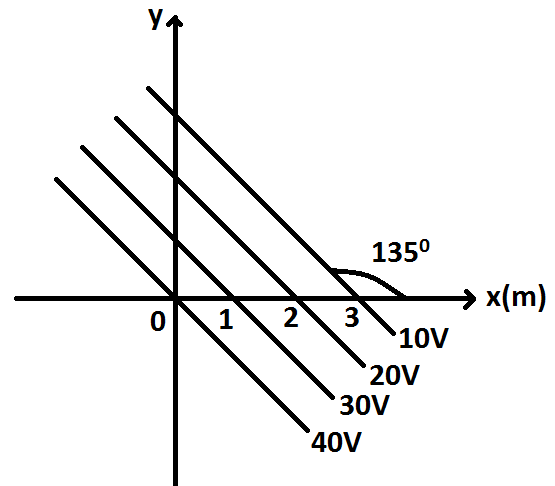
(A) $ 10\sqrt 2 V/m $ at $ {45^ \circ } $ with x-axis
(B) $ 10\sqrt 2 V/m $ at $ - {45^ \circ } $ with x-axis
(C) $ 5\sqrt 2 V/m $ at $ {45^ \circ } $ with x-axis
(D) $ 5\sqrt 2 V/m $ at $ - {45^ \circ } $ with x-axis
Answer
 Verified
570.3k+ views
Hint :We know that the electric field of the region is perpendicular to the equipotential surfaces. Therefore, we will find the horizontal and vertical component of the electric field. After that, using these both components, we will find the angle with the horizontal.
Complete Step By Step Answer:
By applying the rules of geometry, we can determine the angles and dimensions on the y-axis as shown in the figure.
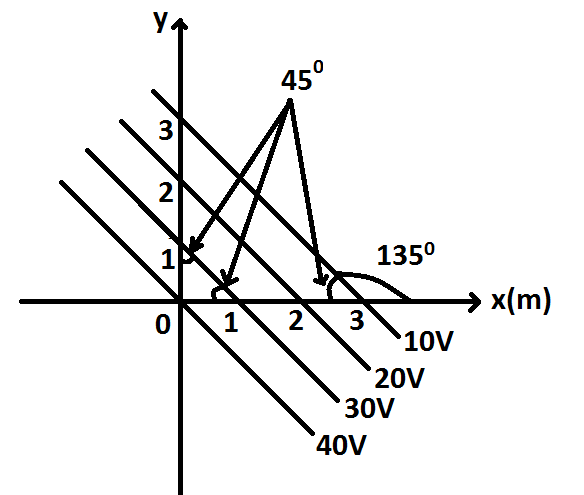
Now, we will find the horizontal component of the electric field.
$ {E_x} = \dfrac{{ - dV}}{{dx}} = \dfrac{{ - \left( {30 - 40} \right)}}{{2 - 1}} = 10i $
Similarly, the horizontal component of the electric field can be determined.
$ {E_y} = \dfrac{{ - dV}}{{dy}} = \dfrac{{ - \left( {30 - 40} \right)}}{{2 - 1}} = 10j $
We know that the electric field is given by the addition of its horizontal and vertical component.
$ E = {E_x} + {E_y} = 10i + 10j $
The magnitude of this electric field is given by:
$ \sqrt {{{10}^2} + {{10}^2}} = 10\sqrt 2 V/m $ .
Now to find the tangent of the angle made by the electric field with the horizontal, we need to divide its vertical component by its horizontal components.
Let us consider that the electric field is making angle $ \theta $ with the x-axis.
$
\Rightarrow \tan \theta = \dfrac{{dy}}{{dx}} = \dfrac{1}{1} = 1 \\
\Rightarrow \theta = {45^ \circ } \\
$
Hence, option A is the right answer.
Note :
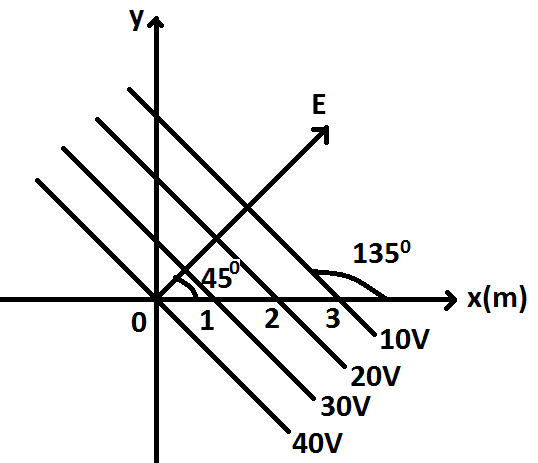
Here, we have determined the magnitude and the direction of the electric field. We also know that it is perpendicular to the equipotential surfaces. Thus, if we want to indicate the electric field in the diagram, we can show it accordingly as shown in the following figure.
Complete Step By Step Answer:
By applying the rules of geometry, we can determine the angles and dimensions on the y-axis as shown in the figure.
Now, we will find the horizontal component of the electric field.
$ {E_x} = \dfrac{{ - dV}}{{dx}} = \dfrac{{ - \left( {30 - 40} \right)}}{{2 - 1}} = 10i $
Similarly, the horizontal component of the electric field can be determined.
$ {E_y} = \dfrac{{ - dV}}{{dy}} = \dfrac{{ - \left( {30 - 40} \right)}}{{2 - 1}} = 10j $
We know that the electric field is given by the addition of its horizontal and vertical component.
$ E = {E_x} + {E_y} = 10i + 10j $
The magnitude of this electric field is given by:
$ \sqrt {{{10}^2} + {{10}^2}} = 10\sqrt 2 V/m $ .
Now to find the tangent of the angle made by the electric field with the horizontal, we need to divide its vertical component by its horizontal components.
Let us consider that the electric field is making angle $ \theta $ with the x-axis.
$
\Rightarrow \tan \theta = \dfrac{{dy}}{{dx}} = \dfrac{1}{1} = 1 \\
\Rightarrow \theta = {45^ \circ } \\
$
Hence, option A is the right answer.
Note :
Here, we have determined the magnitude and the direction of the electric field. We also know that it is perpendicular to the equipotential surfaces. Thus, if we want to indicate the electric field in the diagram, we can show it accordingly as shown in the following figure.
Recently Updated Pages
Master Class 12 Business Studies: Engaging Questions & Answers for Success

Master Class 12 Biology: Engaging Questions & Answers for Success
Master Class 12 Chemistry: Engaging Questions & Answers for Success
Class 12 Question and Answer - Your Ultimate Solutions Guide
Master Class 11 Social Science: Engaging Questions & Answers for Success
Master Class 11 English: Engaging Questions & Answers for Success
Trending doubts
Which are the Top 10 Largest Countries of the World?
Draw a labelled sketch of the human eye class 12 physics CBSE
Name the crygenes that control cotton bollworm and class 12 biology CBSE
Differentiate between homogeneous and heterogeneous class 12 chemistry CBSE
Ribosomal RNA is actively synthesised in A Nucleoplasm class 12 biology CBSE
How many molecules of ATP and NADPH are required information class 12 biology CBSE