




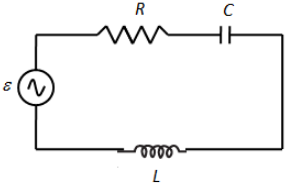
Figure shows a series LCR circuit connected to a variable frequency 230 V source. \[L = 5.0\,{\text{H}}\], \[C = 80\,\mu F\], \[R = 40\,\Omega \].
(a) Determine the source frequency which drives the circuit in resonance.
(b) Obtain the impedance of the circuit and the amplitude of current at the resonating frequency.
(c) Determine the rms potential drop across the three elements of the circuit. Show that the potential drop across the LC combination is zero at the resonating frequency.
Answer
 Verified
627.6k+ views
Hint: At resonance, the inductive reactance and capacitive reactance becomes equal. Use this fact to determine the impedance of the circuit. The amplitude of the current in an LCR circuit is the ratio of peak voltage to impedance of the circuit. The voltage drop across each component is equal to the product of total current and reactance of that element.
Formula used:
Resonating frequency in the LC circuit,
\[\omega = \dfrac{1}{{\sqrt {LC} }}\]
Here, L is the inductor and C is the capacitor.
Impedance of the series LCR circuit is given as,
\[Z = \sqrt {{R^2} + {{\left( {{X_L} - {X_C}} \right)}^2}} \]
Here, \[{X_L}\] is the inductive reactance and \[{X_C}\] is the capacitive reactance.
Complete step by step answer:
We have given, \[L = 5.0\,{\text{H}}\], \[C = 80\,\mu F\], \[R = 40\,\Omega \].
(a) We have the expression for the resonating frequency in the LC circuit,
\[\omega = \dfrac{1}{{\sqrt {LC} }}\]
Here, L is the inductor and C is the capacitor.
Substituting \[L = 5.0\,{\text{H}}\] and \[C = 80\,\mu F\] in the above equation, we get,
\[\omega = \dfrac{1}{{\sqrt {\left( 5 \right)\left( {80 \times {{10}^{ - 6}}} \right)} }}\]
\[ \Rightarrow \omega = \dfrac{1}{{0.02}}\]
\[ \Rightarrow \omega = 50\,{\text{rad/s}}\]
Therefore, the source frequency which drives the circuit in resonance is 50 rad/s.
(b) We know that at resonance, the capacitive reactance and inductive reactance are equal. Therefore, \[{X_L} = {X_C}\]
Here, \[{X_L}\] is the inductive reactance and \[{X_C}\] is the capacitive reactance.
We have the impedance of the series LCR circuit is given as,
\[Z = \sqrt {{R^2} + {{\left( {{X_L} - {X_C}} \right)}^2}} \]
Substituting \[{X_L} = {X_C}\] in the above equation, we get,
\[Z = \sqrt {{R^2} + {{\left( {{X_C} - {X_C}} \right)}^2}} \]
\[ \Rightarrow Z = \sqrt {{R^2}} \]
\[ \Rightarrow Z = R\]
\[ \Rightarrow Z = 40\,\Omega \]
Therefore, the impedance of the circuit is \[40\,\Omega \].
We have the expression for the amplitude of the current in LCR circuit is,
\[{I_0} = \dfrac{{{V_0}}}{Z}\]
Here, \[{V_0}\] is the peak voltage and it is given as,
\[{V_0} = \sqrt 2 V\], where V is the source voltage.
Therefore, the amplitude of the current becomes,
\[{I_0} = \dfrac{{\sqrt 2 V}}{Z}\]
\[ \Rightarrow {I_0} = \dfrac{{\sqrt 2 \left( {230} \right)}}{{40}}\]
\[ \Rightarrow {I_0} = 8.13\,{\text{A}}\]
Therefore, the amplitude of the current is 8.13 A.
(c) Let’s find the total current in the circuit as,
\[I = \dfrac{{{I_0}}}{{\sqrt 2 }}\]
\[ \Rightarrow I = \dfrac{{8.13}}{{\sqrt 2 }}\]
\[ \Rightarrow I = 5.75\,{\text{A}}\]
Now, we know that the potential drop across the inductor is given as,
\[{V_L} = I \times \omega L\] , where, \[\omega \] is the resonance frequency.
Substituting 5.75 A for I, 50 rad/s for \[\omega \] and 5.0 H for L in the above equation, we get,
\[{V_L} = \left( {5.75} \right) \times \left( {50} \right)\left( 5 \right)\]
\[ \Rightarrow {V_L} = 1437.5\,{\text{V}}\]
We have the potential drop across the capacitor is given as,
\[{V_C} = I \times \dfrac{1}{{\omega C}}\]
Substituting 5.75 A for I, 50 rad/s for \[\omega \] and \[80\,\mu F\] for C in the above equation, we get,
\[{V_C} = \left( {5.75} \right) \times \dfrac{1}{{\left( {50} \right)\left( {80 \times {{10}^{ - 6}}} \right)}}\]
\[ \Rightarrow {V_C} = \left( {5.75} \right) \times \left( {250} \right)\]
\[ \Rightarrow {V_C} = 1437.5\,{\text{V}}\]
The voltage drop across the resistor is given as,
\[{V_R} = I \times R\]
Substituting 5.75 A for I and \[40\,\Omega \] for R in the above equation, we get,
\[{V_R} = \left( {5.75} \right) \times \left( {40} \right)\]
\[ \Rightarrow {V_R} = 230\,{\text{V}}\]
We have the potential drop across the LC circuit is given as,
\[{V_{LC}} = I\left( {{X_L} - {X_C}} \right)\]
As we have seen earlier, at resonance, \[{X_L} = {X_C}\].
Therefore, the potential drop across the LC combination becomes zero.
Note:The potential drop across the LC circuit at resonance is zero and therefore,\[{V_{LC}} = I\left( {{X_L} - {X_C}} \right) = I{X_L} - I{X_C} = 0\]
\[ \Rightarrow I{X_L} = I{X_C}\]
\[ \Rightarrow {V_L} = {V_C}\]
Therefore, the potential drop across both inductor and capacitor is the same at resonance as we see in the solution.At resonance, the impedance of the whole circuit that is resistance in the LCR circuit is only due to the resistor.
Formula used:
Resonating frequency in the LC circuit,
\[\omega = \dfrac{1}{{\sqrt {LC} }}\]
Here, L is the inductor and C is the capacitor.
Impedance of the series LCR circuit is given as,
\[Z = \sqrt {{R^2} + {{\left( {{X_L} - {X_C}} \right)}^2}} \]
Here, \[{X_L}\] is the inductive reactance and \[{X_C}\] is the capacitive reactance.
Complete step by step answer:
We have given, \[L = 5.0\,{\text{H}}\], \[C = 80\,\mu F\], \[R = 40\,\Omega \].
(a) We have the expression for the resonating frequency in the LC circuit,
\[\omega = \dfrac{1}{{\sqrt {LC} }}\]
Here, L is the inductor and C is the capacitor.
Substituting \[L = 5.0\,{\text{H}}\] and \[C = 80\,\mu F\] in the above equation, we get,
\[\omega = \dfrac{1}{{\sqrt {\left( 5 \right)\left( {80 \times {{10}^{ - 6}}} \right)} }}\]
\[ \Rightarrow \omega = \dfrac{1}{{0.02}}\]
\[ \Rightarrow \omega = 50\,{\text{rad/s}}\]
Therefore, the source frequency which drives the circuit in resonance is 50 rad/s.
(b) We know that at resonance, the capacitive reactance and inductive reactance are equal. Therefore, \[{X_L} = {X_C}\]
Here, \[{X_L}\] is the inductive reactance and \[{X_C}\] is the capacitive reactance.
We have the impedance of the series LCR circuit is given as,
\[Z = \sqrt {{R^2} + {{\left( {{X_L} - {X_C}} \right)}^2}} \]
Substituting \[{X_L} = {X_C}\] in the above equation, we get,
\[Z = \sqrt {{R^2} + {{\left( {{X_C} - {X_C}} \right)}^2}} \]
\[ \Rightarrow Z = \sqrt {{R^2}} \]
\[ \Rightarrow Z = R\]
\[ \Rightarrow Z = 40\,\Omega \]
Therefore, the impedance of the circuit is \[40\,\Omega \].
We have the expression for the amplitude of the current in LCR circuit is,
\[{I_0} = \dfrac{{{V_0}}}{Z}\]
Here, \[{V_0}\] is the peak voltage and it is given as,
\[{V_0} = \sqrt 2 V\], where V is the source voltage.
Therefore, the amplitude of the current becomes,
\[{I_0} = \dfrac{{\sqrt 2 V}}{Z}\]
\[ \Rightarrow {I_0} = \dfrac{{\sqrt 2 \left( {230} \right)}}{{40}}\]
\[ \Rightarrow {I_0} = 8.13\,{\text{A}}\]
Therefore, the amplitude of the current is 8.13 A.
(c) Let’s find the total current in the circuit as,
\[I = \dfrac{{{I_0}}}{{\sqrt 2 }}\]
\[ \Rightarrow I = \dfrac{{8.13}}{{\sqrt 2 }}\]
\[ \Rightarrow I = 5.75\,{\text{A}}\]
Now, we know that the potential drop across the inductor is given as,
\[{V_L} = I \times \omega L\] , where, \[\omega \] is the resonance frequency.
Substituting 5.75 A for I, 50 rad/s for \[\omega \] and 5.0 H for L in the above equation, we get,
\[{V_L} = \left( {5.75} \right) \times \left( {50} \right)\left( 5 \right)\]
\[ \Rightarrow {V_L} = 1437.5\,{\text{V}}\]
We have the potential drop across the capacitor is given as,
\[{V_C} = I \times \dfrac{1}{{\omega C}}\]
Substituting 5.75 A for I, 50 rad/s for \[\omega \] and \[80\,\mu F\] for C in the above equation, we get,
\[{V_C} = \left( {5.75} \right) \times \dfrac{1}{{\left( {50} \right)\left( {80 \times {{10}^{ - 6}}} \right)}}\]
\[ \Rightarrow {V_C} = \left( {5.75} \right) \times \left( {250} \right)\]
\[ \Rightarrow {V_C} = 1437.5\,{\text{V}}\]
The voltage drop across the resistor is given as,
\[{V_R} = I \times R\]
Substituting 5.75 A for I and \[40\,\Omega \] for R in the above equation, we get,
\[{V_R} = \left( {5.75} \right) \times \left( {40} \right)\]
\[ \Rightarrow {V_R} = 230\,{\text{V}}\]
We have the potential drop across the LC circuit is given as,
\[{V_{LC}} = I\left( {{X_L} - {X_C}} \right)\]
As we have seen earlier, at resonance, \[{X_L} = {X_C}\].
Therefore, the potential drop across the LC combination becomes zero.
Note:The potential drop across the LC circuit at resonance is zero and therefore,\[{V_{LC}} = I\left( {{X_L} - {X_C}} \right) = I{X_L} - I{X_C} = 0\]
\[ \Rightarrow I{X_L} = I{X_C}\]
\[ \Rightarrow {V_L} = {V_C}\]
Therefore, the potential drop across both inductor and capacitor is the same at resonance as we see in the solution.At resonance, the impedance of the whole circuit that is resistance in the LCR circuit is only due to the resistor.
Recently Updated Pages
Explain the structure of megasporangium class 12 biology CBSE

Why is chloroform kept in dark coloured bottles class 12 chemistry CBSE
Derive the balancing condition of a Wheatstone bri class 12 physics CBSE
Draw VI characteristics of a pn junction diode Explain class 12 physics CBSE
Is it possible to carry pride in ones language too class 12 english CBSE
In a population at Hardy Weinberg equilibrium the allele class 12 biology CBSE
Trending doubts
Which is the correct genotypic ratio of mendel dihybrid class 12 biology CBSE
Differentiate between homogeneous and heterogeneous class 12 chemistry CBSE
Which animal never drinks water in its entire life class 12 biology CBSE
Give 10 examples of unisexual and bisexual flowers
Draw a ray diagram of compound microscope when the class 12 physics CBSE
Derive an expression for the electric field intensity class 12 physics CBSE