




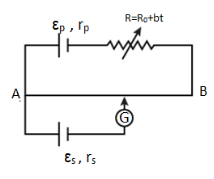
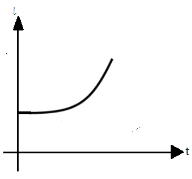
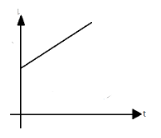
Figure shows a potentiometer in which resistance of rheostat is changing with time $ \left( t \right) $ as $ R = {R_0} + bt $ , where $ {R_0} $ and $ b $ are positive constant. Which of the following graphs best represents the balance length $ l $ (from $ A $ ) with respect to time $ t $ ? (Symbols have their usual meaning)
(A)
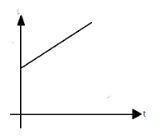
(B)
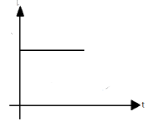
(C)
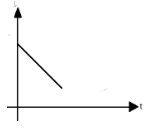
(D)
Answer
 Verified
601.2k+ views
Hint :In order to solve this question, we are going to first see the formula for the potentiometer representing the lengths, then by putting the values for the corresponding lengths and simplifying the relation, the equation is obtained for the graph that shows the nature of the curve.
For a potentiometer, if $ {l_1} $ and $ {l_2} $ are the two lengths of across the galvanometer, then,
$ {x_1}{l_1} = {x_2}{l_2} $
Complete Step By Step Answer:
As for the potentiometer given in this question, we know that if $ {l_1} $ and $ {l_2} $ are the two lengths of across the galvanometer, then,
$ {x_1}{l_1} = {x_2}{l_2} $
Putting here the values of the all four variables, we get the equation,
$ \left( {\dfrac{{{\varepsilon _p}}}{{{r_p} + R + {R_0}}}} \right)\dfrac{R}{{{l_p}}}{l_0} = \left( {\dfrac{{{\varepsilon _p}}}{{{r_p} + bt + R + {R_0}}}} \right)\dfrac{R}{{{l_p}}}{l_1} $
From this equation, we get to see here that,
$ {l_1} = {l_0} + \dfrac{{{l_0}bt}}{{{R_0} + R + {r_p}}} \\
\Rightarrow {l_1} = {l_0}\left[ {1 + \dfrac{{bt}}{{{R_0} + R + {r_p}}}} \right] \\ $
This equation here represents the first graph (A) with the intercept $ {l_0} $ on Y-axis.
Hence, the correct option is (A).
Note :
A potentiometer is an instrument for measuring voltage or 'potential difference' by comparison of an unknown voltage with a known reference voltage. If a sensitive indicating instrument is used, very little current is drawn from the source of the unknown voltage. The principle of a potentiometer is that the potential dropped across a segment of a wire of uniform cross-section carrying a constant current is directly proportional to its length.
For a potentiometer, if $ {l_1} $ and $ {l_2} $ are the two lengths of across the galvanometer, then,
$ {x_1}{l_1} = {x_2}{l_2} $
Complete Step By Step Answer:
As for the potentiometer given in this question, we know that if $ {l_1} $ and $ {l_2} $ are the two lengths of across the galvanometer, then,
$ {x_1}{l_1} = {x_2}{l_2} $
Putting here the values of the all four variables, we get the equation,
$ \left( {\dfrac{{{\varepsilon _p}}}{{{r_p} + R + {R_0}}}} \right)\dfrac{R}{{{l_p}}}{l_0} = \left( {\dfrac{{{\varepsilon _p}}}{{{r_p} + bt + R + {R_0}}}} \right)\dfrac{R}{{{l_p}}}{l_1} $
From this equation, we get to see here that,
$ {l_1} = {l_0} + \dfrac{{{l_0}bt}}{{{R_0} + R + {r_p}}} \\
\Rightarrow {l_1} = {l_0}\left[ {1 + \dfrac{{bt}}{{{R_0} + R + {r_p}}}} \right] \\ $
This equation here represents the first graph (A) with the intercept $ {l_0} $ on Y-axis.
Hence, the correct option is (A).
Note :
A potentiometer is an instrument for measuring voltage or 'potential difference' by comparison of an unknown voltage with a known reference voltage. If a sensitive indicating instrument is used, very little current is drawn from the source of the unknown voltage. The principle of a potentiometer is that the potential dropped across a segment of a wire of uniform cross-section carrying a constant current is directly proportional to its length.
Recently Updated Pages
Which of the following graphs shows the variation of class 12 physics CBSE

Draw a labelled diagram of the human male reproductive class 12 biology CBSE
Describe the experiment to compare the emf of two cells class 12 physics CBSE
What is standard hydrogen electrode
What is conventional current and electric current class 12 physics CBSE
2Bromopentane is treated with an alcoholic KOH solution class 12 chemistry CBSE
Trending doubts
Draw a labelled sketch of the human eye class 12 physics CBSE
Which are the Top 10 Largest Countries of the World?
Differentiate between homogeneous and heterogeneous class 12 chemistry CBSE
Draw ray diagrams each showing i myopic eye and ii class 12 physics CBSE
Which is the correct genotypic ratio of mendel dihybrid class 12 biology CBSE
What is the Full Form of PVC, PET, HDPE, LDPE, PP and PS ?