




Figure shows a point light source and its image is produced by a lens with an optical axis \[{N_1}{N_2}\]. Find the position of the lens and its foci using a ray diagram.

Answer
 Verified
618.3k+ views
Hint: Determine the properties of the image formed in the above figure as the object is placed between the focus and optical axis of the lens. Recall which type of lens can form this type of image? The image is formed on the same side of the object and it is enlarged.
Complete Step by Step Answer:
As we can see the object is placed very near to the lens. Therefore, we can say that the position of the object is between principal focus and optical centre. Also, in the above figure, the image is formed on the same side of the object and it is also magnified. Since the image is formed on the same side and it is erect, the image must be a virtual image formed by the convex lens. We know that the convex lens forms a virtual, enlarged and erect image when the object is placed between the principal focus and optical centre of the lens.
Thus, we have determined that the image is formed by the convex lens. Now, we have to draw the ray diagram of image formation. To do so, the parallel ray from the object when incident on the convex lens, it refracts and goes through the focus of the convex lens.
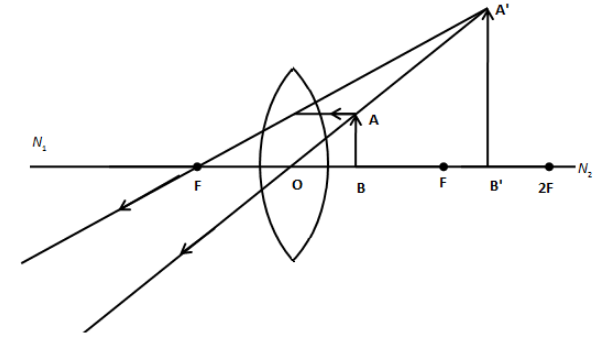
In the above figure, we have shown the position of the object and position of image. The virtual image of the object is formed by back tracing the refracted rays.
Note: Students must know the properties of the image formed by both convex and concave lenses. The convex lens can form both real and virtual images of the object depending upon the position of the object. The concave lens only forms a virtual image since the ray refracted from the concave lens never meets at a fixed point.
Complete Step by Step Answer:
As we can see the object is placed very near to the lens. Therefore, we can say that the position of the object is between principal focus and optical centre. Also, in the above figure, the image is formed on the same side of the object and it is also magnified. Since the image is formed on the same side and it is erect, the image must be a virtual image formed by the convex lens. We know that the convex lens forms a virtual, enlarged and erect image when the object is placed between the principal focus and optical centre of the lens.
Thus, we have determined that the image is formed by the convex lens. Now, we have to draw the ray diagram of image formation. To do so, the parallel ray from the object when incident on the convex lens, it refracts and goes through the focus of the convex lens.
In the above figure, we have shown the position of the object and position of image. The virtual image of the object is formed by back tracing the refracted rays.
Note: Students must know the properties of the image formed by both convex and concave lenses. The convex lens can form both real and virtual images of the object depending upon the position of the object. The concave lens only forms a virtual image since the ray refracted from the concave lens never meets at a fixed point.
Recently Updated Pages
Master Class 12 Economics: Engaging Questions & Answers for Success

Master Class 12 Social Science: Engaging Questions & Answers for Success
Master Class 12 English: Engaging Questions & Answers for Success
Master Class 12 Maths: Engaging Questions & Answers for Success
Master Class 12 Physics: Engaging Questions & Answers for Success
Master Class 12 Biology: Engaging Questions & Answers for Success
Trending doubts
Draw a labelled sketch of the human eye class 12 physics CBSE
Which are the Top 10 Largest Countries of the World?
Draw ray diagrams each showing i myopic eye and ii class 12 physics CBSE
Which is the correct genotypic ratio of mendel dihybrid class 12 biology CBSE
Differentiate between homogeneous and heterogeneous class 12 chemistry CBSE
Which animal never drinks water in its entire life class 12 biology CBSE