




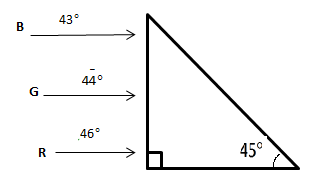
Figure shows a mixture of blue, green and red coloured rays incident normally on a right angled prism. The critical angles of the material of the prism for red, green and blue are \[46^\circ \], \[44^\circ \] and \[43^\circ \] respectively. The arrangement will separate:
a. Red colour from blue and green
b. Blue colour from red and green
c. Green colour from red and blue
d. All the three colours
Answer
 Verified
569.1k+ views
Hint: At \[45^\circ \], all three rays will touch the prism hand, so the angle of incident is \[45^\circ \]. The ray that has a higher angle than \[45^\circ \] will undergo internal reflection and will be separated from the other two rays.
Complete step by step answer:
Given, The critical angles of the material of the prism for red, green and blue are \[46^\circ \]
, \[44^\circ \] and \[43^\circ \] respectively.
By setting the refraction angle equal to \[90^\circ \], the critical angle can be determined from Snell's law. Part of the incident light will be emitted to any angle of incidence other than the critical angle and part would be replicated.
To scatter light into a continuum or to reflect rays of light, a translucent rigid body, often with triangular bases, is used. In geometry, a solid with parallel, congruent polygons and parallelograms with bases or ends is the prism.
Internal reflection: In optics, a beam of light through a medium, such as water or glass, is completely mirrored back into the medium from the surrounding surfaces. When the angle of incidence is greater than that limiting angle, named the critical angle, the anomaly happens.
Since, the angles of blu ray and the green ray are less than \[45^\circ \], they will transmit through the prism. But the angle of the red ray is more than \[45^\circ \]. Therefore, it will undergo total reflection.
Thus, the red ray will be separated from blue and green rays.
Hence, the correct answer is option (A).
Note: Since red's critical angle is greater than \[45^\circ \], it is also the only colour that would not be fully mirrored, so red is segregated from green and blue. Here we have to see which colour is for which angle properly. If we exchange the values of the critical angle, the answer would be different.
Complete step by step answer:
Given, The critical angles of the material of the prism for red, green and blue are \[46^\circ \]
, \[44^\circ \] and \[43^\circ \] respectively.
By setting the refraction angle equal to \[90^\circ \], the critical angle can be determined from Snell's law. Part of the incident light will be emitted to any angle of incidence other than the critical angle and part would be replicated.
To scatter light into a continuum or to reflect rays of light, a translucent rigid body, often with triangular bases, is used. In geometry, a solid with parallel, congruent polygons and parallelograms with bases or ends is the prism.
Internal reflection: In optics, a beam of light through a medium, such as water or glass, is completely mirrored back into the medium from the surrounding surfaces. When the angle of incidence is greater than that limiting angle, named the critical angle, the anomaly happens.
Since, the angles of blu ray and the green ray are less than \[45^\circ \], they will transmit through the prism. But the angle of the red ray is more than \[45^\circ \]. Therefore, it will undergo total reflection.
Thus, the red ray will be separated from blue and green rays.
Hence, the correct answer is option (A).
Note: Since red's critical angle is greater than \[45^\circ \], it is also the only colour that would not be fully mirrored, so red is segregated from green and blue. Here we have to see which colour is for which angle properly. If we exchange the values of the critical angle, the answer would be different.
Recently Updated Pages
Master Class 12 Economics: Engaging Questions & Answers for Success

Master Class 12 Physics: Engaging Questions & Answers for Success
Master Class 12 English: Engaging Questions & Answers for Success
Master Class 12 Social Science: Engaging Questions & Answers for Success
Master Class 12 Maths: Engaging Questions & Answers for Success
Master Class 12 Business Studies: Engaging Questions & Answers for Success
Trending doubts
Which are the Top 10 Largest Countries of the World?
What are the major means of transport Explain each class 12 social science CBSE
Draw a labelled sketch of the human eye class 12 physics CBSE
Why cannot DNA pass through cell membranes class 12 biology CBSE
Differentiate between insitu conservation and exsitu class 12 biology CBSE
Draw a neat and well labeled diagram of TS of ovary class 12 biology CBSE