




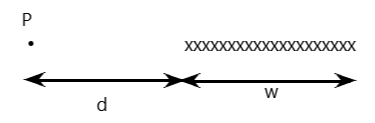
Figure shows a cross section of a long ribbon of width $ \omega $ that is carrying a uniformly distributed total current $ i $ into the page. Calculate the magnitude and direction of the magnetic field $ B $ at a point P in the plane of the ribbon at a distance $ d $ from its edge.
Answer
 Verified
563.4k+ views
Hint: Since a uniform distribution is involved the current density should be incorporated. Using the expression for the magnetic field for such wires, integrate through the entire width of the wire.
Formula used: In this solution we will be using the following formulae;
$ dB = \dfrac{{\mu \lambda dx}}{{2\pi x}} $ where $ B $ is the magnetic field, and $ dB $ signifies a differential element of it, $ \mu $ is the permeability of free space, and $ x $ is the position/length in the horizontal axis.
$ \lambda $ is the line current density and can be defined as $ \lambda = \dfrac{i}{\omega } $ where $ i $ is the current, and $ \omega $ is the width of the wire.
Complete Step-by-Step solution
To solve we recall the biot savart law, which can be described for a wire as
$ dB = \dfrac{{\mu \lambda dx}}{{2\pi x}} $ where $ B $ is the magnetic field, and $ dB $ signifies a differential element of it, $ \mu $ is the permeability of free space, and $ x $ is the position/length in the horizontal axis, and $ \lambda $ is the current density.
Since the current is unchanging and is uniform, the current density is a constant.
We are to find the magnetic field at distance $ d $ from the wire. To do so, we integrate the above equation from $ d $ to $ d + \omega $ as in
$ B = \int_d^{d + \omega } {\dfrac{{\mu \lambda dx}}{{2\pi x}}} = \dfrac{{\mu \lambda }}{{2\pi }}\int_d^{d + \omega } {\dfrac{{dx}}{x}} $
By integrating, we have
$ B = \dfrac{{\mu \lambda }}{{2\pi }}\left[ {\ln x} \right]_d^{d + \omega } $
Carrying out the range, we have that
$ B = \dfrac{{\mu \lambda }}{{2\pi }}\ln \dfrac{{d + \omega }}{d} $
But $ \lambda $ is the line current density and can be defined as $ \lambda = \dfrac{i}{\omega } $ where $ i $ is the current, and $ \omega $ is the width of the wire.
Hence,
$ B = \dfrac{{\mu \dfrac{i}{\omega }}}{{2\pi }}\ln \dfrac{{d + \omega }}{d} $
$ \Rightarrow B = \dfrac{{\mu i}}{{2\pi \omega }}\ln \dfrac{{d + \omega }}{d} $
Using the right hand rule for current, we see that the direction of the magnetic field at point
P is directed upward.
Note
For clarity, as done above, observe that the current density was written finally as $ \dfrac{i}{\omega} $ . This is because in any such question in an exam, the answers must be written in terms of the parameters given. Any incorporated parameters should be defined in terms of given ones.
Formula used: In this solution we will be using the following formulae;
$ dB = \dfrac{{\mu \lambda dx}}{{2\pi x}} $ where $ B $ is the magnetic field, and $ dB $ signifies a differential element of it, $ \mu $ is the permeability of free space, and $ x $ is the position/length in the horizontal axis.
$ \lambda $ is the line current density and can be defined as $ \lambda = \dfrac{i}{\omega } $ where $ i $ is the current, and $ \omega $ is the width of the wire.
Complete Step-by-Step solution
To solve we recall the biot savart law, which can be described for a wire as
$ dB = \dfrac{{\mu \lambda dx}}{{2\pi x}} $ where $ B $ is the magnetic field, and $ dB $ signifies a differential element of it, $ \mu $ is the permeability of free space, and $ x $ is the position/length in the horizontal axis, and $ \lambda $ is the current density.
Since the current is unchanging and is uniform, the current density is a constant.
We are to find the magnetic field at distance $ d $ from the wire. To do so, we integrate the above equation from $ d $ to $ d + \omega $ as in
$ B = \int_d^{d + \omega } {\dfrac{{\mu \lambda dx}}{{2\pi x}}} = \dfrac{{\mu \lambda }}{{2\pi }}\int_d^{d + \omega } {\dfrac{{dx}}{x}} $
By integrating, we have
$ B = \dfrac{{\mu \lambda }}{{2\pi }}\left[ {\ln x} \right]_d^{d + \omega } $
Carrying out the range, we have that
$ B = \dfrac{{\mu \lambda }}{{2\pi }}\ln \dfrac{{d + \omega }}{d} $
But $ \lambda $ is the line current density and can be defined as $ \lambda = \dfrac{i}{\omega } $ where $ i $ is the current, and $ \omega $ is the width of the wire.
Hence,
$ B = \dfrac{{\mu \dfrac{i}{\omega }}}{{2\pi }}\ln \dfrac{{d + \omega }}{d} $
$ \Rightarrow B = \dfrac{{\mu i}}{{2\pi \omega }}\ln \dfrac{{d + \omega }}{d} $
Using the right hand rule for current, we see that the direction of the magnetic field at point
P is directed upward.
Note
For clarity, as done above, observe that the current density was written finally as $ \dfrac{i}{\omega} $ . This is because in any such question in an exam, the answers must be written in terms of the parameters given. Any incorporated parameters should be defined in terms of given ones.
Recently Updated Pages
Master Class 12 Economics: Engaging Questions & Answers for Success

Master Class 12 Physics: Engaging Questions & Answers for Success
Master Class 12 English: Engaging Questions & Answers for Success
Master Class 12 Social Science: Engaging Questions & Answers for Success
Master Class 12 Maths: Engaging Questions & Answers for Success
Master Class 12 Business Studies: Engaging Questions & Answers for Success
Trending doubts
Which are the Top 10 Largest Countries of the World?
What are the major means of transport Explain each class 12 social science CBSE
Draw a labelled sketch of the human eye class 12 physics CBSE
Why cannot DNA pass through cell membranes class 12 biology CBSE
Differentiate between insitu conservation and exsitu class 12 biology CBSE
Draw a neat and well labeled diagram of TS of ovary class 12 biology CBSE