




Figure shows a conducting loop $ABCDA$ placed in a uniform magnetic field (strength $B$) perpendicular to its plane. The part $ABC$ is the (three-fourth) portion of the square of side length $l$. The part $ADC$ is a circular arc of radius $R$. The points $A$ and $C$ are connected to a battery which supplies a current $I$ to the circuit. The magnetic force on the loop due to the field $B$ is:

A. $zero$
B. $BIl$
C. $2BIR$
D. $\dfrac{{BIlR}}{{I + R}}$
Answer
 Verified
622.5k+ views
Hint: Since, the current through the loop $ABCDA$ splits into to part, one flows through $ABC$ and other through $ADC$. During the current flow, there will be some force generated. To find the total force generated in the loop $ABCDA$, the force generated on loops $ABC$ and $ADC$ are calculated. Since, the two currents travel the same distance in the magnetic field, the current gets added. Thus, the total force can be calculated.
Useful formula:
Relation between force, current and magnetic field will be given by,
$F = BIl$
Where, $F$ is the force on the conductor, $B$ is the magnetic field, $I$ is the current flows through the conductor and $l$ is the length of the conductor.
Complete Step by step solution:
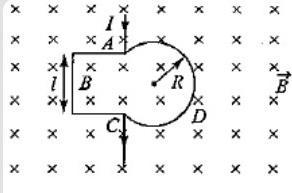
Assume that,
The current through the loop $ABC$ is $I1$
The current through the loop $ADC$ is $I2$
The length where the current flow in loop $ABC$ is ${l_1}$
The length where the current flow in loop $ADC$ is ${l_2}$
The force generated on the loop $ABC$,
${F_{ABC}} = B \times I1 \times {l_1}\;......................................\left( 1 \right)$
Where, ${F_{ABC}}$ is the force generated on loop $ABC$, $I1$ is the current flows through the loop $ABC$ and ${l_1}$ is the length of the loop $ABC$.
The force generated on the loop $ADC$,
${F_{ADC}} = B \times I2 \times {l_2}\;......................................\left( 2 \right)$
Where, ${F_{ADC}}$ is the force generated on loop $ADC$, $I2$ is the current flows through the loop $ADC$ and ${l_2}$ is the length of the loop $ADC$.
Hence, the total force on loop $ABCDA$ is the sum of the force on loop $ABC$ and the force on loop $ADC$,
$F = {F_{ABC}} + {F_{ADC}}..........................................\left( 3 \right)$
Substitute the values of (1) and (2) equation (1),
$
F = \left( {B \times I1 \times {l_1}} \right) + \left( {B \times I2 \times {l_2}} \right) \\
F = B\left[ {\left( {I1 \times {l_1}} \right) + \left( {I2 \times {l_2}} \right)} \right] \\
$
Since, the current travels the same length in the loops $ABC$ and $ADC$ ,
$l = {l_1} = {l_2}$
Hence,
$
F = B\left[ {\left( {I1 \times l} \right) + \left( {I2 \times l} \right)} \right] \\
F = B \times l\left[ {I1 + I2} \right] \\
$
The total current, $I = I1 + I2$
Thus,
$
F = B \times l\left[ I \right] \\
F = BIl \\
$
Hence, the option (B) is correct.
Note: In the loop $ABCDA$, even the structure of the loops $ABC$ and $ADC$ may vary, but the current flows through the loops in the uniform magnetic field travels the same distance in both the loops. A force will be generated in the current carrying conductor placed in a uniform magnetic field, this is the statement of Faraday’s law of induction. The force generated in the loop $ABCDA$, is the sum of the force generated in loops $ABC$ and $ADC$.
Useful formula:
Relation between force, current and magnetic field will be given by,
$F = BIl$
Where, $F$ is the force on the conductor, $B$ is the magnetic field, $I$ is the current flows through the conductor and $l$ is the length of the conductor.
Complete Step by step solution:
Assume that,
The current through the loop $ABC$ is $I1$
The current through the loop $ADC$ is $I2$
The length where the current flow in loop $ABC$ is ${l_1}$
The length where the current flow in loop $ADC$ is ${l_2}$
The force generated on the loop $ABC$,
${F_{ABC}} = B \times I1 \times {l_1}\;......................................\left( 1 \right)$
Where, ${F_{ABC}}$ is the force generated on loop $ABC$, $I1$ is the current flows through the loop $ABC$ and ${l_1}$ is the length of the loop $ABC$.
The force generated on the loop $ADC$,
${F_{ADC}} = B \times I2 \times {l_2}\;......................................\left( 2 \right)$
Where, ${F_{ADC}}$ is the force generated on loop $ADC$, $I2$ is the current flows through the loop $ADC$ and ${l_2}$ is the length of the loop $ADC$.
Hence, the total force on loop $ABCDA$ is the sum of the force on loop $ABC$ and the force on loop $ADC$,
$F = {F_{ABC}} + {F_{ADC}}..........................................\left( 3 \right)$
Substitute the values of (1) and (2) equation (1),
$
F = \left( {B \times I1 \times {l_1}} \right) + \left( {B \times I2 \times {l_2}} \right) \\
F = B\left[ {\left( {I1 \times {l_1}} \right) + \left( {I2 \times {l_2}} \right)} \right] \\
$
Since, the current travels the same length in the loops $ABC$ and $ADC$ ,
$l = {l_1} = {l_2}$
Hence,
$
F = B\left[ {\left( {I1 \times l} \right) + \left( {I2 \times l} \right)} \right] \\
F = B \times l\left[ {I1 + I2} \right] \\
$
The total current, $I = I1 + I2$
Thus,
$
F = B \times l\left[ I \right] \\
F = BIl \\
$
Hence, the option (B) is correct.
Note: In the loop $ABCDA$, even the structure of the loops $ABC$ and $ADC$ may vary, but the current flows through the loops in the uniform magnetic field travels the same distance in both the loops. A force will be generated in the current carrying conductor placed in a uniform magnetic field, this is the statement of Faraday’s law of induction. The force generated in the loop $ABCDA$, is the sum of the force generated in loops $ABC$ and $ADC$.
Recently Updated Pages
Master Class 12 Business Studies: Engaging Questions & Answers for Success

Master Class 12 Biology: Engaging Questions & Answers for Success
Master Class 12 Chemistry: Engaging Questions & Answers for Success
Class 12 Question and Answer - Your Ultimate Solutions Guide
Master Class 11 Social Science: Engaging Questions & Answers for Success
Master Class 11 English: Engaging Questions & Answers for Success
Trending doubts
Which is more stable and why class 12 chemistry CBSE
Which are the Top 10 Largest Countries of the World?
Draw a labelled sketch of the human eye class 12 physics CBSE
Differentiate between homogeneous and heterogeneous class 12 chemistry CBSE
What are the major means of transport Explain each class 12 social science CBSE
Sulphuric acid is known as the king of acids State class 12 chemistry CBSE