




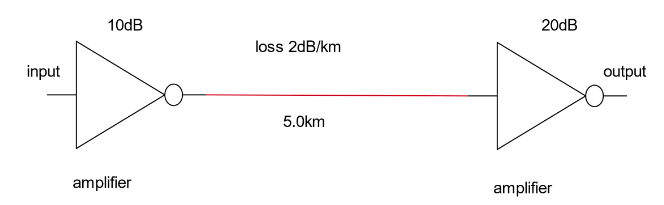
Figure shows a communication system. What is the output power when the input signal is of $ 1.01mW $ ? (gain in $ dB = 10{\log _{10}}\left( {\dfrac{{{P_o}}}{{{P_i}}}} \right) $ )
Answer
 Verified
547.2k+ views
Hint: The input power of the signal is given. We are asked to find the output value of power. We can start by calculating the total loss in the whole transmission of the signal. The total gain, that is the sum of gain in input and output values is found. We then add the total gain to the total loss and get the overall gain. Then by the application of these values in the given formula we can find the required solution.
Complete Step By Step Answer:
Let us start by writing down the values given in the question
$ dB = 10{\log _{10}}\left( {\dfrac{{{P_o}}}{{{P_i}}}} \right) $
The power input is $ {P_i} = 1.01mW $
The total gain in both input and output amplifiers is given as $ 10 + 20 = 30dB $
The overall gain can be found by subtracting the total loss that is $ 5 \times 2 = 10 $ from the overall gain
We get $ 30 - 10 = 20dB $ , this is the total gain
Now we substitute the given and acquired values on the formula $ dB = 10{\log _{10}}\left( {\dfrac{{{P_o}}}{{{P_i}}}} \right) $ and get
$ 20 = 10{\log _{10}}\left( {\dfrac{{{P_o}}}{{{P_i}}}} \right) $
Further simplifying we get $ 2 = {\log _{10}}\left( {\dfrac{{{P_o}}}{{{P_i}}}} \right) $
Using the property $ {\log _{10}}\dfrac{X}{Y} = {\log _{10}}X - {\log _{10}}Y $ we get
$ {\log _{10}}{P_o} = 2 + {\log _{10}}{P_i} = 2.0043 $
Taking the antilogarithm on both the sides, we get
$ {P_o} = 101mW $
The output power of the system is $ 101mW $ .
Note:
The gain of power of power gain in an electrical circuit is the ratio of the output power to the input power. The concept of power gain is most commonly used in the use of transistors as they can be used as amplifiers and amplifiers are basically the electronic components that amplify or enlarge input signals. In amplifier configuration, (there are three, common base, common collector, common emitter) the configuration having the highest power gain is the common emitter configuration.
Complete Step By Step Answer:
Let us start by writing down the values given in the question
$ dB = 10{\log _{10}}\left( {\dfrac{{{P_o}}}{{{P_i}}}} \right) $
The power input is $ {P_i} = 1.01mW $
The total gain in both input and output amplifiers is given as $ 10 + 20 = 30dB $
The overall gain can be found by subtracting the total loss that is $ 5 \times 2 = 10 $ from the overall gain
We get $ 30 - 10 = 20dB $ , this is the total gain
Now we substitute the given and acquired values on the formula $ dB = 10{\log _{10}}\left( {\dfrac{{{P_o}}}{{{P_i}}}} \right) $ and get
$ 20 = 10{\log _{10}}\left( {\dfrac{{{P_o}}}{{{P_i}}}} \right) $
Further simplifying we get $ 2 = {\log _{10}}\left( {\dfrac{{{P_o}}}{{{P_i}}}} \right) $
Using the property $ {\log _{10}}\dfrac{X}{Y} = {\log _{10}}X - {\log _{10}}Y $ we get
$ {\log _{10}}{P_o} = 2 + {\log _{10}}{P_i} = 2.0043 $
Taking the antilogarithm on both the sides, we get
$ {P_o} = 101mW $
The output power of the system is $ 101mW $ .
Note:
The gain of power of power gain in an electrical circuit is the ratio of the output power to the input power. The concept of power gain is most commonly used in the use of transistors as they can be used as amplifiers and amplifiers are basically the electronic components that amplify or enlarge input signals. In amplifier configuration, (there are three, common base, common collector, common emitter) the configuration having the highest power gain is the common emitter configuration.
Recently Updated Pages
Explain the structure of megasporangium class 12 biology CBSE

Why is chloroform kept in dark coloured bottles class 12 chemistry CBSE
Derive the balancing condition of a Wheatstone bri class 12 physics CBSE
Draw VI characteristics of a pn junction diode Explain class 12 physics CBSE
Is it possible to carry pride in ones language too class 12 english CBSE
In a population at Hardy Weinberg equilibrium the allele class 12 biology CBSE
Trending doubts
Draw a labelled sketch of the human eye class 12 physics CBSE
Which are the Top 10 Largest Countries of the World?
Draw ray diagrams each showing i myopic eye and ii class 12 physics CBSE
Which is the correct genotypic ratio of mendel dihybrid class 12 biology CBSE
Differentiate between homogeneous and heterogeneous class 12 chemistry CBSE
Which animal never drinks water in its entire life class 12 biology CBSE