




Fenestra ovalis is the opening of
A. Cranium
B. Tympanum
C. Tympanic cavity
D. Brain
Answer
 Verified
649.5k+ views
Hint: It is also known as the fenestra vestibuli or oval window.
Complete answer:
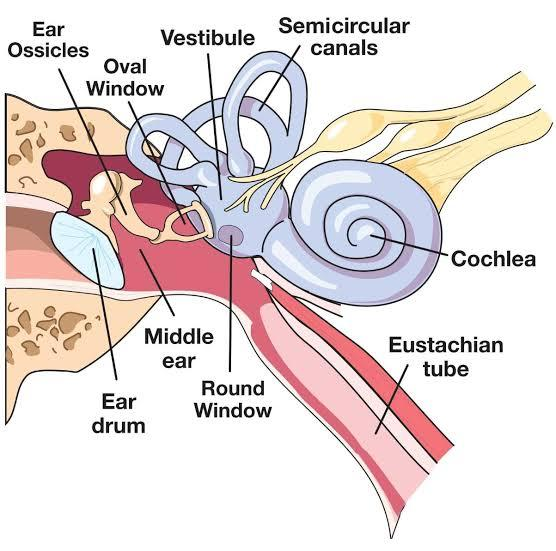
‘Fenestra ovalis' is a membranous connective tissue that is present in the Tympanic cavity at the junction of the middle ear and inner ear. It is a reinform or kidney-shaped opening that opens into the vestibule of the cochlea present in the inner ear. On the outer side, it is connected to the base of the stapes bone. The vibrations carried by the three ossicles are amplified and then taken by the oval window to transfer it to the cochlea.
Additional Information:
> The junction of the middle ear and inner ear also possess another opening known as the ‘Round window.
> It is also known as the Fenestra rotundum or Fenestra cochleae and remains covered by the round window membrane.
> It is present a little below and behind the oval window separated by a promontory.
> When the fluid in the oval window is displaced by the pressure applied by the stapes, the fluid in the round window also moves in the opposite phase i.e. when the membrane of the oval window vibrates outwards, the round window membrane vibrates inwards.
> This coordinated movement helps the cochlear fluid to move, the vibrations are carried to the hair cells and hair cells move against the tectorial membrane to produce a hearing sensation.
So, the correct answer is the Tympanic cavity.
Note:
- Cochlea consists of the organ of Corti, the sensory organ responsible for hearing.
- Cochlear has two parts, the bony labyrinth and the membranous labyrinth filled with perilymph and endolymph respectively.
- The bony labyrinth is further divided into upper scala vestibuli and lower scala tympani.
- The Scala vestibuli opens into the oval window whereas the scala tympani terminates into the round window.
Complete answer:
‘Fenestra ovalis' is a membranous connective tissue that is present in the Tympanic cavity at the junction of the middle ear and inner ear. It is a reinform or kidney-shaped opening that opens into the vestibule of the cochlea present in the inner ear. On the outer side, it is connected to the base of the stapes bone. The vibrations carried by the three ossicles are amplified and then taken by the oval window to transfer it to the cochlea.
Additional Information:
> The junction of the middle ear and inner ear also possess another opening known as the ‘Round window.
> It is also known as the Fenestra rotundum or Fenestra cochleae and remains covered by the round window membrane.
> It is present a little below and behind the oval window separated by a promontory.
> When the fluid in the oval window is displaced by the pressure applied by the stapes, the fluid in the round window also moves in the opposite phase i.e. when the membrane of the oval window vibrates outwards, the round window membrane vibrates inwards.
> This coordinated movement helps the cochlear fluid to move, the vibrations are carried to the hair cells and hair cells move against the tectorial membrane to produce a hearing sensation.
So, the correct answer is the Tympanic cavity.
Note:
- Cochlea consists of the organ of Corti, the sensory organ responsible for hearing.
- Cochlear has two parts, the bony labyrinth and the membranous labyrinth filled with perilymph and endolymph respectively.
- The bony labyrinth is further divided into upper scala vestibuli and lower scala tympani.
- The Scala vestibuli opens into the oval window whereas the scala tympani terminates into the round window.
Recently Updated Pages
Vineet deposited Rs 15600 in a fixed deposit at simple class 10 maths CBSE

Puneet prepared two posters on National Integration class 10 maths CBSE
Acetyleneethyne burns in oxygen to give carbon dioxide class 10 chemistry CBSE
Sita sells a dining set to Neeta for Rs 6000 and gains class 10 maths CBSE
Match columnI with columnII and choose the correct class 12 biology NEET_UG
Match columnI with columnII and choose the correct class 12 biology NEET_UG
Trending doubts
Explain the Treaty of Vienna of 1815 class 10 social science CBSE
What is the Total Duration of Football Match?
Why is there a time difference of about 5 hours between class 10 social science CBSE
10 examples of evaporation in daily life with explanations
Cricket: What's a batter not out at innings end called?
What is the full form of POSCO class 10 social science CBSE