




FAD acts as an electron acceptor in between:
A) Fumaric and malic acid
B) Succinic and fumaric acid
C) Malic and oxaloacetic acid
D) Citric and isocitric acid
Answer
 Verified
604.8k+ views
Hint:TCA cycle (tricarboxylic acid cycle) and the Krebs cycle are the other names of the citric acid cycle. It is the process of continuous series of chemical reactions which is carried in all aerobic organisms. In this cycle stored energy is released through the oxidation of acetyl-CoA which is derived from carbohydrates, fats, and proteins.
Complete answer:
>The name of these citric acid cycles derived from the citric acid that is used and then regenerated by various chemical reactions to complete the cycle.
>The cycle utilizes acetate that is acetyl-CoA and water, reduces NAD+ to NADH, and releases carbon dioxide.
>The NADH formed by the citric acid cycle is used by the oxidative phosphorylation pathway also known as the electron transfer chain.
>The main purpose of these two cycles is the degradation of the food we eat and then transfer this food into the ATP that is the form of energy.
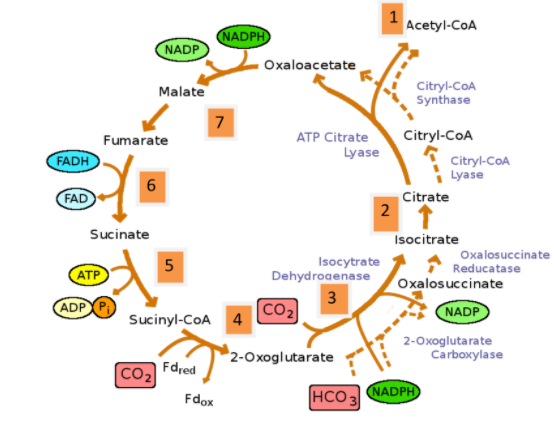
>As shown in the picture at the sixth step is the dehydration step Succinate converted into fumarate in the citric acid cycle. The succinate ( four carbon) molecule which is oxidized, to fumarate and two hydrogen atoms with their electrons are transferred to FAD and converted into $FADH_2$ in presence of enzyme succinate dehydrogenase.
>Succinic acid and fumaric acid produce into the TCA cycle.
Hence the correct answer is option ‘B’.
Note:Mitochondria matrix is the place where citric acid cycle occur in eukaryotic cells while in prokaryotic cells, such as bacteria, which do not have mitochondria, the citric acid cycle reaction performed in the cytosol.
Complete answer:
>The name of these citric acid cycles derived from the citric acid that is used and then regenerated by various chemical reactions to complete the cycle.
>The cycle utilizes acetate that is acetyl-CoA and water, reduces NAD+ to NADH, and releases carbon dioxide.
>The NADH formed by the citric acid cycle is used by the oxidative phosphorylation pathway also known as the electron transfer chain.
>The main purpose of these two cycles is the degradation of the food we eat and then transfer this food into the ATP that is the form of energy.
>As shown in the picture at the sixth step is the dehydration step Succinate converted into fumarate in the citric acid cycle. The succinate ( four carbon) molecule which is oxidized, to fumarate and two hydrogen atoms with their electrons are transferred to FAD and converted into $FADH_2$ in presence of enzyme succinate dehydrogenase.
>Succinic acid and fumaric acid produce into the TCA cycle.
Hence the correct answer is option ‘B’.
Note:Mitochondria matrix is the place where citric acid cycle occur in eukaryotic cells while in prokaryotic cells, such as bacteria, which do not have mitochondria, the citric acid cycle reaction performed in the cytosol.
Recently Updated Pages
Master Class 11 Social Science: Engaging Questions & Answers for Success

Master Class 11 English: Engaging Questions & Answers for Success
Master Class 11 Maths: Engaging Questions & Answers for Success
Master Class 11 Chemistry: Engaging Questions & Answers for Success
Master Class 11 Biology: Engaging Questions & Answers for Success
Master Class 11 Physics: Engaging Questions & Answers for Success
Trending doubts
Differentiate between an exothermic and an endothermic class 11 chemistry CBSE
One Metric ton is equal to kg A 10000 B 1000 C 100 class 11 physics CBSE
Difference Between Prokaryotic Cells and Eukaryotic Cells
There are 720 permutations of the digits 1 2 3 4 5 class 11 maths CBSE
Draw a diagram of a plant cell and label at least eight class 11 biology CBSE
Two of the body parts which do not appear in MRI are class 11 biology CBSE