




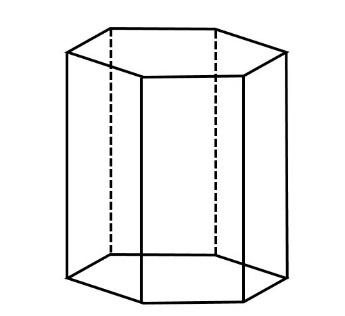
How many faces, edges and vertices respectively do the given solid have?
A) 8, 12, 18
B) 10, 18, 12
C) 8, 18, 12
D) 10, 12, 18
Answer
 Verified
630.3k+ views
Hint: Here, first we should describe edges, vertices and faces. The given solid is a hexagonal prism. With the help of definitions of edges, faces and vertices and by looking into the figure we will get an idea about the number of faces, edges and vertices.
Complete step-by-step answer:
Here, a solid is given and we have to find the number of edges, faces and vertices of the solid.
First let us discuss the definitions of faces, edges and vertices.
A vertex is a point where two or more line segments meet. For example, a triangle has three vertices, a pentagon has 5 vertices etc.
For a polygon an edge is a line segment on the boundary joining one vertex to another. For example a pentagon has 5 edges, a triangle has 3 edges etc.
For a polyhedron an edge is a line segment where two faces meet. For example a tetrahedron has 6 edges.
A face is any of the individual flat surfaces of a solid object. For example a tetrahedron has 4 faces.
Now consider the given solid which is a hexagonal prism. A hexagonal prism is a prism with hexagonal base and top. It has 8 faces, 18 edges and 12 vertices. Out of these 8 faces, 6 faces are rectangles and two faces are hexagons, that is why the name hexagonal prism.
Therefore, we can say that:
Number of faces = 8
Number of edges = 18
Number of vertices = 12
Therefore, the correct answer for this question is option (c).
Note: Here, to check whether the number of faces, edges and vertices are correct or not, you can apply the Euler’s formula: V + F – E = 2, where V is the number of vertices, F is the number of faces and E is the number of edges.
Complete step-by-step answer:
Here, a solid is given and we have to find the number of edges, faces and vertices of the solid.
First let us discuss the definitions of faces, edges and vertices.
A vertex is a point where two or more line segments meet. For example, a triangle has three vertices, a pentagon has 5 vertices etc.
For a polygon an edge is a line segment on the boundary joining one vertex to another. For example a pentagon has 5 edges, a triangle has 3 edges etc.
For a polyhedron an edge is a line segment where two faces meet. For example a tetrahedron has 6 edges.
A face is any of the individual flat surfaces of a solid object. For example a tetrahedron has 4 faces.
Now consider the given solid which is a hexagonal prism. A hexagonal prism is a prism with hexagonal base and top. It has 8 faces, 18 edges and 12 vertices. Out of these 8 faces, 6 faces are rectangles and two faces are hexagons, that is why the name hexagonal prism.
Therefore, we can say that:
Number of faces = 8
Number of edges = 18
Number of vertices = 12
Therefore, the correct answer for this question is option (c).
Note: Here, to check whether the number of faces, edges and vertices are correct or not, you can apply the Euler’s formula: V + F – E = 2, where V is the number of vertices, F is the number of faces and E is the number of edges.
Recently Updated Pages
Master Class 9 Social Science: Engaging Questions & Answers for Success

Master Class 9 Science: Engaging Questions & Answers for Success
Master Class 9 Maths: Engaging Questions & Answers for Success
Master Class 9 General Knowledge: Engaging Questions & Answers for Success
Class 9 Question and Answer - Your Ultimate Solutions Guide
Master Class 8 Social Science: Engaging Questions & Answers for Success
Trending doubts
Find the sum of series 1 + 2 + 3 + 4 + 5 + + 100 class 9 maths CBSE
What is the Full Form of ISI and RAW
Fill the blanks with the suitable prepositions 1 The class 9 english CBSE
Difference Between Plant Cell and Animal Cell
Who is eligible for RTE class 9 social science CBSE
What is pollution? How many types of pollution? Define it