




Express the following numbers as a product of its prime factors:140.
Answer
 Verified
629.1k+ views
Hint:
We will first divide 140 by the smallest prime that divides it completely, that is 2. Then, write the quotient, which comes out to be 70 in the next column under 140 and again find the smallest prime number which divides 70 and then repeat the same process until the quotient becomes 1. At last, express the number as the product of primes obtained in prime-factorisation of the number.
Complete step by step solution:
We have to write the number 140 as the product of its prime factors.
That is, we have to write the prime-factorisation of the number, 140
Prime numbers are the numbers that have only 2 factors.
We will divide the number 140 by the smallest prime number which divides it, that is 2.
Then, write the quotient, which comes out to be 70 in the next column under 140 and again find the smallest prime number which divides 70 and then repeat the same process until the quotient becomes 1.
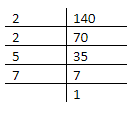
Now, we can write 140 as $2 \times 2 \times 5 \times 7$, which is the product of the prime numbers.
Note:
If we multiply the numbers of prime factorisation of the number, we will get back the same number. 2 is the smallest even prime number and all even numbers are divisible by 2. The prime-factorisation of a number also helps to determine the factors of the number.
We will first divide 140 by the smallest prime that divides it completely, that is 2. Then, write the quotient, which comes out to be 70 in the next column under 140 and again find the smallest prime number which divides 70 and then repeat the same process until the quotient becomes 1. At last, express the number as the product of primes obtained in prime-factorisation of the number.
Complete step by step solution:
We have to write the number 140 as the product of its prime factors.
That is, we have to write the prime-factorisation of the number, 140
Prime numbers are the numbers that have only 2 factors.
We will divide the number 140 by the smallest prime number which divides it, that is 2.
Then, write the quotient, which comes out to be 70 in the next column under 140 and again find the smallest prime number which divides 70 and then repeat the same process until the quotient becomes 1.
Now, we can write 140 as $2 \times 2 \times 5 \times 7$, which is the product of the prime numbers.
Note:
If we multiply the numbers of prime factorisation of the number, we will get back the same number. 2 is the smallest even prime number and all even numbers are divisible by 2. The prime-factorisation of a number also helps to determine the factors of the number.
Recently Updated Pages
Master Class 11 English: Engaging Questions & Answers for Success

Master Class 11 Social Science: Engaging Questions & Answers for Success
Master Class 11 Maths: Engaging Questions & Answers for Success
Master Class 11 Biology: Engaging Questions & Answers for Success
Master Class 11 Physics: Engaging Questions & Answers for Success
Master Class 11 Chemistry: Engaging Questions & Answers for Success
Trending doubts
XIX+XXX A 49 B 51 C 55 D 44 class 5 maths CBSE
Class 5 Social Science Question Answers
It rain today There are so many clouds in the sky Choose class 5 english CBSE
In Indian rupees 1 trillion is equal to how many c class 8 maths CBSE
Which are the Top 10 Largest Countries of the World?
One Metric ton is equal to kg A 10000 B 1000 C 100 class 11 physics CBSE