




Explain with the help of a labeled diagram the distribution of the magnetic field due to a current through a circular loop. Why is it that if a current-carrying coil has $N$ turns, the field produced at any point is n times as large as that produced by a single turn?
Answer
 Verified
574.2k+ views
Hint: To answer this question, we have to first draw a diagram for a current through a loop. To answer the second part, we should remember the formulae of the magnetic field Biot Savart’s law for the magnetic field produced by a circular loop. We can write the magnetic field for one loop and then the magnetic field for $N$ turns and compare.
Formulae used:
$B = \dfrac{{{\mu _0}NI}}{{4\pi R}}$
Here $B$ is the magnetic field produced due to a circular loop, $N$ is the number of turns, $I$ is the current carried by the loop, ${\mu _0}$ is the permeability of free space and $R$ is the radius of the loop.
Complete answer:
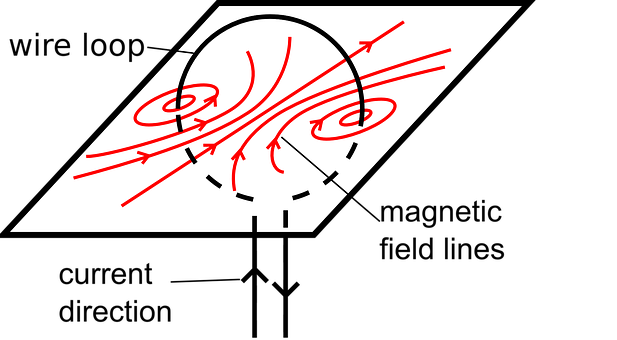
In the above figure, $B$ is the magnetic field that has magnetic field lines produced due to a circular loop and $I$ is the current carried by the loop and its direction in the loop. we can clearly see that using the right-hand thumb rule we can easily predict the direction of magnetic field lines.
In figure $(a)$ , we are trying to find the direction using the right-hand rule, where the thumb points toward the direction of current flow and the curling of fingers show the direction of the magnetic field.
In figure $(b)$ , shows the direction of the magnetic field.
We know that
$ \Rightarrow B = \dfrac{{{\mu _0}NI}}{{4\pi R}}$
Here $B$ is the magnetic field produced due to a circular loop, $N$ is the number of turns, $I$ is the current carried by the loop, ${\mu _0}$ is the permeability of free space and $R$ is the radius of the loop.
For one turn the amount current flowing in the loop will be $I$
So the magnetic field will be
$ \Rightarrow {B_1} = \dfrac{{{\mu _0}I}}{{4\pi R}}$
But for $N$ turns, the current will also increase $N$ times. So the magnetic field will be,
$ \Rightarrow {B_N} = \dfrac{{{\mu _0}NI}}{{4\pi R}} = N{B_1}$
So we know that the magnetic field of a current-carrying loop increases with an increase in the number of turns of the loop.
Note: While calculating the magnetic field for the object, make sure to use the correct formulae. For example, here we need to use the formula for the magnetic field for a loop. So no need to use the formulae of the magnetic field for a wire. Also while finding the direction of the magnetic field for any current-carrying wire or loop, make sure to use the right-hand rule correctly.
Formulae used:
$B = \dfrac{{{\mu _0}NI}}{{4\pi R}}$
Here $B$ is the magnetic field produced due to a circular loop, $N$ is the number of turns, $I$ is the current carried by the loop, ${\mu _0}$ is the permeability of free space and $R$ is the radius of the loop.
Complete answer:
In the above figure, $B$ is the magnetic field that has magnetic field lines produced due to a circular loop and $I$ is the current carried by the loop and its direction in the loop. we can clearly see that using the right-hand thumb rule we can easily predict the direction of magnetic field lines.
In figure $(a)$ , we are trying to find the direction using the right-hand rule, where the thumb points toward the direction of current flow and the curling of fingers show the direction of the magnetic field.
In figure $(b)$ , shows the direction of the magnetic field.
We know that
$ \Rightarrow B = \dfrac{{{\mu _0}NI}}{{4\pi R}}$
Here $B$ is the magnetic field produced due to a circular loop, $N$ is the number of turns, $I$ is the current carried by the loop, ${\mu _0}$ is the permeability of free space and $R$ is the radius of the loop.
For one turn the amount current flowing in the loop will be $I$
So the magnetic field will be
$ \Rightarrow {B_1} = \dfrac{{{\mu _0}I}}{{4\pi R}}$
But for $N$ turns, the current will also increase $N$ times. So the magnetic field will be,
$ \Rightarrow {B_N} = \dfrac{{{\mu _0}NI}}{{4\pi R}} = N{B_1}$
So we know that the magnetic field of a current-carrying loop increases with an increase in the number of turns of the loop.
Note: While calculating the magnetic field for the object, make sure to use the correct formulae. For example, here we need to use the formula for the magnetic field for a loop. So no need to use the formulae of the magnetic field for a wire. Also while finding the direction of the magnetic field for any current-carrying wire or loop, make sure to use the right-hand rule correctly.
Recently Updated Pages
Master Class 12 Economics: Engaging Questions & Answers for Success

Master Class 12 Physics: Engaging Questions & Answers for Success
Master Class 12 English: Engaging Questions & Answers for Success
Master Class 12 Social Science: Engaging Questions & Answers for Success
Master Class 12 Maths: Engaging Questions & Answers for Success
Master Class 12 Business Studies: Engaging Questions & Answers for Success
Trending doubts
Which are the Top 10 Largest Countries of the World?
What are the major means of transport Explain each class 12 social science CBSE
Draw a labelled sketch of the human eye class 12 physics CBSE
Why cannot DNA pass through cell membranes class 12 biology CBSE
Differentiate between insitu conservation and exsitu class 12 biology CBSE
Draw a neat and well labeled diagram of TS of ovary class 12 biology CBSE