




Explain total internal reflection with diagram.
Answer
 Verified
654.6k+ views
Hint: Whenever a light ray is moving from one medium to another medium it experiences a sudden change in velocity and as a result of this it also changes its direction, so when it changes its direction at the point where it is incident with the plane where two of the mediums meet and the incident angle is a certain angle then the light ray can experience the phenomenon of total internal reflection.
Complete step-by-step answer:
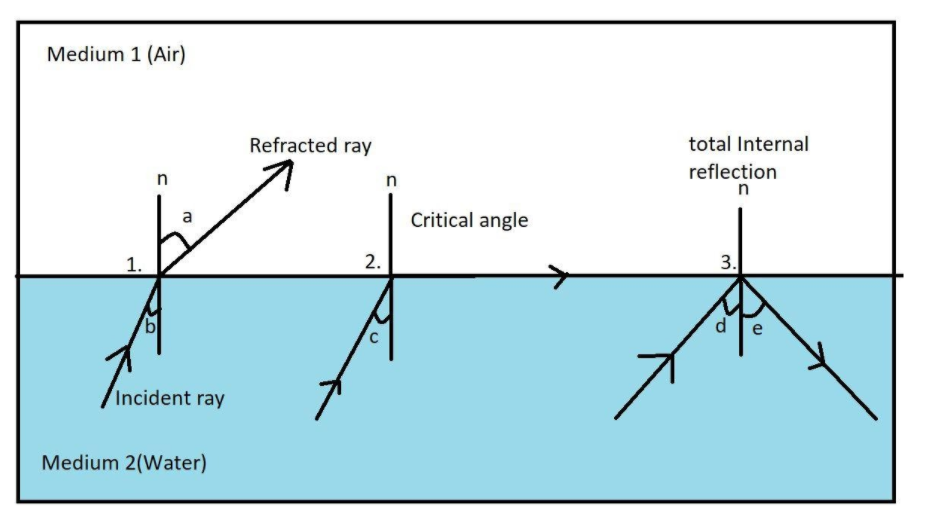
Here in the diagram we see two mediums, medium 1 is air and medium 2 is water,
n is the normal in each case.
Now in the first case it is the normal phenomenon of refraction, ‘b’ is the angle of incidence, and ‘a’ is the angle of refraction.
In the second case we see that the light ray is falling on the plane where the two mediums meet and after falling the ray propagates with the plane of the two mediums. This is because the angle ‘c’ is the critical angle and whenever a light falls on that particular angle it propagates with the plane.
In the third case we see the phenomenon of total internal reflection, none of the light have refracted and the total light is reflected to the medium from where it came. This happened because the angle that the incident light ray made with the surface of the two mediums, the angle was greater than the critical angle and hence it experienced the phenomenon of total internal reflection. Here ‘d’ is the incident angle and ‘e’ is the reflected angle.
Conditions for total internal reflection are:
The light ray moves from a denser medium to a less denser medium.
The angle of incidence must always be greater than the critical angle.
Note: Total internal reflection is the phenomenon due to which complete reflection of a ray of light within a medium takes place, it is generally seen in mediums like water or glass. The phenomenon of total internal reflection happens when the incident angle is greater than the critical angle.
Complete step-by-step answer:
Here in the diagram we see two mediums, medium 1 is air and medium 2 is water,
n is the normal in each case.
Now in the first case it is the normal phenomenon of refraction, ‘b’ is the angle of incidence, and ‘a’ is the angle of refraction.
In the second case we see that the light ray is falling on the plane where the two mediums meet and after falling the ray propagates with the plane of the two mediums. This is because the angle ‘c’ is the critical angle and whenever a light falls on that particular angle it propagates with the plane.
In the third case we see the phenomenon of total internal reflection, none of the light have refracted and the total light is reflected to the medium from where it came. This happened because the angle that the incident light ray made with the surface of the two mediums, the angle was greater than the critical angle and hence it experienced the phenomenon of total internal reflection. Here ‘d’ is the incident angle and ‘e’ is the reflected angle.
Conditions for total internal reflection are:
The light ray moves from a denser medium to a less denser medium.
The angle of incidence must always be greater than the critical angle.
Note: Total internal reflection is the phenomenon due to which complete reflection of a ray of light within a medium takes place, it is generally seen in mediums like water or glass. The phenomenon of total internal reflection happens when the incident angle is greater than the critical angle.
Recently Updated Pages
Master Class 12 Economics: Engaging Questions & Answers for Success

Master Class 12 Social Science: Engaging Questions & Answers for Success
Master Class 12 English: Engaging Questions & Answers for Success
Master Class 12 Maths: Engaging Questions & Answers for Success
Master Class 12 Physics: Engaging Questions & Answers for Success
Master Class 12 Biology: Engaging Questions & Answers for Success
Trending doubts
What is the Full Form of PVC, PET, HDPE, LDPE, PP and PS ?
Draw a ray diagram of compound microscope when the class 12 physics CBSE
Derive an expression for the electric field intensity class 12 physics CBSE
Ethylidene chloride and ethylene dichloride are A Chain class 12 chemistry CBSE
Calculate the equivalent resistance between a and b class 12 physics CBSE
Derive an expression of the magnetic field at the center class 12 physics CBSE