




Explain the working of compound microscope by focal length of convex lens:
Answer
 Verified
564.9k+ views
Hint: The above question requires knowledge of concepts of compound microscope and properties of convex lenses. The compound microscope uses two convex lenses with short focal lengths to produce magnified images of extremely small objects. These are very popular in the study of microorganisms.
Complete step-by-step solution:
A compound microscope is an optical instrument that uses two convex lenses with short focal lengths to observe extremely magnified images of small objects. The picture of a small object can be magnified up to 1000 times using a compound microscope.
When a tiny object is positioned just outside the focus of a compound microscope's objective lens, a simulated, inverted, and highly magnified image of the object is created at the shortest distance of distinct vision from the eye kept close to the eye piece.
Working:
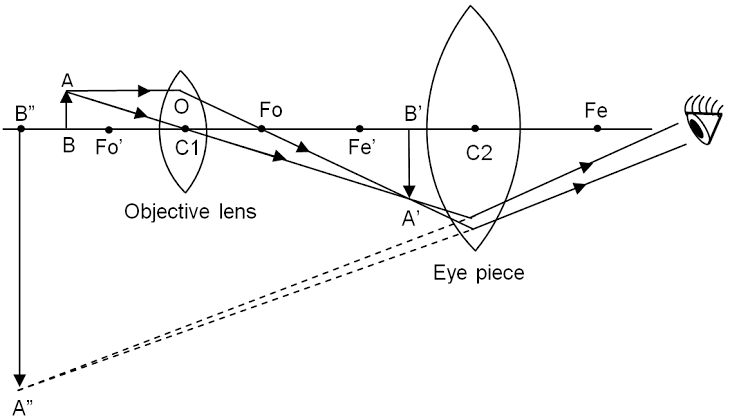
The figure depicts a ray diagram of a compound microscope in action. A small magnifying object AB is set in front of the objective lens just outside its primary focus ${F_o}'$. In this case, the compound microscope's objective lens O creates a true, inverted, and enlarged image of the object A'B'.
Now A'B' serves as an object for the eyepiece E, which has been changed to position A'B' between the optical center C2 and the eye piece's focus ${F_e}'$. The eyepiece now creates a simulated, reversed, and strongly magnified image A”B”. After adjusting the final image A”B” at the least distance of distinct vision of 25 cm from the eye, this final image A”B” is seen by our eye kept close to the eye.
Note:A magnifying glass is another name for a basic microscope. It's a convex lens with a short focal length that's used to see magnified views of tiny objects. A compound microscope is an optical instrument that uses two convex lenses with short focal lengths to observe extremely magnified images of small objects.
Complete step-by-step solution:
A compound microscope is an optical instrument that uses two convex lenses with short focal lengths to observe extremely magnified images of small objects. The picture of a small object can be magnified up to 1000 times using a compound microscope.
When a tiny object is positioned just outside the focus of a compound microscope's objective lens, a simulated, inverted, and highly magnified image of the object is created at the shortest distance of distinct vision from the eye kept close to the eye piece.
Working:
The figure depicts a ray diagram of a compound microscope in action. A small magnifying object AB is set in front of the objective lens just outside its primary focus ${F_o}'$. In this case, the compound microscope's objective lens O creates a true, inverted, and enlarged image of the object A'B'.
Now A'B' serves as an object for the eyepiece E, which has been changed to position A'B' between the optical center C2 and the eye piece's focus ${F_e}'$. The eyepiece now creates a simulated, reversed, and strongly magnified image A”B”. After adjusting the final image A”B” at the least distance of distinct vision of 25 cm from the eye, this final image A”B” is seen by our eye kept close to the eye.
Note:A magnifying glass is another name for a basic microscope. It's a convex lens with a short focal length that's used to see magnified views of tiny objects. A compound microscope is an optical instrument that uses two convex lenses with short focal lengths to observe extremely magnified images of small objects.
Recently Updated Pages
Master Class 12 Economics: Engaging Questions & Answers for Success

Master Class 12 Biology: Engaging Questions & Answers for Success
Master Class 11 English: Engaging Questions & Answers for Success
Master Class 11 Physics: Engaging Questions & Answers for Success
Master Class 11 Computer Science: Engaging Questions & Answers for Success
Master Class 11 Chemistry: Engaging Questions & Answers for Success
Trending doubts
Which are the Top 10 Largest Countries of the World?
Draw a labelled sketch of the human eye class 12 physics CBSE
Why is the cell called the structural and functional class 12 biology CBSE
Draw ray diagrams each showing i myopic eye and ii class 12 physics CBSE
Differentiate between homogeneous and heterogeneous class 12 chemistry CBSE
Which is the correct genotypic ratio of mendel dihybrid class 12 biology CBSE