




Explain the working of a half wave rectifier using a p-n junction diode with the help of a circuit diagram.
Answer
 Verified
573k+ views
Hint :A p-n junction has two types of current; In forward bias, it has a huge amount of current which is because of electrons, while in reverse bias, there is negligible current or no current, because of holes in a semiconductor. Half wave rectifier converts an AC input of current into a DC output of voltage and current.
Complete Step By Step Answer:
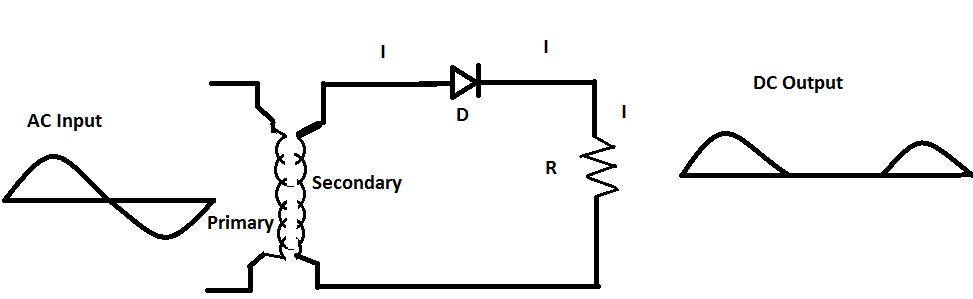
The components of the half wave rectifier are an AC current source, a resistor, diode and a step down transformer.
In a half wave rectifier, we provide an input alternating current (AC) source. In an AC current, the current alternates its direction in the circuit with each cycle. The transformer is use to increase or decrease the AC voltage.
When in the transformer, the positive cycle of the current starts, then at that point, the diode is forward biased. When the diode is forward biased, the circuit is closed, and there is a current flow in the circuit. When the current is in its negative half cycle, the diode becomes reverse biased and negligible amount of current flows in the diode which is due to the holes, thus the circuit is opened and no current flows into the circuit. Thus, the output which we obtain is a DC output, as only during the positive half cycle, the current flows. Thus, the output would be as shown in figure. Here, the output voltage is DC voltage.
Note :
A rectifier converts an alternating current to direct current, that is, it allows the current to flow in one direction only. There are two types of rectifiers – Half wave rectifier and full wave rectifier. In the above solution, we have defined a half wave rectifier. A full wave rectifier converts both the positive half cycle and the negative half cycle into direct current.
Complete Step By Step Answer:
The components of the half wave rectifier are an AC current source, a resistor, diode and a step down transformer.
In a half wave rectifier, we provide an input alternating current (AC) source. In an AC current, the current alternates its direction in the circuit with each cycle. The transformer is use to increase or decrease the AC voltage.
When in the transformer, the positive cycle of the current starts, then at that point, the diode is forward biased. When the diode is forward biased, the circuit is closed, and there is a current flow in the circuit. When the current is in its negative half cycle, the diode becomes reverse biased and negligible amount of current flows in the diode which is due to the holes, thus the circuit is opened and no current flows into the circuit. Thus, the output which we obtain is a DC output, as only during the positive half cycle, the current flows. Thus, the output would be as shown in figure. Here, the output voltage is DC voltage.
Note :
A rectifier converts an alternating current to direct current, that is, it allows the current to flow in one direction only. There are two types of rectifiers – Half wave rectifier and full wave rectifier. In the above solution, we have defined a half wave rectifier. A full wave rectifier converts both the positive half cycle and the negative half cycle into direct current.
Recently Updated Pages
Master Class 12 Business Studies: Engaging Questions & Answers for Success

Master Class 12 Chemistry: Engaging Questions & Answers for Success
Master Class 12 Biology: Engaging Questions & Answers for Success
Class 12 Question and Answer - Your Ultimate Solutions Guide
Master Class 6 English: Engaging Questions & Answers for Success
Master Class 6 Maths: Engaging Questions & Answers for Success
Trending doubts
Which are the Top 10 Largest Countries of the World?
Draw a labelled sketch of the human eye class 12 physics CBSE
Name the crygenes that control cotton bollworm and class 12 biology CBSE
Differentiate between homogeneous and heterogeneous class 12 chemistry CBSE
In a transcription unit the promoter is said to be class 12 biology CBSE
Sulphuric acid is known as the king of acids State class 12 chemistry CBSE