




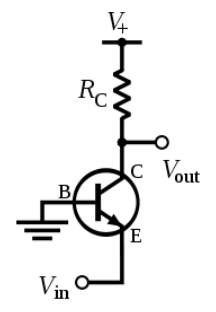
Explain the working of a common base transistor amplifier with the help of a circuit diagram. The load resistance of the output circuit is $600k\Omega$ and the resistance of the input circuit is $150p\Omega$ in a common base amplifier. If the current amplification is$0.09\;,$ then calculate the voltage amplification.
Answer
 Verified
622.5k+ views
Hint: A common base amplifier is a bipolar junction transistor (BJT) which can amplify the input voltage. The term bipolar refers to the semiconductor used, which is either NPN or PNP, depending on the doping of the material.
Formula used:
$V=\dfrac{R_{l}}{R_{i}}\times\beta$
Complete answer:
We know that a bipolar junction transistor has three terminals namely, the collector, the emitter and the base. When one of the terminals is grounded, the other two terminals are either forward biased or reversed biased depending on the function of the transistor.
The current gain is a dimensionless number, which is the ratio of the output current to the input current, and is denoted by $\beta$. Similarly, the voltage gain is also a dimensionless number, which is the ratio of output voltage to input voltage. Also , the current gain given as $\beta=\dfrac{I_{c}}{I_{b}}$, where $I_{c}$ is in the collector current and $I_{b}$ is the base current in the circuit.
The bipolar junction transistors have varied uses, like they can be used as a switch or in the amplification of the signals, they are also used in temperature sensors.
Let us consider a common base bipolar junction transistor, where the emitter is grounded.
Given that the current gain $\beta=0.09$ , the input resistance is $150p\Omega=150\times 10^{-12}\Omega$ and the load resistance is $R_{l}=600k\Omega=600\times 10^{3}\Omega$ .
Then we know that the voltage gain $V$ is given as $V=\dfrac{R_{l}}{R_{i}}\times\beta$
Substituting we get, $V=\dfrac{150\times 10^{-12}}{600\times 10^{3}}\times 0.90=22.5\times 10^{-17}$
Hence the voltage gain in the amplifier is $22.5\times 10^{-17}$.
Note:
CB or the common base amplifier is one of the three bipolar junction transistors, the other two are CE or the common emitter and the CC or the common collector. In the circuit, the emitter , base and the collector are grounded respectively.
Formula used:
$V=\dfrac{R_{l}}{R_{i}}\times\beta$
Complete answer:
We know that a bipolar junction transistor has three terminals namely, the collector, the emitter and the base. When one of the terminals is grounded, the other two terminals are either forward biased or reversed biased depending on the function of the transistor.
The current gain is a dimensionless number, which is the ratio of the output current to the input current, and is denoted by $\beta$. Similarly, the voltage gain is also a dimensionless number, which is the ratio of output voltage to input voltage. Also , the current gain given as $\beta=\dfrac{I_{c}}{I_{b}}$, where $I_{c}$ is in the collector current and $I_{b}$ is the base current in the circuit.
The bipolar junction transistors have varied uses, like they can be used as a switch or in the amplification of the signals, they are also used in temperature sensors.
Let us consider a common base bipolar junction transistor, where the emitter is grounded.
Given that the current gain $\beta=0.09$ , the input resistance is $150p\Omega=150\times 10^{-12}\Omega$ and the load resistance is $R_{l}=600k\Omega=600\times 10^{3}\Omega$ .
Then we know that the voltage gain $V$ is given as $V=\dfrac{R_{l}}{R_{i}}\times\beta$
Substituting we get, $V=\dfrac{150\times 10^{-12}}{600\times 10^{3}}\times 0.90=22.5\times 10^{-17}$
Hence the voltage gain in the amplifier is $22.5\times 10^{-17}$.
Note:
CB or the common base amplifier is one of the three bipolar junction transistors, the other two are CE or the common emitter and the CC or the common collector. In the circuit, the emitter , base and the collector are grounded respectively.
Recently Updated Pages
Master Class 12 Business Studies: Engaging Questions & Answers for Success

Master Class 12 Chemistry: Engaging Questions & Answers for Success
Master Class 12 Biology: Engaging Questions & Answers for Success
Class 12 Question and Answer - Your Ultimate Solutions Guide
Master Class 11 English: Engaging Questions & Answers for Success
Master Class 11 Social Science: Engaging Questions & Answers for Success
Trending doubts
Which are the Top 10 Largest Countries of the World?
Draw a labelled sketch of the human eye class 12 physics CBSE
The end of compass needle which points towards north class 12 physics CBSE
Differentiate between homogeneous and heterogeneous class 12 chemistry CBSE
In order to find out the different types of gametes class 12 biology NEET_UG
Why is the cell called the structural and functional class 12 biology CBSE