




Explain the term phenotype and genotype
Answer
 Verified
599.4k+ views
Hint: Genotype and phenotype are terms that are utilized to separate between the hereditary cosmetics of an individual and which qualities are to be communicated individually. The genotype is the finished quality arrangement of a creature. At the point when a portion of these qualities is communicated relying upon the ecological conditions, trademark highlights of that specific living being can be watched.
Complete answer:
The genotype is the finished arrangement of qualities conveyed by a specific living being. Subsequently, it is an aspect of the arrangements of the genome or the hereditary cosmetics of that creature. The genotype conveys the guidelines for the turn of events and the working of a cell. Thus, it is alluded to as the "outline" of a cell. These directions are composed of the guide of the hereditary code. The genotype is one factor that decides the qualities, appearance, and conduct of a specific creature. The appearance and conduct can be changed by acquired epigenetic factors and natural variables. Accordingly, two people conveying comparative genotypes can be diverse in detectable qualities. Notwithstanding, the genotype is acquired through the offspring by means of generation.
For eg., Blood gathering, eye tone, tallness, a hereditary illness
Phenotype is the physical sign of a life form, including the detectable structure, capacity, and conduct. The genotype of a living being decides its particles, macromolecules, cells, digestion, energy use, organs, tissues, reflexes, and conduct. The genotype, along with the other two components: epigenetic and ecological variables, decides the phenotype of that specific life form. Basically, the phenotype is the thing that you see or the discernible articulation of qualities joining with ecological impact. The event of more than one phenotype for a specific morphological quality is alluded to as phenotypic polymorphism.
For eg., Weight, body, nose of fowls
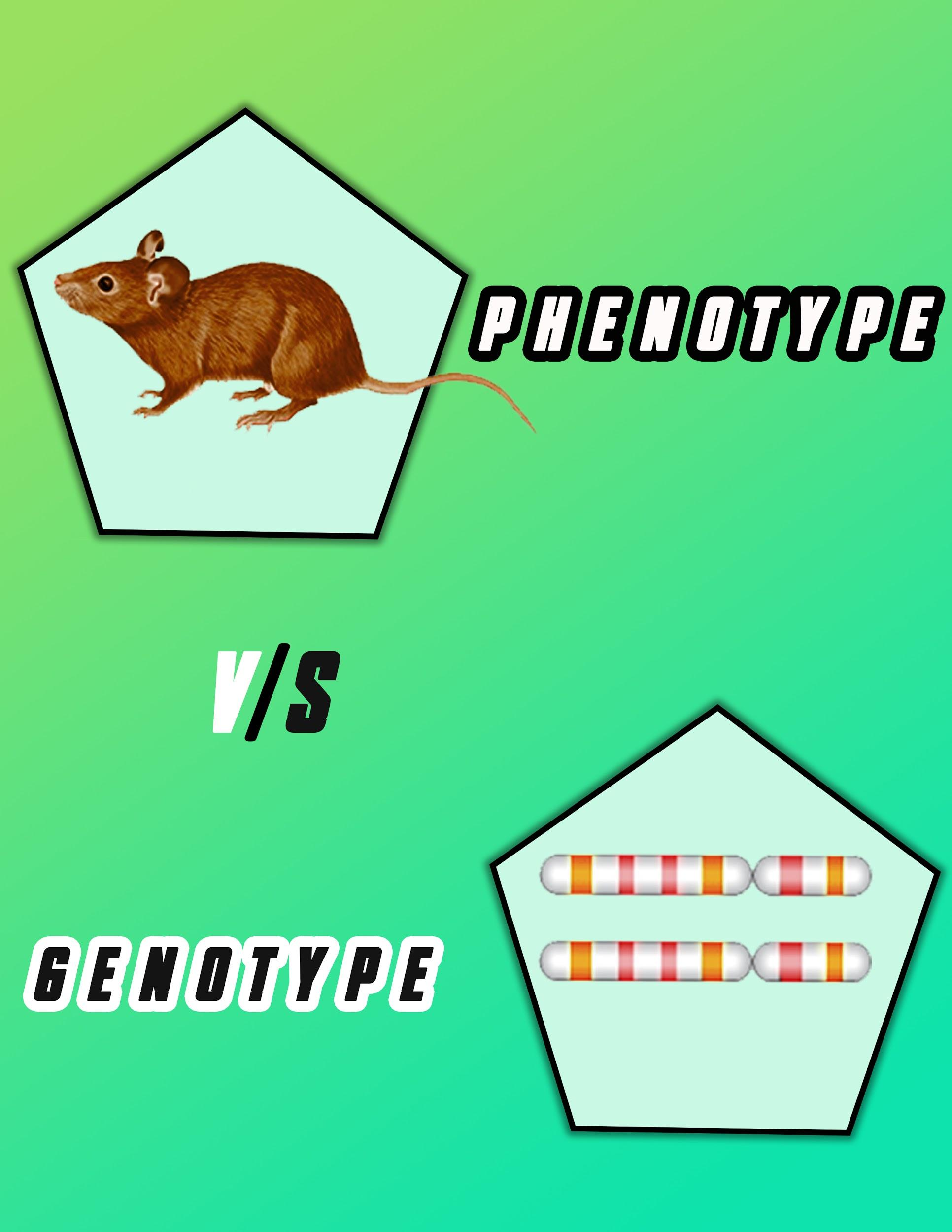
Note: Most genotypes follow the Mendelian legacy. Deciding the genotype of a life form is alluded to as genotyping. A genotypic examination may incorporate PCR, RFLP, nucleic corrosive hybridization, DNA sequencing, or DNA microarray strategies.
A portion of the phenotypes of hereditary cosmetics is not obvious. They can be distinguished utilizing sub-atomic natural or biochemical methods, for example, Western smudging, SDS¬PAGE, and enzymatic measures. Human blood bunches are a case of phenotypes joined at the cell level. Assembled structures like fledgling nets, hatchlings instances of caddis fly, and beaver dams are instances of broadened phenotypes.
Complete answer:
The genotype is the finished arrangement of qualities conveyed by a specific living being. Subsequently, it is an aspect of the arrangements of the genome or the hereditary cosmetics of that creature. The genotype conveys the guidelines for the turn of events and the working of a cell. Thus, it is alluded to as the "outline" of a cell. These directions are composed of the guide of the hereditary code. The genotype is one factor that decides the qualities, appearance, and conduct of a specific creature. The appearance and conduct can be changed by acquired epigenetic factors and natural variables. Accordingly, two people conveying comparative genotypes can be diverse in detectable qualities. Notwithstanding, the genotype is acquired through the offspring by means of generation.
For eg., Blood gathering, eye tone, tallness, a hereditary illness
Phenotype is the physical sign of a life form, including the detectable structure, capacity, and conduct. The genotype of a living being decides its particles, macromolecules, cells, digestion, energy use, organs, tissues, reflexes, and conduct. The genotype, along with the other two components: epigenetic and ecological variables, decides the phenotype of that specific life form. Basically, the phenotype is the thing that you see or the discernible articulation of qualities joining with ecological impact. The event of more than one phenotype for a specific morphological quality is alluded to as phenotypic polymorphism.
For eg., Weight, body, nose of fowls
Note: Most genotypes follow the Mendelian legacy. Deciding the genotype of a life form is alluded to as genotyping. A genotypic examination may incorporate PCR, RFLP, nucleic corrosive hybridization, DNA sequencing, or DNA microarray strategies.
A portion of the phenotypes of hereditary cosmetics is not obvious. They can be distinguished utilizing sub-atomic natural or biochemical methods, for example, Western smudging, SDS¬PAGE, and enzymatic measures. Human blood bunches are a case of phenotypes joined at the cell level. Assembled structures like fledgling nets, hatchlings instances of caddis fly, and beaver dams are instances of broadened phenotypes.
Recently Updated Pages
Three beakers labelled as A B and C each containing 25 mL of water were taken A small amount of NaOH anhydrous CuSO4 and NaCl were added to the beakers A B and C respectively It was observed that there was an increase in the temperature of the solutions contained in beakers A and B whereas in case of beaker C the temperature of the solution falls Which one of the following statements isarecorrect i In beakers A and B exothermic process has occurred ii In beakers A and B endothermic process has occurred iii In beaker C exothermic process has occurred iv In beaker C endothermic process has occurred

Master Class 11 Social Science: Engaging Questions & Answers for Success
Master Class 11 Physics: Engaging Questions & Answers for Success
Master Class 11 Maths: Engaging Questions & Answers for Success
Master Class 11 Economics: Engaging Questions & Answers for Success
Master Class 11 Computer Science: Engaging Questions & Answers for Success
Three beakers labelled as A B and C each containing 25 mL of water were taken A small amount of NaOH anhydrous CuSO4 and NaCl were added to the beakers A B and C respectively It was observed that there was an increase in the temperature of the solutions contained in beakers A and B whereas in case of beaker C the temperature of the solution falls Which one of the following statements isarecorrect i In beakers A and B exothermic process has occurred ii In beakers A and B endothermic process has occurred iii In beaker C exothermic process has occurred iv In beaker C endothermic process has occurred
Master Class 11 Social Science: Engaging Questions & Answers for Success
Master Class 11 Physics: Engaging Questions & Answers for Success
Trending doubts
One Metric ton is equal to kg A 10000 B 1000 C 100 class 11 physics CBSE
There are 720 permutations of the digits 1 2 3 4 5 class 11 maths CBSE
State and prove Bernoullis theorem class 11 physics CBSE
Draw a diagram of a plant cell and label at least eight class 11 biology CBSE
Difference Between Prokaryotic Cells and Eukaryotic Cells
1 Quintal is equal to a 110 kg b 10 kg c 100kg d 1000 class 11 physics CBSE