




Explain the structure of neurons.
Answer
 Verified
605.1k+ views
Hint: In this question we are going to explain the structure of neuron.Nervous system cells are called neurons. They have three distinct parts, including a cell body, axon, and dendrites. These parts help them to send and receive chemical and electrical signals.
Complete answer:
Let's discuss and find the answer.
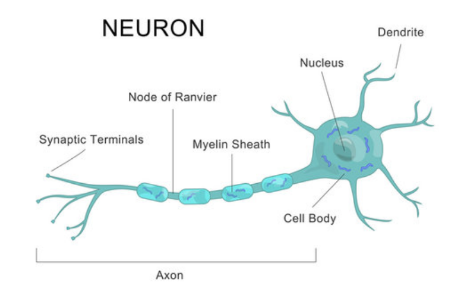
1.The structure of neurons: Nerve cells or neurons are the structural and functional units of the nervous system. It consists of three major parts namely, cell body, dendrites, axon.
2.Cell Body: It is irregular in shape or polyhedral. It contains cytoplasm and certain granular bodies called Nissl's granules which contain a group of ribosomes for protein synthesis.
3.Dendrites: Dendrites are short fibers that branch repeatedly and protrude out of the cell body. They transmit electrical impulse towards the cyton.
4.Axon: They are long fibers arising from the cell body with a branched distal end. It terminates in a synaptic knob. It is filled with neurotransmitters.
5.Parts of axon:
a. Axoplasm: It is the cytoplasm of an axon.
b. Myelin sheath: It is made up of many layers of Schwann cells.
c. Neurilemma: The outermost layer of Schwann cells.
d. Nodes of Ranvier: These are gaps left by a myelin sheath.
Note: The neurons perform the function of receiving signals in the form of electrical impulses and they also perform the transmission of these impulses from the receptors or sensory organs to the central nervous system (CNS) and from the CNS to the target organs.
Complete answer:
Let's discuss and find the answer.
1.The structure of neurons: Nerve cells or neurons are the structural and functional units of the nervous system. It consists of three major parts namely, cell body, dendrites, axon.
2.Cell Body: It is irregular in shape or polyhedral. It contains cytoplasm and certain granular bodies called Nissl's granules which contain a group of ribosomes for protein synthesis.
3.Dendrites: Dendrites are short fibers that branch repeatedly and protrude out of the cell body. They transmit electrical impulse towards the cyton.
4.Axon: They are long fibers arising from the cell body with a branched distal end. It terminates in a synaptic knob. It is filled with neurotransmitters.
5.Parts of axon:
a. Axoplasm: It is the cytoplasm of an axon.
b. Myelin sheath: It is made up of many layers of Schwann cells.
c. Neurilemma: The outermost layer of Schwann cells.
d. Nodes of Ranvier: These are gaps left by a myelin sheath.
Note: The neurons perform the function of receiving signals in the form of electrical impulses and they also perform the transmission of these impulses from the receptors or sensory organs to the central nervous system (CNS) and from the CNS to the target organs.
Recently Updated Pages
Basicity of sulphurous acid and sulphuric acid are

Master Class 11 English: Engaging Questions & Answers for Success
Master Class 11 Physics: Engaging Questions & Answers for Success
Master Class 11 Computer Science: Engaging Questions & Answers for Success
Master Class 11 Chemistry: Engaging Questions & Answers for Success
Master Class 11 Social Science: Engaging Questions & Answers for Success
Trending doubts
Draw a diagram of a plant cell and label at least eight class 11 biology CBSE
Proton was discovered by A Thomson B Rutherford C Chadwick class 11 chemistry CBSE
What is the purity of pure gold in carat class 11 chemistry CBSE
Can anyone list 10 advantages and disadvantages of friction
Lysosomes are known as suicidal bags of cell why class 11 biology CBSE
Derive the equation of motion by the calculus method class 11 physics CBSE