




Explain the roles of the following with the help of an example each in recombinant DNA technology:
A. Restriction Enzymes
B. Plasmids
Answer
 Verified
601.5k+ views
Hint: Recombinant DNA (rDNA) technology is a process in which DNA molecules or segments from two different biological species are joined together/recombine and then to introduce and inserted the resulting DNA hybrid into the host organism to produce new heritable genetic combinations.
Complete answer:
A. Restriction Enzymes: Restriction enzymes are commonly known as Molecular scissors which is a protein produced by bacteria or isolated from bacteria that cuts or cleaves the double-stranded DNA at a specific site or sequence. These restriction enzymes originally in the bacteria restrict the growth of viruses by cleaving the foreign DNA, thus removing infectious organisms.
Restriction enzymes are a part of the class of enzymes known as nucleases and it is mainly of two types i.e. Exonucleases and Endonucleases.
- Exonucleases- these nucleases remove nucleotides from the end of a DNA either in ${\text{5'}}$direction or in ${\text{3'}}$ direction.
-Endonucleases- these nucleases make cuts at specific sites within the DNA.
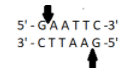
Example: ${\text{EcoR1}}$ restriction enzyme which is isolated from the E.coli (Escherichia coli). It recognizes the palindromic sequence GAATTC of opposite sides and cuts between the G and A within the DNA and these sites are known as restriction sites. Restriction enzyme cuts leave single-stranded portions at the end and there are overhanging stretches called sticky ends which can be joined using enzyme DNA ligases. So, the restriction site of ${\text{EcoR1}}$ is:
Role in rDNA technology: These restriction enzymes are useful in gene cloning experiments as they cut DNA segments in sizes suitable for cloning.
Plasmids: Plasmids are small, circular, extra chromosomal, autonomous, double-stranded, and self-replicating DNA molecules which are present in the bacteria and also in eukaryotes.
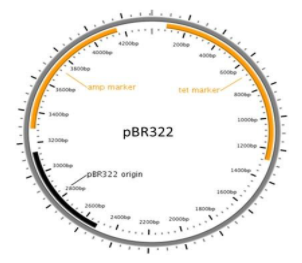
Example:${\text{pBR322}}$. is a cloning vector used in E.coli and it contains genes that allow bacteria to be resistant to antibiotic tetracycline and ampicillin. They contain multiple restriction sites.
${\text{pBR322}}$ :
Role in rDNA technology: a plasmid can be used as a vector to carry foreign genes into the bacteria in rDNA technology. These plasmids are responsible for providing pathogenicity to bacteria.
Note: Recombinant DNA technology is widely used in the field of biotechnology, research, and medicine. For example like in the production of vaccines, and protein therapies like human insulin, interferon, and human growth hormones, etc.
Complete answer:
A. Restriction Enzymes: Restriction enzymes are commonly known as Molecular scissors which is a protein produced by bacteria or isolated from bacteria that cuts or cleaves the double-stranded DNA at a specific site or sequence. These restriction enzymes originally in the bacteria restrict the growth of viruses by cleaving the foreign DNA, thus removing infectious organisms.
Restriction enzymes are a part of the class of enzymes known as nucleases and it is mainly of two types i.e. Exonucleases and Endonucleases.
- Exonucleases- these nucleases remove nucleotides from the end of a DNA either in ${\text{5'}}$direction or in ${\text{3'}}$ direction.
-Endonucleases- these nucleases make cuts at specific sites within the DNA.
Example: ${\text{EcoR1}}$ restriction enzyme which is isolated from the E.coli (Escherichia coli). It recognizes the palindromic sequence GAATTC of opposite sides and cuts between the G and A within the DNA and these sites are known as restriction sites. Restriction enzyme cuts leave single-stranded portions at the end and there are overhanging stretches called sticky ends which can be joined using enzyme DNA ligases. So, the restriction site of ${\text{EcoR1}}$ is:
Role in rDNA technology: These restriction enzymes are useful in gene cloning experiments as they cut DNA segments in sizes suitable for cloning.
Plasmids: Plasmids are small, circular, extra chromosomal, autonomous, double-stranded, and self-replicating DNA molecules which are present in the bacteria and also in eukaryotes.
Example:${\text{pBR322}}$. is a cloning vector used in E.coli and it contains genes that allow bacteria to be resistant to antibiotic tetracycline and ampicillin. They contain multiple restriction sites.
${\text{pBR322}}$ :
Role in rDNA technology: a plasmid can be used as a vector to carry foreign genes into the bacteria in rDNA technology. These plasmids are responsible for providing pathogenicity to bacteria.
Note: Recombinant DNA technology is widely used in the field of biotechnology, research, and medicine. For example like in the production of vaccines, and protein therapies like human insulin, interferon, and human growth hormones, etc.
Recently Updated Pages
Master Class 12 Economics: Engaging Questions & Answers for Success

Master Class 12 English: Engaging Questions & Answers for Success
Master Class 12 Social Science: Engaging Questions & Answers for Success
Master Class 12 Maths: Engaging Questions & Answers for Success
Master Class 12 Physics: Engaging Questions & Answers for Success
Master Class 9 General Knowledge: Engaging Questions & Answers for Success
Trending doubts
Which are the Top 10 Largest Countries of the World?
Draw a labelled sketch of the human eye class 12 physics CBSE
Differentiate between homogeneous and heterogeneous class 12 chemistry CBSE
Sulphuric acid is known as the king of acids State class 12 chemistry CBSE
Why is the cell called the structural and functional class 12 biology CBSE
Draw ray diagrams each showing i myopic eye and ii class 12 physics CBSE