




Explain the oxygen cycle in detail.
Answer
 Verified
622.2k+ views
Hint: There are few biogeochemical cycles that are essential for the cycling of nutrients in an ecosystem. Some examples of these cycles are the carbon cycle, carbon cycle, oxygen cycle, etc. This oxygen cycle involves the movement of oxygen and all the processes are evaluated as either source or sink.
Complete Answer:
The oxygen cycle helps move oxygen through the Atmosphere, the Biosphere, and the Lithosphere.
The Atmosphere is the region of gases that lies just above the Earth’s surface and is one of the largest reservoirs of free oxygen. The Biosphere consists of the sum of all the Earth’s ecosystems and it too has some free oxygen produced from photosynthesis and other life processes carried out by the organisms. The largest reservoir of oxygen is the lithosphere in the bound form present as a part of chemical compounds such as silicates and oxides.
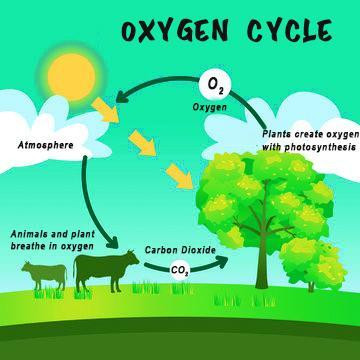
In the atmosphere, oxygen is freed by a process known as photolysis in which high-energy sunlight breaks apart the oxygen-bearing molecules to produce free oxygen. The ozone cycle is also an example of this process. The oxygen molecule is broken down to atomic oxygen by the ultraviolet rays. This free oxygen then recombines with the existing oxygen to form ozone. This part of the oxygen cycle is important as it shields the Earth from most of the harmful UV radiation turning it into harmless heat.
In the biosphere, the main cycles include respiration and photosynthesis which are essential for sustaining life. Respiration is when organisms consume oxygen by breathing in and use it in metabolic processes and then exhale carbon dioxide. Photosynthesis is the process of conversion of light energy from sunlight to chemical energy in the form of food. It is the reverse of respiration and is mainly done by the plants.
The lithosphere fixes oxygen in minerals such as silicates and oxides and the process is mostly automatic. All it takes is for a pure element to come in contact with free oxygen. A portion of the oxygen from the bound minerals is freed by chemical weathering thus releasing free oxygen to the sink.
Note:
- A source is the process that acts as the cause for the production of oxygen. For example, the process of photosynthesis and thus plants act as a source for oxygen.
- A sink is a process that acts as the site of consumption of oxygen. For example, in respiration free oxygen is utilized by the organism and thus the process of respiration is a sink.
- Source and sink vary according to the process involved.
Recently Updated Pages
If x a + bt + ct2 where x is in meters and t is in class 11 physics CBSE

A car covers the first half distance between two places class 11 physics CBSE
The resultant of two vectors overrightarrow P and overrightarrow class 11 physics CBSE
Find the value of cos 135 class 11 maths CBSE
A mass M is held in place by an applied force F and class 11 physics CBSE
A solution of glucose in water is labelled as 10 dfracwv class 11 chemistry CBSE
Trending doubts
One Metric ton is equal to kg A 10000 B 1000 C 100 class 11 physics CBSE
Find the value of the expression given below sin 30circ class 11 maths CBSE
What do you mean by retardation What is its SI uni class 11 physics CBSE
Draw a diagram of nephron and explain its structur class 11 biology CBSE
10 examples of friction in our daily life
Difference between physical and chemical change class 11 chemistry CBSE